Archive | Adelaide beach front RSS feed for this section

A Bite at Grange

19 Sep

Dear Reader:

A lone silver gull is flying parallel to the shore just above the Norfolk pines that grow along the Grange beach front. Suddenly it veers off course, dipping towards one of the trees and letting out a loud, raucous shriek. This unusual behaviour encourages me to stop and take a closer look through the telephoto lens. And there, perched serenely on the topmost branch is a beautiful nankeen kestrel surveying its stretch of prime coastal real estate.

Nankeen kestrel looking for prey

Nankeen kestrel looking for prey (click all images to enlarge)


Nankeen kestrels are small falcons that are widely distributed across the country. They usually live in rural or outback regions where they hover over fields and open bushland preying on small mammals, reptiles and occasionally taking birds in the air; which explains the gull’s nervous disposition. Seeing one in an urban area is a really quite unusual. For the next half an hour I follow the raptor as it patrols the shoreline and dunes moving from tree tops to fence posts to survey its territory.

The Marines, beachside heritage homes

The Marines, beachside heritage homes


Grange Beach is just 15 minutes from the centre of Adelaide. An old wooden jetty, classic golden sands and heritage buildings make it an ideal place to go for a walk and grab a bite to eat summer or winter! A walking &cycling trail passes through the area winding between the seafront properties and coastal revegetation zones providing a unique blend natural and urban habitats that encourages a wide variety of wildlife.

Spotted dove

Spotted dove

Singing honeyeater in coastal scrub

Singing honeyeater in coastal scrub

The unfortunately named pigface

The unfortunately named pigface


After watching the kestrels I follow the track south. The delicate shrubs and grasses that stabilise the dunes are home to many different bird species from common house sparrows to spotted doves and singing honeyeaters. Although it is a coolish day and the insect life is in short supply a few bees and butterflies are congregating around some early blooming pigface, a common succulent in the dunes.

Grange jetty at low tide showing worm casing encrustaceans

Grange jetty at low tide showing worm casing encrustaceans


For a little variety I walk back along the beach. The tide is out exposing concrete-like encrustations of tube worms cemented to the jetty piles. A track leads from the beach to the old kiosk which is now a fashionable restaurant. My day ends with a glass of white, salt and pepper squid with sautéed scallops in the shell accompanied by a generous serve of crusty bread.

Grange Kiosk

Grange Kiosk


Until our next adventure

Baz          

On the Edge of the Blue Line

25 Dec

On the Edge of the Blue Line

The sand is golden with a uniform, rippled pattern to it; like the sole of an old fashioned sneaker. Every few metres small clumps of grassy weed appear until finally the sand merges into an endless green meadow of seagrass. Seagrasses are not algae but true plants with leaves, roots and in most species, flowers. They form a crucial ecosystem in the shallow waters of Gulf St Vincent. As I hover above the dense mass of leaves, a school of tiny silver fish lifts out of their embrace, swims a few metres then blends back into the shelter of the meadow.

1

Blue line as seen from the sand hills near Henley Beach


I am snorkelling off Henley which is better known as a fashionable beachside cafe strip rather than a dive destination. I decided to arrive a little early and enjoy a cup of coffee while I waited for the sun to get high enough for underwater photography. The water is clear and the ocean warm and inviting at this time of year and it is just a short swim from the local jetty to the blue line where the sand and seagrasses merge. The lush tangle of gently waving blades that surround me are home to one of the planet’s richest marine environments. It is a place where whiting, mullet, blue crabs, giant rays and squid (to mention just a few inhabitants) find food and shelter for themselves and their young.

2 Seagrass meadows

Seagrass meadow


I swim a little further into the seagrass until I locate a patch of sand with some darker detritus around its edge, indicating that something might have dug into the substrate. I stir the sand with the tip of my dive knife…nothing…I swim a few metres further and repeat the process. On the third attempt I get a result. A dinner plate sized blue swimmer crab bursts out of the sand with pincers extended and full of aggression. These crabs are prolific along the upper gulf in the summer months providing a valuable commercial fishery and great sport for recreational fishers and divers.

5 Blue swimmer crab

Blue swimmer crab


Experience has taught me that the boundary between seagrass and sand is an ideal place to observe different animals. Because I am wearing extra weights I am able to rest effortlessly on the bottom in this zone and wait for something to happen. Over the next few dives my strategy pays off as a small group of juvenile King George whiting settle close to me as they search for worms and molluscs between weed and sand.

4 Juvenile King George whiting

Juvenile King George whiting


A little further offshore small sand patches occur regularly in the seagrass meadow. Often there are a few rocks colonised by brown or green algae and even variations in seagrass species in these areas and these slight variations in terrain frequently produce the greatest diversity of marine life. My first sand patch does just that. Lying close to the bottom, I let my eyes adjust to the light and moving shadows produced by the tidal flow and rippling surface. Just a few centimetres from my lens a seahorse clings to a blade of eelgrass using its tail and tiny fins to move in time with the swaying miniature forest of the underwater meadow.

3 Big bellied seahorse

Big bellied seahorse


I have been in the water for over an hour and I am getting a little chilly and besides a cappuccino and breakfast roll beckon back at the Henley Square where many a tourist sips coffee unaware of the glorious marine world just a short swim away.


Cheers

Baz


Rare Birds on the Beach

16 May

Dear Reader:
This week’s post is coming to you from Southport, a surf beach just south of Port Noarlunga but still sheltered by the reef (see Jan 21st post). I am sitting in a small cafe sipping a cup of coffee and reflecting on the last couple of hours spent wandering through the sand hills and along the beach.
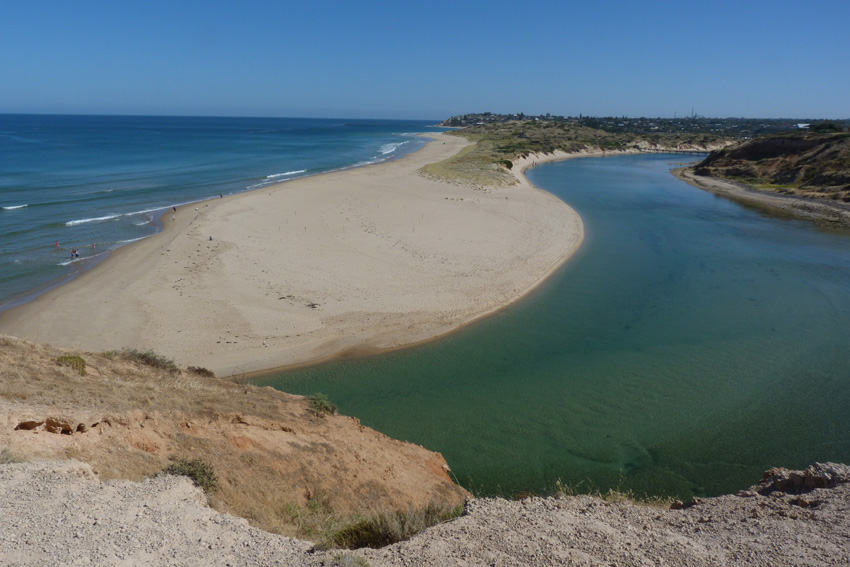
I had driven to Southport in the early afternoon with the specific intention of walking along the tidal flats, where the Onkaparinga estuary drains into the sea, to photograph crabs and wading birds. However, I had not counted on such a high tide; the mudflats were covered and I could only access the walking trails that meander through the sand hills from beach on the seaward side.

A Southport Beach, estuary with bridge in the background red

Southport Beach, estuary with bridge in the background

I parked by the roadside and crossed the river on a small bridge below the cliff line and spent a few minutes watching anglers casting for bream and garfish. Nearby, a father and son paddled a sea kayak towards the ocean disturbing a small flock of black swans as they edged close to one of the steeper banks where the sandy slope of the dunes ran into the water.

B Kayaking below the cliffs red

Kayaking below the cliffs

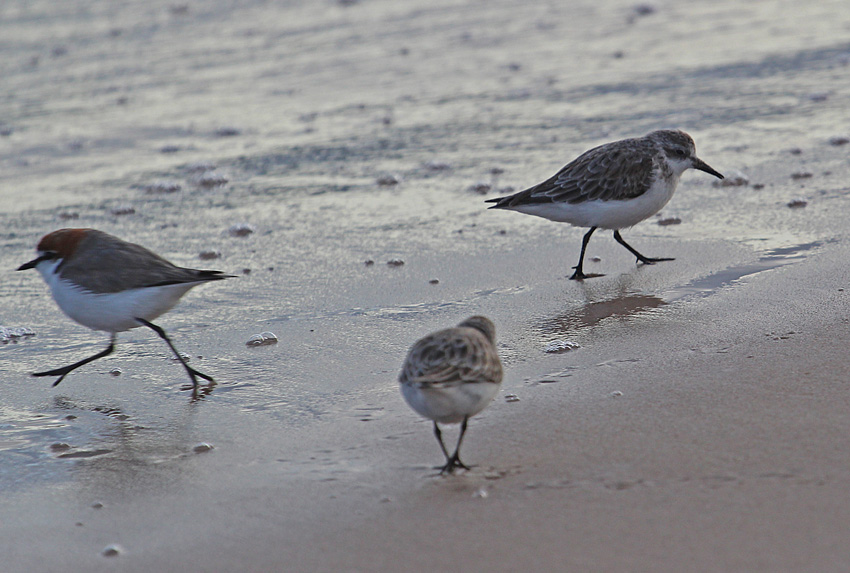
As I traversed the final set of dunes above the beach I felt the afternoon sea breeze on my face and caught the muffled crash of waves breaking on the shore. Several surfers were enjoying a choppy break and more adventurous anglers were wading into the white water to cast for salmon. I headed down to the sand to find one of the trail entrances to the dunes that open onto the beach. As I trudged through the soft sand I noticed a group of diminutive shore birds racing between the foamy lines of waves curving up the beach. At first glance they appeared to be similar in appearance but a more critical look through the telephoto revealed a mixture of species and sexes.

D Mixed group of waders foraging between waves red

Mixed group of waders foraging between waves

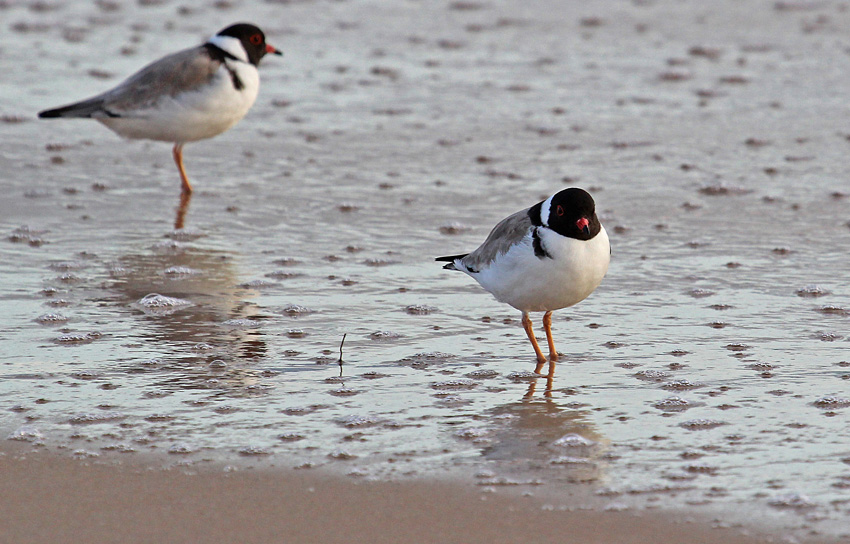
One particular pair stood out amongst the others. I held my breath, refocussed and squeezed off a series of shots, dropped to one knee to better incorporate the water into the background and fired again. I was photographing a pair of hooded plovers, an endangered species that nests on open beaches and a bird that I had only glimpsed at a distance along the Coorong’s extensive beaches further south. As I captured the last image, the wind picked up and the little flock of waders lifted as one and flew further down the beach.

E Hooded Plovers red

Hooded plovers

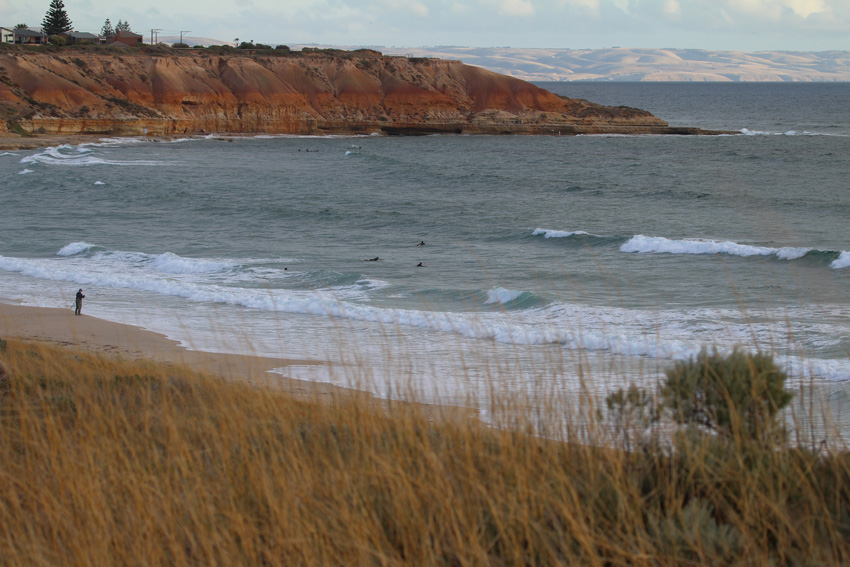
A sat for a few minutes, smiling inwardly as I reviewed the images then continued down to the trail entrance. As I climbed back up into the dunes I reflected on the extraordinary beauty and diversity of this stretch of coastline, a mere 20 Kms from the city centre. Walking through the dunes was like entering another world made up of: low scrub, wiry grasses and a thick layer of undergrowth fashioned from the skeletal remains of branches and tree trunks. I walked slowly and paused frequently observing a variety of insects, several lizard species and an assortment of birds including: honeyeaters, magpies and crested pigeons.

C View of the beach from the dunes in the afternoon light red

View of the beach from the dunes in the afternoon light

But today it was the ocean that called and as the light started to fade I took another track down to the shoreline and worked my way back to the section of beach where I had encountered the plovers. Sadly, the plovers were long gone but a little group of red capped dotterels remained, bedding down for the night in the footprints that I had left in the sand when I walked this way just an hour ago.

F Red Capped Dotterels bedding down for the night red

Red capped dotterels bedding down for the night

My coffee is finished now and it is time to drive home and share this afternoon with you.

And yes, dear reader, I missed the tide but somehow I think it might have been for the better.

Sincerely
Baz

← Back

Thank you for your response. ✨

Life Under the Port Noarlunga Jetty

21 Jan

Dear reader

This week has been hot with temperatures hovering around the mid 30s- perfect weather for a dip in the ocean. Although our urban beaches are perfect for swimming it is the more rugged coastline further south that always attracts my attention. As a keen snorkeler and underwater photographer the cliffs, headlands and rocky reefs, interspersed with fine, sandy beaches, create a tempting environment for anyone interested in marine life.

Port Noarlnga jetty showing growth of mussels and beach

Port Noarlnga jetty showing growth of mussels and beach

Consequently, last Saturday morning found me donning my summer wet suit and sliding into the water under the Port Noarlunga jetty; a favourite dive location only a 45 minute drive south of Adelaide’s CBD. Like many of South Australia’s jetties; this one is the legacy of bygone days when wooden ketches collected grain from coastal farming communities. The old wooden structure juts out from a sheltered beach and is sandwiched between low limestone cliffs and an estuary. Two hundred metres out to sea it intersects a reef that runs parallel to the shore. Although the reef is a marine sanctuary there is limited fishing allowed along the first three quarters of the jetty. Most divers go to the end of the jetty and drop straight onto the reef. However, on this occasion I had decided to swim under the jetty and look at the way the environment and marine life changes with depth and proximity to the reef.

starfish on jetty pile amongst coraline algae and green algae red

Starfish on jetty pile amongst coraline algae and green algae

 The first few metres were quite a surprise. I had expected bare sand and little life. Instead I found quite a community of organisms in the shallow warm water. Small schools of mullet and yellowfin-whiting and some bream were patrolling the sandy bottom searching for small crustaceans and worms. A few large razorfish, a fan shaped mollusc that buries its pointed end in the sand, protruded amongst the small outcrops of rock and sparse seagrass patches while several sand crabs scuttled for cover in the weed as I swam over them.

Razorfish amongst seagrass

Razorfish amongst seagrass

In the shallow zone, the jetty piles are constantly exposed to air and sun as the tides and winds vary. Only a few grey snail shells and worm tubes clung to them finding moisture and protection in the cracks in the wood. As the water became deeper a coating of small black mussels shaded the grey wood of the piles and a mixed growth of algae, sea squirts, sponges and other encrusting organisms started to appear. In the open water schools of baitfish would occasionally appear in tightly choreographed formations; a group strategy evolved for minimising successful attacks by predators. Closer to the surface, I caught sight of the occasional garfish and even a small group of squid chasing after a fisherman’s lure.

Squid in open water following lure

Squid in open water near the jetty attracted by angling lures

As I approached the end of the jetty, the character of the environment changed dramatically. The growth of invertebrates covering the wooden supports had thickened and a veritable garden of different organisms of every texture and colour imaginable competed for space and food. Small patterned fish and shrimps darted amongst these marine jungles and an occasional starfish also moved slowly though them in search of prey. The baitfish had been replaced by a mixed school of sea sweep and old wives.

School of sea sweep with a few striped old wives

School of sea sweep with a few striped old wives in the background

When I reached the end of the jetty I used the aluminium dive ladder to climb out and sat for a while on the wooden walkway and watched a few divers exploring the reef. A quick glance at my dive watch indicated that I had been in the water for well over an hour. The time had passed quickly and I had been more than pleasantly surprised by the marine life under the jetty….worth another visit.

Cheers

Baz

Baz

← Back

Thank you for your response. ✨

Seaside Dragons

30 Dec

After a chilly morning the day has warmed considerably, making it perfect weather for hunting dragons. My quarry is the glorious little Painted Ground-dragon, a species that lives in the remnant coastal dunes fringing several of Adelaide’s beachside suburbs. The dunes behind Tennyson Beach provide a perfect habitat; scrubby heath with coastal grasses and succulent ground covers. The best strategy is to walk slowly along the marked trails stopping frequently to listen for a tell tale rustle in the understory.

Tennyson dunes showing low fencing to preserve environment

Painted Ground-dragons (Ctenophorus pictus) are one of the 65 species of dragon lizards that occur in Australia. They are diurnal with long tails and legs and a typically rough, stippled appearance. Some of their scales form ridges and points that give them a rather undeserverd, fearsome appearance. Painted Dragons grow to around 20 cms in length, live in burrows in sandy soil amongst low vegetation and feed mainly on small invertebrates.

close up of male Painted Dragon showing skin texture and colouring

Close up of male Painted Dragon showing skin texture and colouring

At this time of the year the feisty little reptiles have some serious breeding to attend to and they need a few rays to warm up their blood. The rather promiscuous females are game for any male that looks their way and the guys need some energy to put on their twisting, bobbing and erecting displays.

male Paintd Dragon in display mode

Male Paintd Dragon in display mode

male Painted Dragon sunning himself  amongst understory

Male Painted Dragon sunning himself amongst understory

Sexual necessity and the never ending quest for food gives me an advantage as Painted Dragons will often break cover or bask on a branch or tree root to get more exposure to the sun. The complex barred pattern on their bodies, coupled with the blue grey and orange colouring of the showy males and browns and creams of the females, makes them difficult to spot unless they move. The trick is to walk quietly enough to hear them yet boldly enough to flush them out.

As I pass a tangle of dead branches and spiky coastal grass a female that has been lying on one of the wind scoured limbs runs across the path, freezing as she reaches the edge. I fire off a couple of frames. Then I glance back at the area she emerged from, immediately spotting a now forlorn male perched on a bare branch that overlooked her hiding place. He appears to be performing a set of lacklustre push-ups and tail wriggles in a futile attempt to lure her back.female Painted Dragon flushed onto path

As the afternoon progresses I get a few more shots and watch a large White Faced Heron stalking insidiously through the dunes, also hunting dragons but with a far more sinister intent. Finally, hot and tired from my afternoon’s endeavours I take one of the short, sand blown trails down to the beach and enjoy a leisurely paddle through the cool, clear water.

White Faced Heron stalking lizards

White Faced Heron stalking lizards

But ther is one final surprise to end my dragon hunting day. As I walk towards the edge of the car park, I catch sight of one last lizard. Not a Painted Dragon this time but its larger relative the Bearded Dragon. This one, probably a male is wrapped around the dead trunk of an old acacia tree, surveying his territory.

Bearded Dragon surveying territory

Bearded Dragon surveying territory

Some days the gods of wildlife do smile on us.