Archive | Adelaide Hills RSS feed for this section

A Golden Day

24 Nov


Dear Reader:

The track is quite steep and the scrub dense. I can hear birds calling and catch fleeting glimpses of tiny finches foraging deep in the bushes. At the same time a group of lorikeets are feeding on eucalyptus blossoms in the canopy. But the birds are wary on this warm spring morning and keep moving out of camera range. Periodically, the eroded openings of narrow mine shafts, fenced off for safety, appear on both sides of the trail. I stop to reflect on the men who worked these dangerous tunnels armed only with buckets, ropes and spades. At the top of the hill, where I started my walk, a restored miner’s cottage and the weathered skeletons of a rock crusher and derrick suggest that the area had once been the centre of a sizeable mining operation.

1 mining equipment

Mining equipment


I am at the Barossa Goldfields about 40 kms from Adelaide between Williamstown and Gawler. At its peak in 1870, the lure of gold attracted around 4000 hopeful souls to these hills and over 25000 ounces of the precious metal was extracted. The site has been carefully restored by volunteers and is in the Para Wirra National Park; a worthwhile stop en route to the Barossa wineries if you care to take the back roads rather than the main highway. There is a network of well marked trails to suit walkers of all abilities and many excellent interpretive signs that cover everything from local geology to the everyday life of the original miners.

2 Cicadas

Cicadas

At the bottom of the trail there is a small creek still flowing from this year’s ample winter rains and as I cross it a kookaburra takes flight from a low branch where it had been watching for prey. The air is warm and buzzing with the calls of cicadas. I find a small eucalypt that seems to have more than its share of the ‘noisy little buggers’ and sit quietly in its shade for the next half hour trying to get a half decent shot.

4 Wattle bird

Wattle bird


As the trail climbs back out of the gully the terrain changes; the thick scrub gives way to more open grassland interspersed with stands of tall eucalypts. In the distance I catch sight of a pair of western grey kangaroos but they bound off over a ridge as I approach them. A scattering of rosellas are feeding in the grass and a wattle bird squawks defiance at a group of miner birds that are encroaching on its territory.

3 sleepy lizard

Sleepy lizard or shingleback skink

As the track takes a sharp bend I come across a sign that indicates a short cut back to the cottage and car park where I started my journey. It seems an opportune time to sit under a tree and take a ‘swig’ from my water bottle. However, I am not the only one who finds this a convenient resting place. I hear a faint rustling sound by my feet and a sleepy lizard materialises between a couple of rocks, its pine cone scales shiny and dark in the dappled light.


5 Grevillias

Grevillea flowers


I leave the lizard to its shady refuge and continue on my way, happy with my wildlife sightings and ready to wind up a successful morning’s trek. Close to the cottage another trail head appears. This track drops down sharply into a gully and I can see that the terrain has changed yet again. The soil is gravelly and grass trees, grevilleas and a variety of small plants with yellow, lilac and orange flowers, decorate the understory.

6 Grasshopper

Grasshopper species

The ever present eucalypts are a smaller more gnarled species. A few cicadas still buzz in the trees but on closer examination I can see a variety of other insects in the scrub including a glorious little cricket with ‘pink-camo-splotches’.

7 Grass tree amongst low eucalypts

Grass tree amongst stand of low growing eucalypts


I walk a couple of hundred metres further and realise that this trail is worth more than a cursory glance- but not today. And so ‘Dear Readers’ I look forward to another hike around the goldfields and the opportunity to share whatever I find with you.


Cheers

Baz


Kids, Kookaburras and Creeks

4 Oct

Dear Readers

It would be lovely to write for a living. To earn my dollars wandering South Australia’s diverse wilderness areas taking photos and composing articles to share with you. Dream over….reality check! Like most of the world I need a steady job to survive and my profession is teaching. One of the many requirements at my school is to take my year 6 students on camp each year. Fortunately, Adelaide has many wonderful destinations in the adjacent hills and along the coastline that provide a range of outdoor activities. Many of these sites also double as corporate destinations. This year we chose Wirraway a campsite located on the eastern fringe of the Mt Lofty Ranges. It is a beautiful location situated amongst rolling hills with a little creek running through the property. And, to my delight their program included a nature walk along with the adventure activities.

G

Typical hills country


Each morning I woke at six and reluctantly dragged my weary bones out of bed; any teachers reading this will immediately understand that the previous night’s sleep was limited to a few hours. The students were not allowed out of their dorms until 7.00 which gave me an hour to wander around the grounds uninterrupted. Campsites always attract wildlife. However well intentioned the staff may be there are always a few food scraps to be had, nooks and crannies to nest or hide in as well as wood piles and building materials that might be home to both predator and prey. On my first morning a pair of rats scurried under the raised foundations of the caretaker’s home watched with interest by me and anticipation by a kookaburra sitting in a an old gum tree (there’s a song title there).

kooka2 red

Hungry kookaburra


The camp site was also home to a wild rabbit that liked to munch the grass close to one of the girls’ dorms but scurried back into the bushes at the slightest noise. Each time it appeared I tried to signal the students to be quiet and take a look…no such luck. Only a picture snapped in the quiet hours and shown at the dinner table convinced them that I was not making it up.

A

Peter makes a rare appearance


Both male and female superb blue wrens were common though timid and constantly on the move keeping low in the bushes and feeding in the leaf litter. And a resident flock of red browed finches moved between the flowering trees and bushes often coming close when I was working with the students and staying away if I had a camera nearby. Fancy that!!

C

Male superb blue wren

B

Finches all in a line


Our nature walk was quite a revelation. You would not expect city kids to be overly responsive to a lengthy stroll in the bush when the alternative activities included horse riding, archery and rock climbing. Surprisingly, they showed a keen interest in what the guide had to say and even sat quietly by the creek for a few minutes trying to work out how many different frog species could be identified from their distinctive calls. Even the plant life scored a hit, most notably the unusual grass trees that were flowering at the time and an old weathered log with lichen and moss growing in its sinuous furrows.

E

Flowering grass plants

F

Patterns and colours in nature


The three days passed quickly and each group appeared to enjoy their excursions into the bush.  Kids get few opportunities to experience the outdoors in our digital world and watching their faces as they discovered the beauty of wild things was a rare pleasure.


Until my next post

Cheers

Baz

Corella Wars

24 Aug

Dear Reader:

Strathalbyn is one of those country towns that make you think of Britain. An imposing church presides over a pleasant stretch of river complete with ducks, gently sloping banks and an old fashioned rotunda. Huge Norfolk pines are mingled with classic river red gums and picnicking families often spread blankets on the banks and eat sandwiches or barbecue a few snags.

Like a flurry of snow Corellas perch in the trees they are feeding on showing bare branches

Church, rotunda and corellas in the trees


But the rustic charm is not sound-tracked by the gentle call of songbirds. Quite the opposite, it is the raucous call of parrots that often fills the air. Large flocks of short beaked corellas frequently descend upon the trees that line the Finnis River where it passes through the town. They are particularly fond of the towering pines and hundreds will sit along the branches of each tree tearing at the cones and limbs with their powerful beaks. At the same time they engage in a variety of typically cockatoo-like social interactions ranging from mutual grooming and preening to wing flapping, mock fights and beak duels; all of which are accompanied by a variety of screeches and squawks.

A Corella social behaviour

Corella social behaviour


Short-beaked or little corellas (Cacatua sanguine) are, as the name suggests, a member of the cockatoo family. They grow to around 40 cms in length and can weigh over half a kilogram. These corellas often congregate in flocks that can number thousands of birds. They are mainly ground feeders, rooting out tubers and bulbs and are particularly fond of cereal crops like wheat and barley; a habit which does not endear them to many farmers.

B Corellas use a combination of wings , beaks and feet  to position themselves

Corellas use a combination of wings , beaks and feet to position themselves


Although most locals and visitors alike enjoy the sight of thousands of graceful white birds wheeling through the sky, the continual noise and quite substantial damage to the heritage trees has become a significant problem. Various means have been employed to move the flock to the outskirts of the town including: culling, high frequency sound bursts and quite recently using a trained peregrine falcon to discourage them.

D Little corella flock circling pine trees

Flock of little corellas circling pine trees


Strathalbyn is only an hour’s drive from the city and the wildlife along the Finnis and open bushland that dominates the area makes it a wonderful day’s outing. And the corellas are the most endearing of birds to observe despite their rather destructive disposition.

 I hope you enjoyed this story.

Cheers

Baz

Photo Reflections 1

21 Jul

Dear Reader;

As you may have gathered from my previous posts, South Australia has a diverse selection of landscapes and wildlife. When you add our temperate climate and clear skies to the mix, it becomes abundantly obvious that this is a place well suited to wildlife photography. In this post, and a few more in the future, I will share some of my favourite wildlife encounters and the images they produced. They will not always be my most technically correct pictures but they will be the ones that invoke my fondest memories.

Telowie Gorge 2_09-10-07_0008_1

Telowie Gorge; a classic dry creek habitat


Echidnas are the hedgehogs of Australia. They trundle along like little battle tanks searching for termite mounds which they rip apart with their powerful front claws. They are in fact monotremes, a peculiar group of mammals that lay eggs; their closest relative is the platypus one of the world’s most bizarre creatures. This particular echidna was wandering across a dirt track on Kangaroo Island and paid little attention to me as I followed it for several hundred metres into the thick bush.

A Echidna trundling across dirt track

Echidna trundling across dirt track


Zebra finches are found throughout South Australia. They tend to frequent dense bushland where there is a lot of cover. The males are more distinctly marked and brightly coloured than the females. I lay cramped in a thicket of acacia bushes for over an hour watching a group of these colourful birds waiting for the opportunity to capture an image that demonstrated the difference between the sexes. As you can see I was eventually rewarded for my efforts when a pair landed on a nearby branch.

B Male and female zebra finches

Male and female zebra finches


As a wildlife photographer I spend a considerable amount of time flat on the ground, half covered in dust and leaf litter. It is therefore inevitable that sometimes I will share these times and spaces with the critters that call them home. However, I was not quite so philosophical when a sizeable forest scorpion decided to co-habit the log I was balancing my camera lens on. We spent an awkward few minutes together before the little arachnid decided that it was more comfortable under the log where it had been peacefully residing before a large hominid disturbed its rest.

C Scorpion

An inquisitive scorpion


One of the most difficult tasks I face as a wildlife writer is to adequately describe with words and pictures the environments that I explore. The edge of the Aldinga reef is one of my favourite haunts. The shallow limestone reef breaks the surface at low tide and falls away sharply several hundred meters offshore to sandy bottom dominated by algae and seagrasses. The actual edge is well defined with a series of crevices and caves that provide a wonderful habitat for a variety of fish including drummer, leatherjackets and magpie perch. On my last dive I took a dozen pictures trying to describe this characteristic environment eventually capturing the one you see here which included all the essential elements; algal growth, three species of fish and the rocky edge of the reef.  

D The edge of the reef

The edge of the reef


I hope that you enjoyed these images and the little stories that accompanied them.


Cheers

Baz 

A Walk to the Falls

12 Jul

Dear Reader

Last Saturday was a classic Adelaide winter’s day. It had rained the night before and a fine patina of dew decorated the shrubs in my garden. The sky was clear and despite a chill in the morning air it promised to be sunny and dry; perfect conditions for a walk in the park. Not any park though. My park of choice was a little conservation reserve nestled in the foothills about 20 minutes from the city centre. Like Waterfall Gully,  Morialta Conservation Park is graced by a series of waterfalls and steep walking trails that cut through a variety of classic bush habitats.

AB Typical sandstone and eucalypt bushland within the park

Typical sandstone and eucalypt bushland within the park

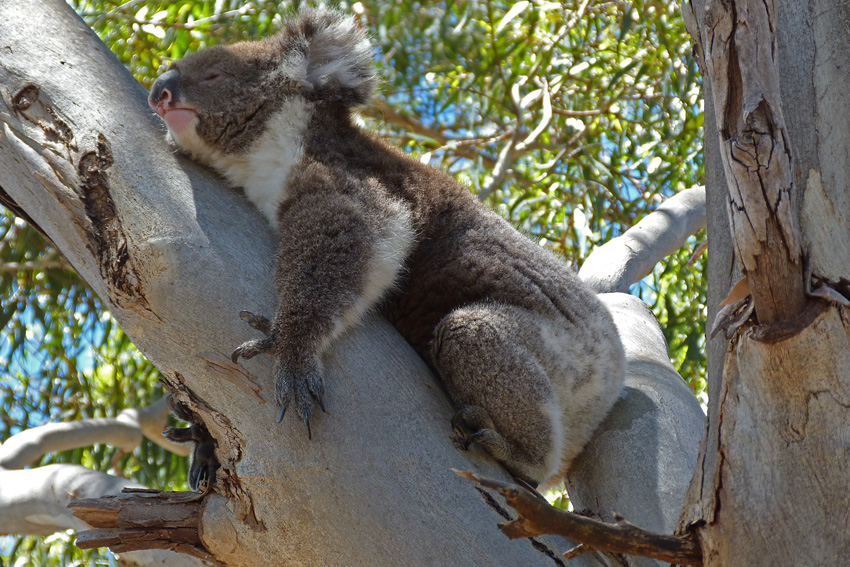
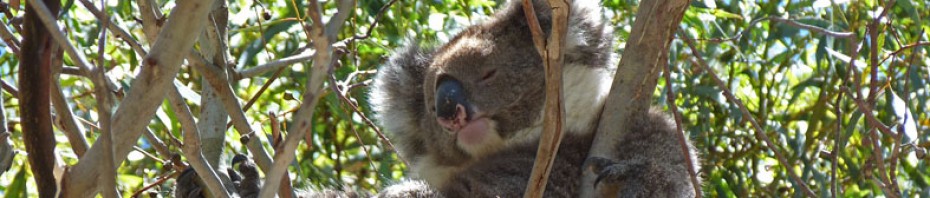
 The drive took me a little longer than expected as I was waylaid by the smell of freshly cooked pastries emanating from a little bakery. My rucksack now stocked with enough calories to sustain my upcoming physical endeavours and probably those of the next week, I pulled into the little car park alongside the creek, hung a camera from my shoulder and set off up the southernmost trail. The sun was still low in the sky and only the southern face of the steep-sided valley benefited from it.  I had walked just a few metres and was emerging from the shade when I noticed some walkers standing below a tall eucalyptus tree pointing excitedly at one of the higher branches. I followed their obvious line of sight and there, nestled into the fork between trunk and branch was a fairly large koala doing what koalas do best ….stretching out and resting.

AC Koala in tree near the trailhead

Koala in tree near the trailhead

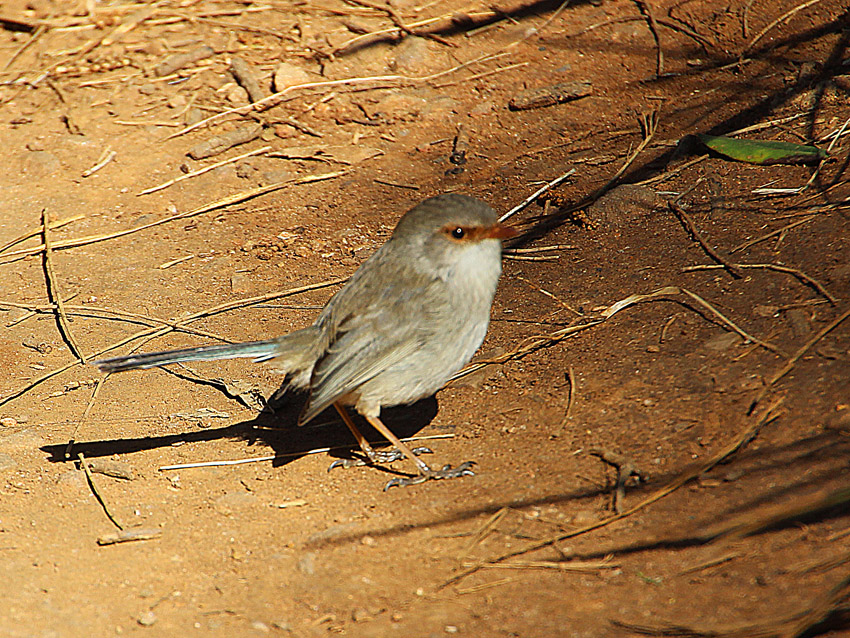
The koala was an unexpected and encouraging start to the day and after spending few minutes watching it I started up the trail with a fair degree of optimism. Winter is never the best time for wildlife. Plants have fewer flowers and fruits and the insects that are attracted to them are in short supply. Of course there is always an up-side when it comes to nature and the damp ground makes it easier for some bird species to fossick for grubs and worms. A pair of blue wrens seemed to be making the best of these conditions, madly hopping from one tree branch to the next then down onto the ground in a never ending search for food. Their constant motion and the morning light gave me only a few half-chances to capture some images and no hope of freezing their motion completely. I did manage a couple of shots that showed some of the obvious differences between the male and female of this species.

AI Male blue wren

Male blue wren

AH Female blue wren

Female blue wren

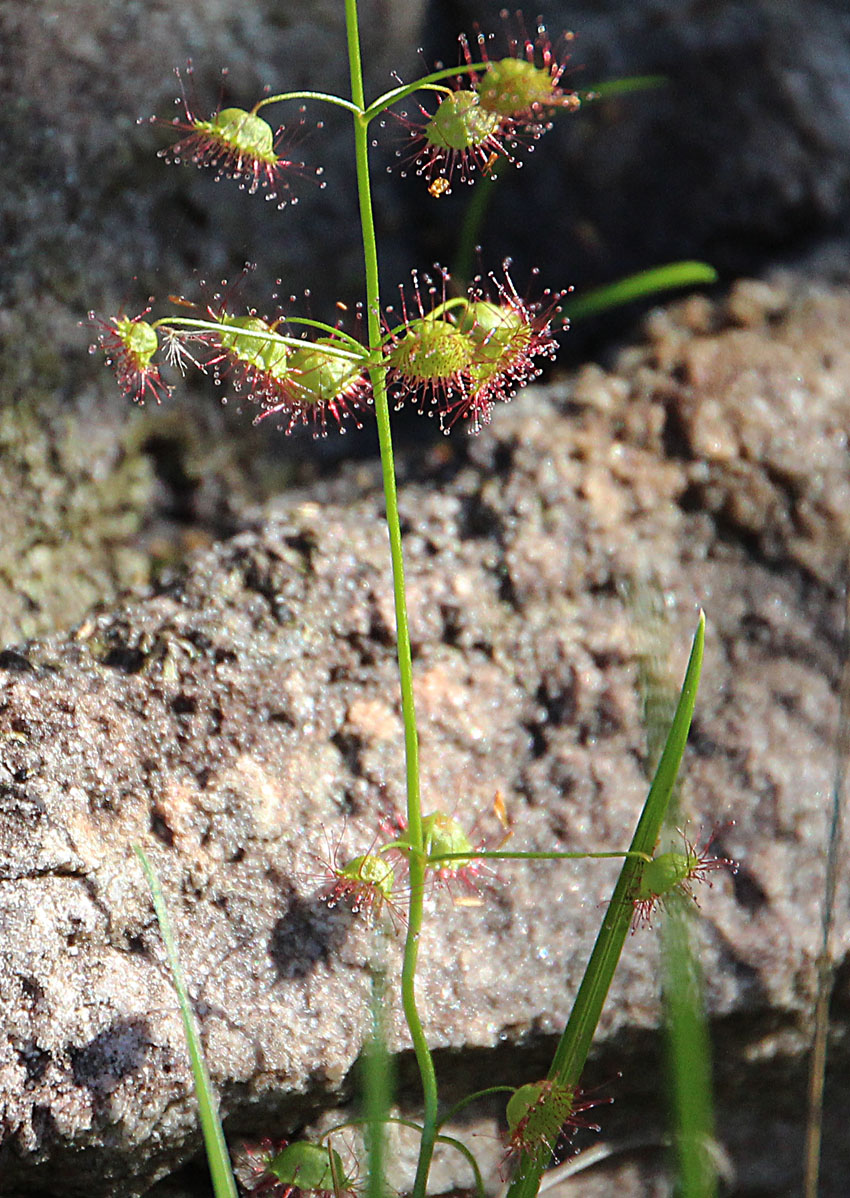
A little further up the track I stopped and sat on a large boulder and scanned the undergrowth for insects or lizards. There was nothing to be seen or heard but I did notice some honeydew plants growing amongst the grasses near a rocky outcrop. These delicate little plants have tiny inverted cups radiating from their stems. The cups are fringed by small filaments and have sticky, viscous fluid in the centre. Unwary insects are trapped in the sweet heart of the cups and the filaments close on them to seal their fate. The unfortunate bug is then digested by its ‘vegetable’ captor providing essential nutrients that other plants might get from the soil.

AG Honeydew plant

Honeydew plant


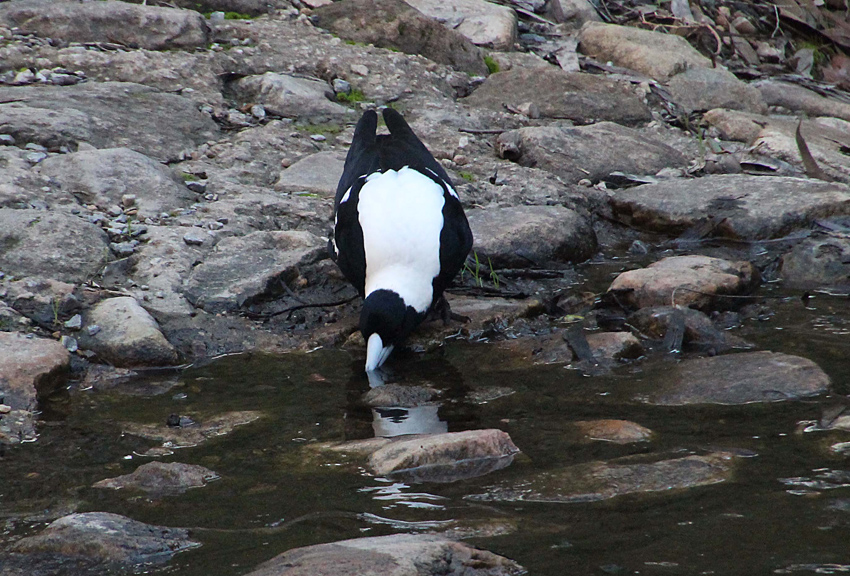
Colourful wrens, cute koalas and carnivorous plants had provided quite a range of wildlife in the first kilometre or so of my walk. As expected, the wildlife had not been prolific but there always seemed to be something around the next bend if I took the time to pause and use all of my senses. The next few kilometres were enjoyable but largely uneventful. A few honeyeaters flitted between late flowering shrubs, a magpie nervously snatched a drink from the creek while a squadron of miner birds squabbled in a stand of acacia bushes. It was not until I was almost back to the car park and walking below some tall, pale eucalyptus trees that bordered the creek that my next significant encounter occurred.

AD Magpie drinking from the creek below the falls

Magpie drinking from the creek below the falls

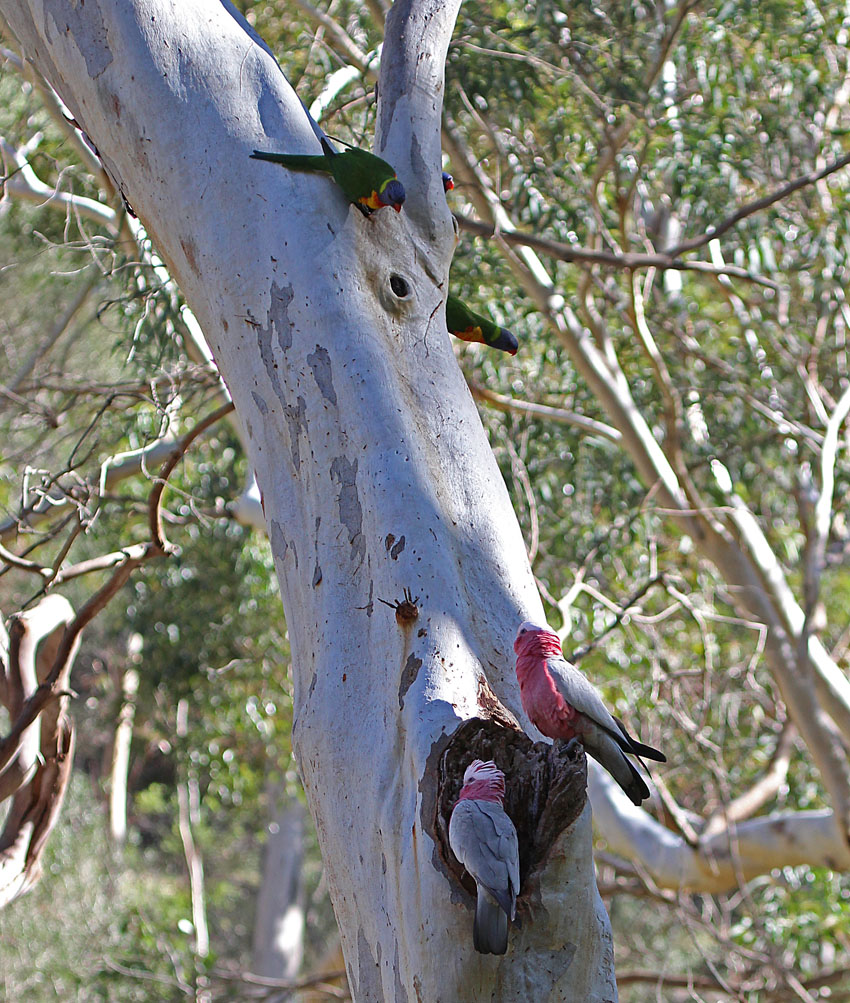
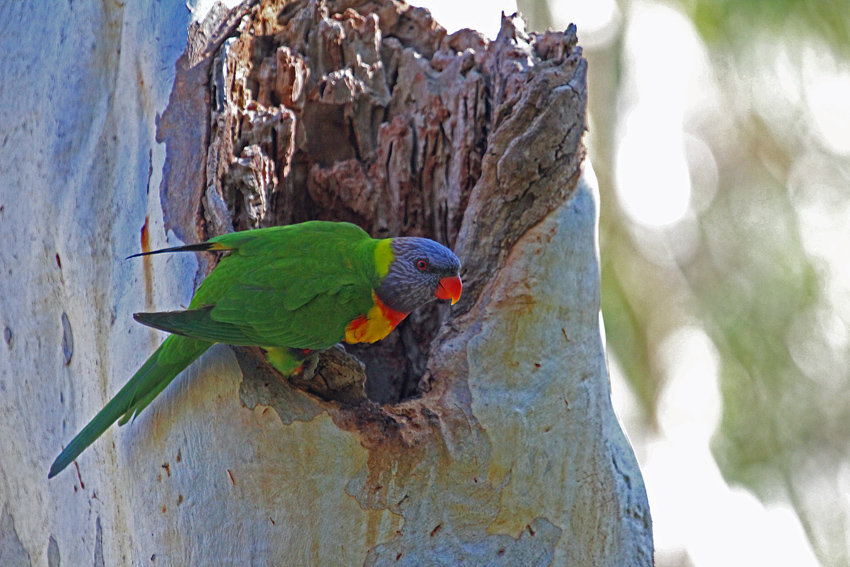
A small group of rainbow lorikeets had gathered on the branches of a massive gum tree about 10 metres off the ground. They were screeching loudly and seemed quite agitated. I moved away so as not to scare them and sat quietly in the cover of some thick bushes watching closely through my long lens. The source of their consternation soon became obvious; a pair of galahs had commandeered a nesting hole in the trunk of the tree. Over the next half an hour I witnessed a heated real estate battle develop as a continual rotation of chattering rainbows tried to dislodge their larger rivals. Eventually the galahs moved off and one of the rainbow lorikeets immediately flew down and started to peck around the perimeter of the nest hole.

A A pair of rainbows watching galahs at nest site

A pair of rainbows watching galahs at nest site

AF Inspecting the new proerty

Inspecting the new property

I finished my walk sitting on the edge of the creek with a cappuccino from the coffee van that plies its trade on the weekend and a pastry from my stash. Not a bad way to spend a sunny winter’s day for any wildlife enthusiast.


Thanks for taking the time to read this post.


Cheers

Baz