Archive | Creeks and wetlands RSS feed for this section

Misty Morning Rats

9 Jun

 This year, the first few days of winter have been a little cloudy with a light mist over the city in the early hours. It is the kind of weather that encourages a cup of coffee, at the Par 3 Cafe by the Torrens Weir, before my weekend bike ride around the river trail. But the cool quiet mornings do have one distinct advantage. Some of the more reclusive creatures that inhabit the river banks seem a little less wary and easier to find; most notably…The Australia water rat…one of my favourite species.


AFF Torrens Weir in winter feeding the river below

Torrens weir in winter feeding the river below


As you can imagine, misty mornings, shy wildlife and carrying a camera on a bike does present a few challenges. My digital SLR and long lens are too heavy and the low light conditions push the compact super zoom that I can comfortably wear on my hip, to its absolute limits. Consequently, please excuse a couple of the rather grainy images that I have included later in this post. However, the mere fact that I was able to capture these pictures encourages me to share them and their story with you.


AA Willy Wagtail lookin for insects amongst the reeds

Willy wagtail looking for insects amongst the reeds


Over the many years that I have walked or cycled around our permanent creeks and wetlands I have only caught the occasional glance of Australian water rats. The tell tale ‘V’ shaped wake that they leave and their low profile in the water make them unmistakable. Unfortunately, after a brief appearance they invariably dive or disappear into the tangle of reeds and grasses on the water’s edge. It is also quite easy to confuse them with common rats, which swim well and often live close to waterways. Unlike their terrestrial cousins, water rats are a little more robust have a slightly blunter face with a heavier covering of whiskers. Their back feet are also webbed and they have a white tip to the tail.


AG Common rat scavenging close to the river

Common rat scavenging close to the river


Back to my tale of coffee and misty mornings; last Saturday I had cycled from home to the weir and was peddling along the track that runs south above the river when I noticed a classic ‘V’ shaped wake in the water. I quickly dismounted, whipped off my helmet and gloves and pulled out my camera. The water rat swam upstream diving periodically and I was able to walk slowly along the trail watching it for around 5 minutes. Eventually it disappeared into the undergrowth near the bank but not before another one paddled close by affording me a rather unique photo opportunity. However, as I mentioned at the start of this piece, the light conditions were far from perfect and my target animals were the best part of a 100 metres away. A lot of frames and little Photoshop produced the two images you can see here.

AC Australian Water Rat sheltering under the bank edit 2

Australian water rat sheltering under the bank


AD Australian water rats swimming across the river

Australian water rats swimming across the river

Encouraged, I returned the next day and sat quietly on the bank for the best part of an hour, hoping for a repeat performance. I did see one water rat for a brief moment but I could not focus rapidly enough to get a clear image. At this point, the coffee beckoned and I cycled back to the weir stopping a couple of times on the way to enjoy the winter’s early scattering of leaves on the river bank and watch a pair of silver gulls wading in the water cascading over the sluice gates.


AH Early winter leaves on the river bank

Autumn leaves on the river bank

AE Australian silver gull looking for prey in the overflow

Australian silver gull foraging in the overflow

Now that I know there are several water rats in the area I am determined to travel the same path on foot over the next few months with my DSLR to see if I can improve on these pictures. But for now I am thrilled to have seen the little animals foraging in the wild and to have captured a few simple images.


Until next time

Baz

Go back

Your message has been sent

Warning
Warning
Warning
Warning

Warning.

Waterfall Gully’s Aquatic Skinks

27 Apr

In the driest state on the driest continent water is, as you can imagine, the most precious of commodities. To be entirely honest, Adelaide has a wonderful climate but in summer we can go for many weeks without a drop of rain. During this time the few spring fed creeks that flow down from hills become a refuge for a wide variety of wildlife.  

AA edit

Waterfall above the creek

Frogs, native fish, fresh water crustaceans, aquatic lizards and certain bird species all need this permanent source of water. The spectacular little falls that have carved out Waterfall Gully on the city’s eastern fringe feeds one of the few environments where water dependent wildlife can survive the harsh summer months. At the foot of the falls; a restaurant, walking trails, and car parking sit adjacent to the creek making it a wonderful place for hikers, casual visitors and naturalists alike. 

B edit

A spotted marsh frog amongst the reeds

 After a particularly dry start to autumn I decided to drive out to Waterfall Gully to assess how the wildlife was coping with the conditions. A friend told me that he used to see quite lot of water skinks in the area years ago. I had only caught the occasional glimpse of the little lizards while cycling around the Torrens Lake in the city or on the banks of the Murray. This seemed like the perfect time to try to get some better images of these fascinating little reptiles. 

AAA edit

The creek provides a secure environment for many creatures including snakes, lizards, frogs and fish

Water skinks, actually the eastern water skink (Eulamprus quoyii) grows to around 30cms in length. They hunt for small invertebrates in and around permanent water. These lizards are territorial and males and females look alike. Up to 9 well developed young are born in the summer. They are common prey for Kookaburras, snakes and feral cats. Like most skinks, eastern water skinks can drop their tail when grabbed as an escape strategy and often have shortened or partly re-grown tails.

E edit

Eastern water skink basking on a rock in the late afternoon

 On my first trip I drove up the narrow road to Waterfall Gully and parked the car close to the creek below the falls. Within a few minutes I had spotted my first lizard. It was sitting on a flat rock in the middle of the creek and had a substantial part of its tail missing. Around one in ten of the skinks that I saw that afternoon were missing parts of their tails.

C edit

This little lizard got away but not without losing part of its tail

 As I walked towards the waterfall I noticed that the skinks were quite abundant throughout the creek and its banks. Some were tucked into the undergrowth while others were foraging amongst leaves and twigs that had accumulated between the rocks in the creek bed. I did not see any swimming though a few were partially immersed in water, apparently waiting for prey.

D edit

An eastern water skink foraging in the creek bed

 I returned to Waterfall Gully several times over the next few weeks to watch the water skinks and try to capture some better images. On my last excursion I sat quietly by a section of creek for over half an hour watching the lizards, small birds and insects that lived there. The wildlife had survived the ‘big dry’ quite well it seemed.

IMG_1205 edit

Perhaps I’ll focus on the insects next time

A Sunday Walk…….Hackney Street Bridge

1 Mar

Dear reader

South Australia’s wild expanses are vast and the wildlife fascinating  in these remote areas but the cities and towns have their own natural features and often the wildlife is equally prolific and interesting in these urban spaces.

The River Torrens flows from the Adelaide hills through the city and on to the coast. It is an effective wildlife corridor supporting a wide range of animals and plants. The government of South Australia, along with local councils and interested wildlife groups, have crafted the aptly named ‘Linear Park’ along the urban sector of the waterway. It is defined by a narrow strip of bushland that runs along the river from the hills suburb of Athelstone to its outlet at Henley Beach. Walking or cycling along sections of this trail is a great way to experience the wildlife of the region. In some areas there are also interpretive references and information about the Kaurna People; the original Aboriginal inhabitants of the Adelaide plains.

Bubble fountains installed in the river help reduce algal blooms in the hot summer months

Bubble fountains installed in the river help reduce algal blooms in the hot summer months

The section of park that runs between the two bridges spanning Hackney and Frome roads is one of my favourite haunts. Although it is on the very fringe of the city centre there is a surprising amount of wildlife for the careful observer to enjoy. My last walk along this section of the river was an early morning jaunt on a Sunday. I shared the path with a few cyclists and joggers all blissfully unaware of the interesting creatures that they were passing.

Cyclist crossing linear park behind the Zoo

Cyclist crossing linear park behind the Zoo

Several stands of large eucalypts overhang this part of the river providing perfect roosting sires for great cormorants. This particular morning several of the birds were puffing out their neck feathers and jockeying for position on some bare branches trying to catch the first rays of the sun filtering through the canopy. As I walked along the bank they started to stretch their wings and glide down to the water to begin the morning’s hunt for fish, frogs and occasional water kkink.

Great Cormorants roosting in trees overhanging the Torrens Lake

Great cormorants roosting in trees overhanging the Torrens Lake

And there were quite a few nervous skinks for the cormorants to set their sights on. Amongst the tall papyrus reeds that grow along much of the bank, I could hear the rustle of the little reptiles as they scurried into the dense matt of stalks and grasses. Eventually one of the lizards decided that freezing was a better escape strategy and I was able to capture an image before it too, disappeared into the reeds. The area seemed to have quite a large population of lizards so I adopted a sit and wait policy. A few minutes later my patience was rewarded when I noticed two cormorants fishing close to the reeds.  After several failed attempts one of the birds emerged with either a slender fish or a lizard firmly clamped in its hooked beak which it then dispatched with a quick gulp.

A water skink freezes in the undergrowth near the river bank

A water skink freezes in the undergrowth near the river bank


The first half an hour of my walk had taken me along the western bank up to the Frome Road Bridge. From there I crossed the river and walked back along the opposite side. Small groups of Pacific and maned ducks were feeding close to the bank and a small Australian grebe was having an energetic wash in a sheltered pool.  But it was a colourful dragonfly that really caught my attention as it flitted over the water eventually settling on the branch of a gum tree. One brief moment for a photo op and it was gone.

Dragonfly on eucalyptus branch

Dragonfly on eucalyptus branch

My final wildlife encounter was with a couple of mudlarks that had built a cup shaped mud nest in one of the taller eucalypts that grew out from the bank. One of these territorial little birds was aggressively defending its territory against a large raven that had landed too close to their nesting site. The other bird was perched on a branch peering into the bushes near the water in search of prey.

A Mudlark perches on a branch watching for insects

A mudlark perches on a branch watching for insects


Insects, reptiles, birds and a good walk; not a bad way to spend the morning- just one final touch, breakfast in one of Adelaide’s parkland bistros a few minute’s drive from the river.

Cheers

Baz

Go back

Your message has been sent

Warning
Warning
Warning
Warning

Warning.

A Morning Walk Along Dry Creek

3 Feb

Dry creek is one the numerous watercourses that drain the Adelaide Hills. It is a corridor of native vegetation that attracts a variety of birds, insects and reptiles. Like most of Adelaide’s creeks, it has well established walking and bike trails and provides a convenient and effective way to experience the natural beauty that our state has to offer. The section of the creek that I usually explore is extremely easy to access as it is a five minute walk from Tea Tree Plaza a major hills face shopping complex that is serviced by numerous buses.

Dry Creek from Ladywood Bridge

Dry Creek from Ladywood Bridge

In the drier summer months Dry Creek provides a few pools of water for the local wildlife to survive the hot dry weather. The creek runs close to the bottom of my street and several times each week I will cycle or walk along its course observing and photographing the never ending cycle of life that it supports. This is one of many posts that will document my continued fascination with this easily accessed wildlife refuge. Sometimes I will focus on a particular species. Alternatively, I may simply record my observations of the wildlife that I encounter on a walk or ride.

The canopy of an ancient River Gum provides a myriad of micro habitats for birds and invertebrates and even the odd possum or Koala

Yesterday morning I fitted a new Canon 100-400 lens to my 600D and headed down to the creek to take a stroll and try out the equipment in a variety of situations. As it is mid-summer and many of the eucalypts trees that line the creek have stopped flowering and the shrubs and grasses are losing much of their nutritional value making the wildlife a little scarce. Treading lightly and watching carefully was the order of the day. Within a couple of minutes I heard the warbling cry of a White Backed Magpie and one of the powerful black and white birds dropped out of a tree just in front of me with a sizeable Christmas Beetle in its beak. I lifted the camera and focused quickly but the bug already heading down its gullet and I only managed to catch a smug looking bird staring across the grass in search of more prey.

Satisfied White Backedd Magpie that has just swallowed a beetle

Further along the creek I edged closer to the water and started to search for insects amongst the wild grasses and rushes. To my surprise I came upon a roach perched on a head of wild wheat. Not the common, old black roach that we find around the house and compost bins but a striking gold and brown specimen. An attractive roach- if roaches can be called that. Although the roach was quite large it was a good test for the lens as a macro tool. But with a minimum focusing distance is 1.8 metres, some cropping would be still be required.

Bush cockroach on cereal grass head

The creek even on a midsummer morning is rarely a quiet place and this day was no exception. A crescendo of raucous squawking announced a flight of Sulphur Crested Cockatoos. They circled high above the creek then landed in an old decaying Red Gum that towered above one of the few pools to still hold water. One bird in particular seemed to take offence at my presence and sat defiantly on the end of a branch simultaneously erecting his bright yellow crest and screeching cockatoo obscenities in my direction.

Suphur Crested Cockatoo feeling a little stressed near nesting hole

My final discovery for the morning was neither bird, mammal nor insect but a reptile. When I reached the largest pool along this part of the creek I noticed a pattern of concentric ripples radiating from a point near a patch of reeds. Through the camera, I could just make out the pointy snout of a freshwater turtle coming up for air; a good test for the lens at distance and in the low light conditions and a great way to finish my morning walk.

Short Necked Turtle coming up for a breath of air

Solandra Wetland’s Musk Lorikeets

4 Jan

Dear Reader

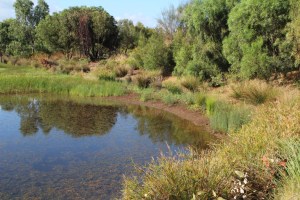
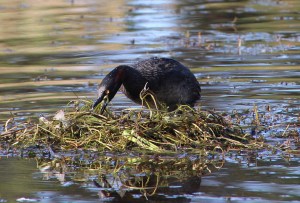
Last week, on a warm summer afternoon, I decided to walk down to the pond at the bottom of the street to photograph a pair of nesting Australian grebes. The pond is part of a chain of wetlands that feeds off the nearby creek and filters stormwater for use on local parks and gardens around Tea Tree Gully. It provides a welcome oasis for many species during the dry summer months and supports a small semi-permanent population of water birds.

Local pond

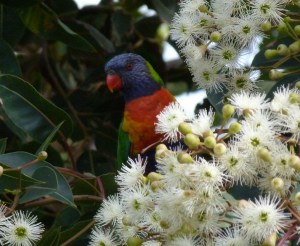
On the edge of the pond there are a few medium sized eucalyptus trees that flower this time of year. They have broad canopies adorned with either cream or coral blossoms and are a favourite destination of the local rainbow lorikeet tribe. As I passed the trees I could hear the raucous screech of feeding birds but the tone seemed a little different to the cacophony of sound that frequently greets me.  A quick glance confirmed that most of these parrots were musk lorikeets with just a smattering of rainbows amongst them.

Rainbow Lorikeet amongst white gum blossoms

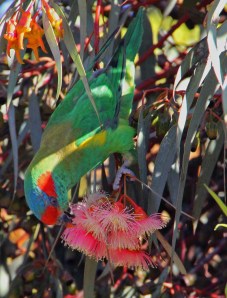
Musk lorikeeets ( Glossopsitta concinna) are medium sized lorikeets between 20-30cms from head to tail. They use their brush tipped tongues to feed on pollen and nectar but will also eat some seeds, fruits and insects. They often travel in flocks and are usually found in dry woodlands where they nest in hollow branches. They are slightly smaller than rainbows and less common in this area.

Musk Lorikeet feeding on coral gum blossoms

I decided that the grebes could wait. And, while I have quite a good collection of rainbow pictures I rarely see more than a few Muskies and the chance to photograph them while feeding does not come along too often. They were endearing little animals to watch as they performed an extraordinary range of acrobatic movements. Sometimes they hung upside down to get their beaks into a bunch of blossoms; at other times they used it as a prehensile tool to climb along spindly branches. Despite their preoccupation with feeding they were still a little nervous and as I moved cautiously around the trees they scattered into the denser parts of the foliage making photography somewhat difficult.

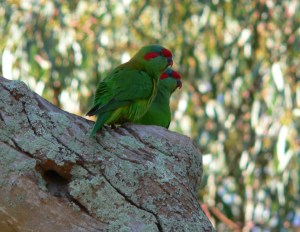
Pair of Musk Lorikeets

I tried sitting quietly in some of the surrounding bushes closer to the pond and using the telephoto on full zoom. An equally unsuccessful manoeuvre, as the birds seemed to rarely feed on the outer blossoms as doing so would probably increase their exposure to local predators like harriers and falcons. Finally I adopted a more professional and scientific approach to the problem; walk slowly, keep shooting and hope for the best.

Musk Lorikeet pair bonding near nest hole

Dozens of frames later, with the light diminishing and more than a few bird droppings adorning my jacket, I left my flock of musk lorikeets to their meal and walked down to the pond for a quick look at the pair of grebes. One was repairing the nest and the other half hidden in the reeds at the edge. Australian Grebe building nest

Another post for another day

Cheers

Baz

Go back

Your message has been sent

Warning
Warning
Warning
Warning

Warning.