Tag Archives: Australian birds

An Urban Billabong

29 Sep

Dear Reader:

The word billabong looms large in Australian folklore. It is where ‘a jolly swagman’ met his untimely end and mythical beasties called ‘bunyips’ supposedly emerge from the water to devour unwary campers. In reality, billabongs are freshwater wetlands that flood when river levels are high then become more isolated in the dry season. They are essentially backwaters that provide a refuge for many different species of animals as well as being popular locations for camping and fishing.

i

Still, dark waters of an urban billabong


In South Australia the lower reaches of the Murray River has many lovely billabongs that have provided me with many a peaceful afternoon’s wildlife watching and photography. However, the trail that runs along the banks of Adelaide’s Torrens River also incorporates a little billabong which is tucked behind the upmarket suburb of St Peters, just a stone’s throw from the CBD. It was rehabilitated in the mid eighties and over the intervening years various community and government groups have overseen its care and maintenance.

c

A mosaic of the rainbow serpent reflects the importance that Aboriginal people attached to billabongs


Last weekend, I packed my little super-zoom camera, hopped on the bike and pedalled up to the billabong to take stock of the wildlife. It has been a long wet winter and I was hoping that the warmth of the first few weeks of spring would stimulate some wildlife activity. I was not entirely disappointed. As I approached the little wooden landing that fronts the water, a pair of amorous crested pigeons pranced and displayed to each other. Close to a patch of reeds a mother black duck was tending a pair of fluffy little ducklings.

h

Courting crested pigeons

k

A pair of black swans nibble the water side vegetation


During the winter months the landscape may be verdant but few of the native shrubs flower and the insects that rely on the blossoms are rare. Now the billabong was clearly beginning to emerge from its winter blues and life was starting to reassert itself. As well as the hormonal pigeons and baby ducks a colony of colonial spiders had constructed a silken trap in an acacia bush and delicate little purple chocolate lilies were emerging from their winter dormancy.

chocolate lily

Chocolate lily

L

Colonial spiders construct a complex web in a wattle bush


As spring turns to summer I am sure the wildlife will continue to flourish and I look forward to revisiting and reporting back to you.

Cheers

Baz      

Corella Wars

24 Aug

Dear Reader:

Strathalbyn is one of those country towns that make you think of Britain. An imposing church presides over a pleasant stretch of river complete with ducks, gently sloping banks and an old fashioned rotunda. Huge Norfolk pines are mingled with classic river red gums and picnicking families often spread blankets on the banks and eat sandwiches or barbecue a few snags.

Like a flurry of snow Corellas perch in the trees they are feeding on showing bare branches

Church, rotunda and corellas in the trees


But the rustic charm is not sound-tracked by the gentle call of songbirds. Quite the opposite, it is the raucous call of parrots that often fills the air. Large flocks of short beaked corellas frequently descend upon the trees that line the Finnis River where it passes through the town. They are particularly fond of the towering pines and hundreds will sit along the branches of each tree tearing at the cones and limbs with their powerful beaks. At the same time they engage in a variety of typically cockatoo-like social interactions ranging from mutual grooming and preening to wing flapping, mock fights and beak duels; all of which are accompanied by a variety of screeches and squawks.

A Corella social behaviour

Corella social behaviour


Short-beaked or little corellas (Cacatua sanguine) are, as the name suggests, a member of the cockatoo family. They grow to around 40 cms in length and can weigh over half a kilogram. These corellas often congregate in flocks that can number thousands of birds. They are mainly ground feeders, rooting out tubers and bulbs and are particularly fond of cereal crops like wheat and barley; a habit which does not endear them to many farmers.

B Corellas use a combination of wings , beaks and feet  to position themselves

Corellas use a combination of wings , beaks and feet to position themselves


Although most locals and visitors alike enjoy the sight of thousands of graceful white birds wheeling through the sky, the continual noise and quite substantial damage to the heritage trees has become a significant problem. Various means have been employed to move the flock to the outskirts of the town including: culling, high frequency sound bursts and quite recently using a trained peregrine falcon to discourage them.

D Little corella flock circling pine trees

Flock of little corellas circling pine trees


Strathalbyn is only an hour’s drive from the city and the wildlife along the Finnis and open bushland that dominates the area makes it a wonderful day’s outing. And the corellas are the most endearing of birds to observe despite their rather destructive disposition.

 I hope you enjoyed this story.

Cheers

Baz

A Walk to the Falls

12 Jul

Dear Reader

Last Saturday was a classic Adelaide winter’s day. It had rained the night before and a fine patina of dew decorated the shrubs in my garden. The sky was clear and despite a chill in the morning air it promised to be sunny and dry; perfect conditions for a walk in the park. Not any park though. My park of choice was a little conservation reserve nestled in the foothills about 20 minutes from the city centre. Like Waterfall Gully,  Morialta Conservation Park is graced by a series of waterfalls and steep walking trails that cut through a variety of classic bush habitats.

AB Typical sandstone and eucalypt bushland within the park

Typical sandstone and eucalypt bushland within the park

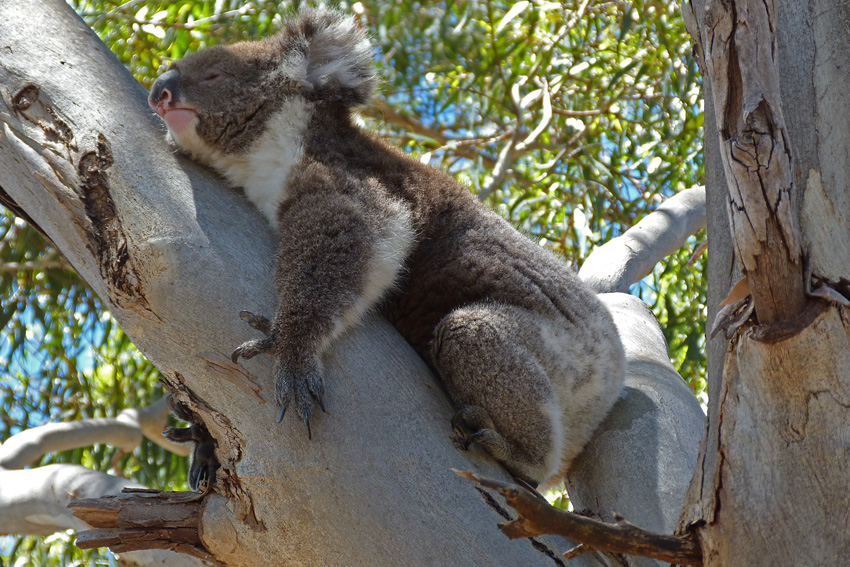
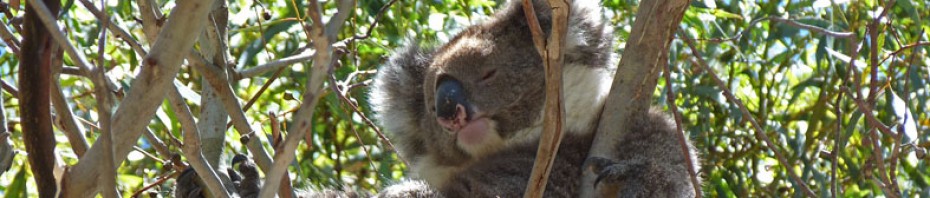
 The drive took me a little longer than expected as I was waylaid by the smell of freshly cooked pastries emanating from a little bakery. My rucksack now stocked with enough calories to sustain my upcoming physical endeavours and probably those of the next week, I pulled into the little car park alongside the creek, hung a camera from my shoulder and set off up the southernmost trail. The sun was still low in the sky and only the southern face of the steep-sided valley benefited from it.  I had walked just a few metres and was emerging from the shade when I noticed some walkers standing below a tall eucalyptus tree pointing excitedly at one of the higher branches. I followed their obvious line of sight and there, nestled into the fork between trunk and branch was a fairly large koala doing what koalas do best ….stretching out and resting.

AC Koala in tree near the trailhead

Koala in tree near the trailhead

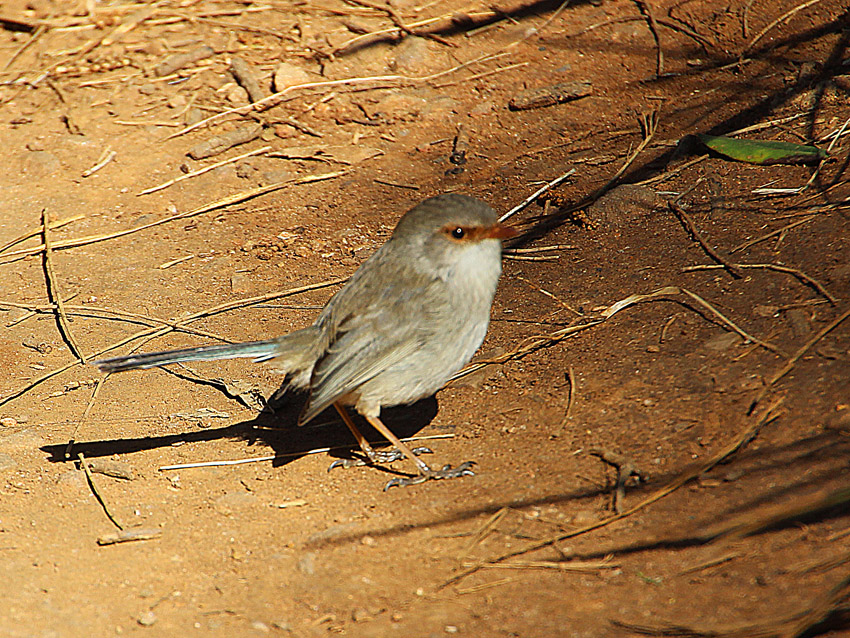
The koala was an unexpected and encouraging start to the day and after spending few minutes watching it I started up the trail with a fair degree of optimism. Winter is never the best time for wildlife. Plants have fewer flowers and fruits and the insects that are attracted to them are in short supply. Of course there is always an up-side when it comes to nature and the damp ground makes it easier for some bird species to fossick for grubs and worms. A pair of blue wrens seemed to be making the best of these conditions, madly hopping from one tree branch to the next then down onto the ground in a never ending search for food. Their constant motion and the morning light gave me only a few half-chances to capture some images and no hope of freezing their motion completely. I did manage a couple of shots that showed some of the obvious differences between the male and female of this species.

AI Male blue wren

Male blue wren

AH Female blue wren

Female blue wren

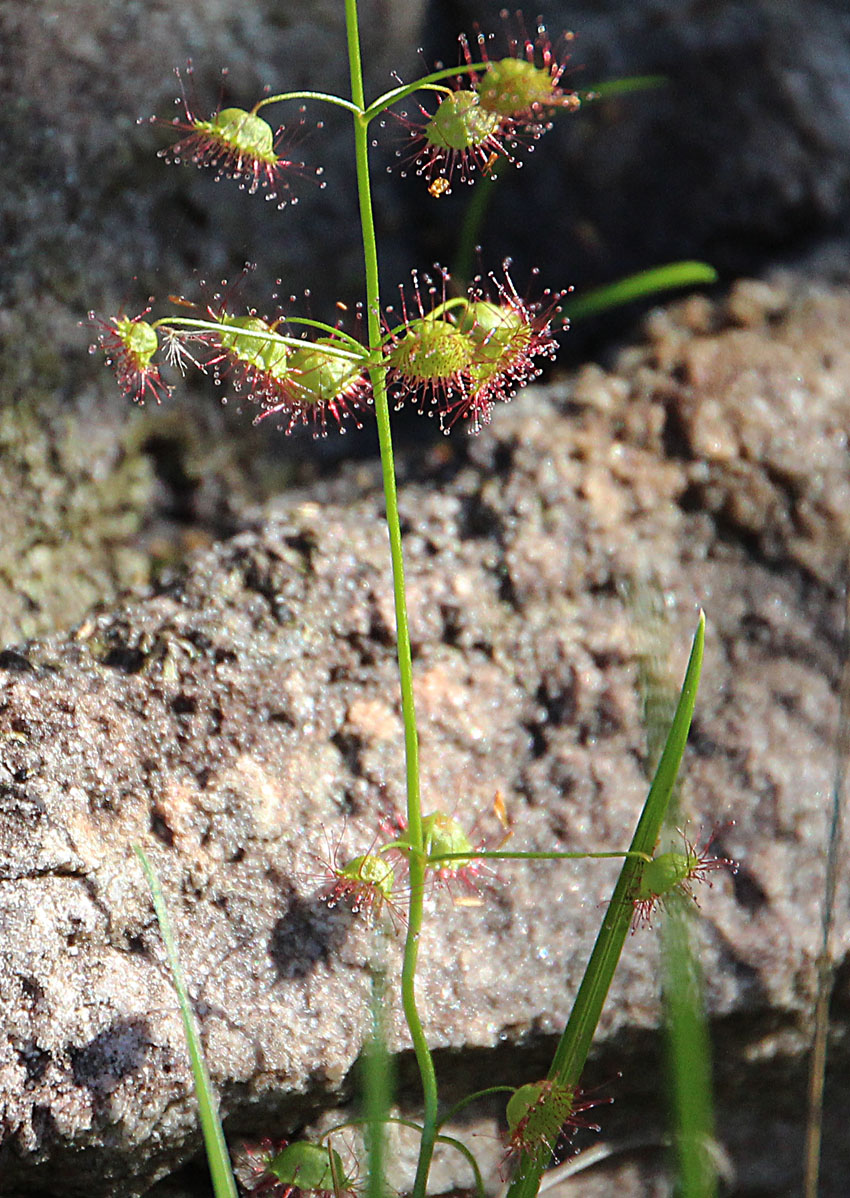
A little further up the track I stopped and sat on a large boulder and scanned the undergrowth for insects or lizards. There was nothing to be seen or heard but I did notice some honeydew plants growing amongst the grasses near a rocky outcrop. These delicate little plants have tiny inverted cups radiating from their stems. The cups are fringed by small filaments and have sticky, viscous fluid in the centre. Unwary insects are trapped in the sweet heart of the cups and the filaments close on them to seal their fate. The unfortunate bug is then digested by its ‘vegetable’ captor providing essential nutrients that other plants might get from the soil.

AG Honeydew plant

Honeydew plant


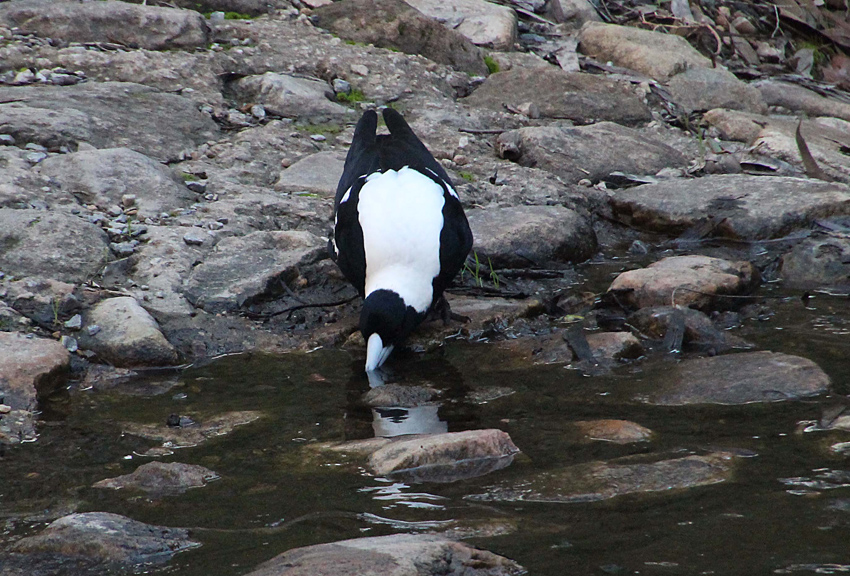
Colourful wrens, cute koalas and carnivorous plants had provided quite a range of wildlife in the first kilometre or so of my walk. As expected, the wildlife had not been prolific but there always seemed to be something around the next bend if I took the time to pause and use all of my senses. The next few kilometres were enjoyable but largely uneventful. A few honeyeaters flitted between late flowering shrubs, a magpie nervously snatched a drink from the creek while a squadron of miner birds squabbled in a stand of acacia bushes. It was not until I was almost back to the car park and walking below some tall, pale eucalyptus trees that bordered the creek that my next significant encounter occurred.

AD Magpie drinking from the creek below the falls

Magpie drinking from the creek below the falls

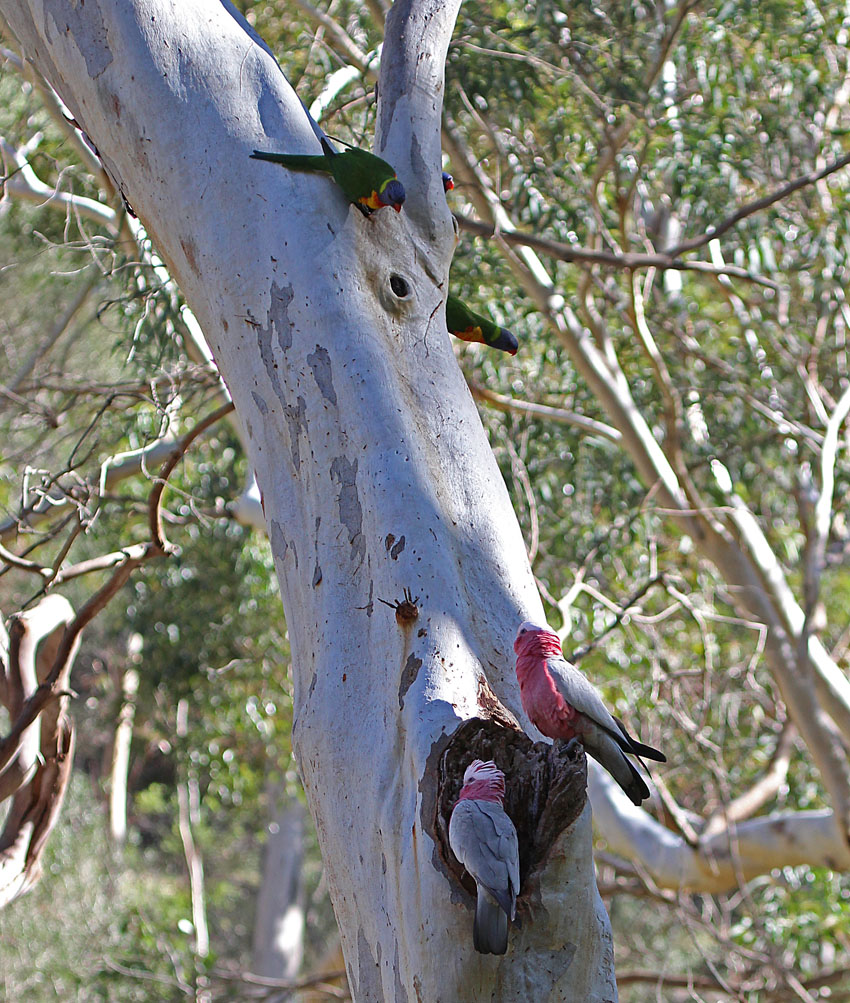
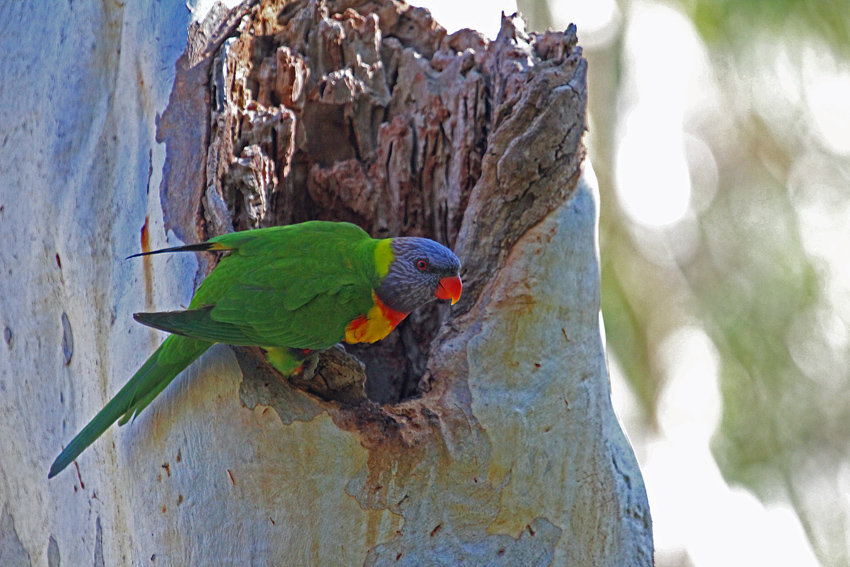
A small group of rainbow lorikeets had gathered on the branches of a massive gum tree about 10 metres off the ground. They were screeching loudly and seemed quite agitated. I moved away so as not to scare them and sat quietly in the cover of some thick bushes watching closely through my long lens. The source of their consternation soon became obvious; a pair of galahs had commandeered a nesting hole in the trunk of the tree. Over the next half an hour I witnessed a heated real estate battle develop as a continual rotation of chattering rainbows tried to dislodge their larger rivals. Eventually the galahs moved off and one of the rainbow lorikeets immediately flew down and started to peck around the perimeter of the nest hole.

A A pair of rainbows watching galahs at nest site

A pair of rainbows watching galahs at nest site

AF Inspecting the new proerty

Inspecting the new property

I finished my walk sitting on the edge of the creek with a cappuccino from the coffee van that plies its trade on the weekend and a pastry from my stash. Not a bad way to spend a sunny winter’s day for any wildlife enthusiast.


Thanks for taking the time to read this post.


Cheers

Baz  

Rare Birds on the Beach

16 May

Dear Reader:
This week’s post is coming to you from Southport, a surf beach just south of Port Noarlunga but still sheltered by the reef (see Jan 21st post). I am sitting in a small cafe sipping a cup of coffee and reflecting on the last couple of hours spent wandering through the sand hills and along the beach.
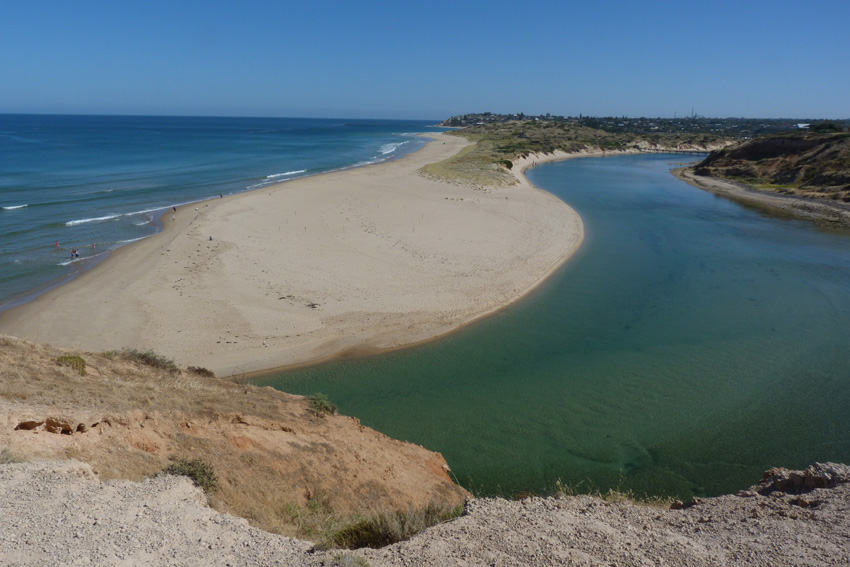
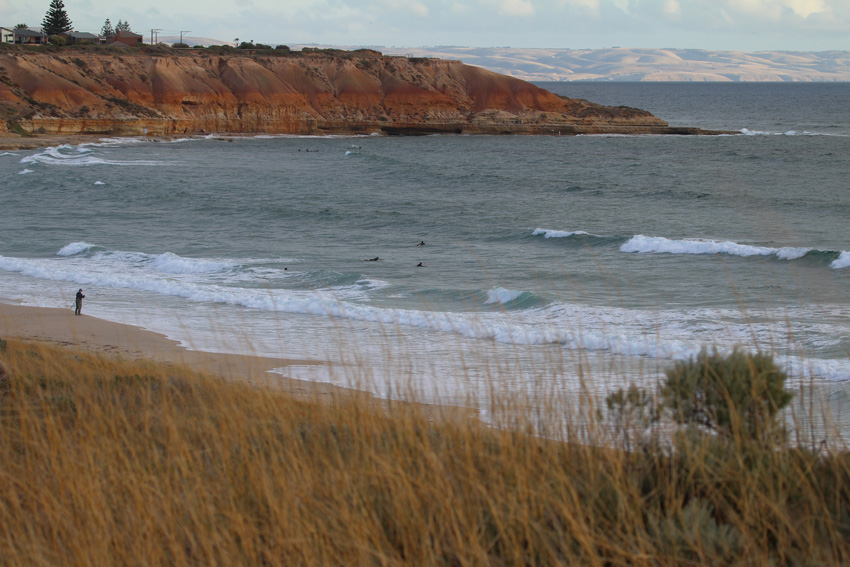
I had driven to Southport in the early afternoon with the specific intention of walking along the tidal flats, where the Onkaparinga estuary drains into the sea, to photograph crabs and wading birds. However, I had not counted on such a high tide; the mudflats were covered and I could only access the walking trails that meander through the sand hills from beach on the seaward side.

A Southport Beach, estuary with bridge in the background red

Southport Beach, estuary with bridge in the background

I parked by the roadside and crossed the river on a small bridge below the cliff line and spent a few minutes watching anglers casting for bream and garfish. Nearby, a father and son paddled a sea kayak towards the ocean disturbing a small flock of black swans as they edged close to one of the steeper banks where the sandy slope of the dunes ran into the water.

B Kayaking below the cliffs red

Kayaking below the cliffs

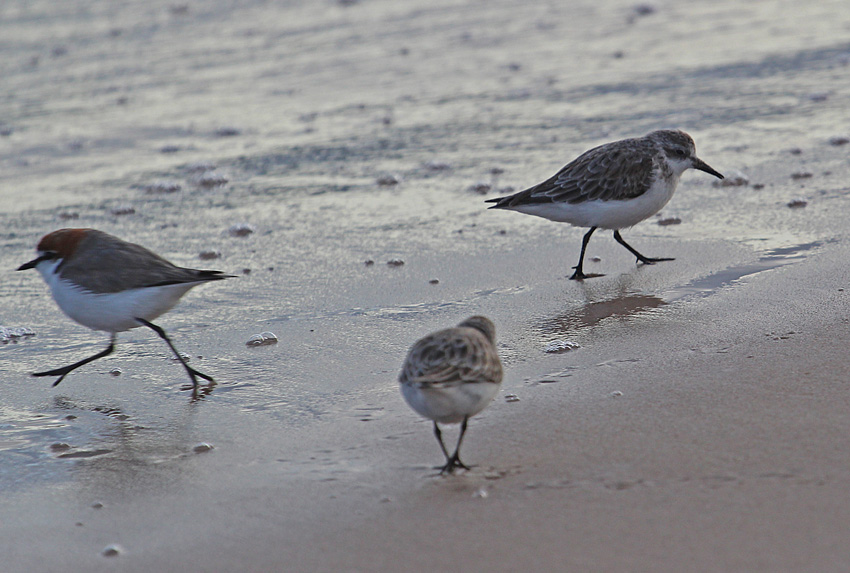
As I traversed the final set of dunes above the beach I felt the afternoon sea breeze on my face and caught the muffled crash of waves breaking on the shore. Several surfers were enjoying a choppy break and more adventurous anglers were wading into the white water to cast for salmon. I headed down to the sand to find one of the trail entrances to the dunes that open onto the beach. As I trudged through the soft sand I noticed a group of diminutive shore birds racing between the foamy lines of waves curving up the beach. At first glance they appeared to be similar in appearance but a more critical look through the telephoto revealed a mixture of species and sexes.

D Mixed group of waders foraging between waves red

Mixed group of waders foraging between waves

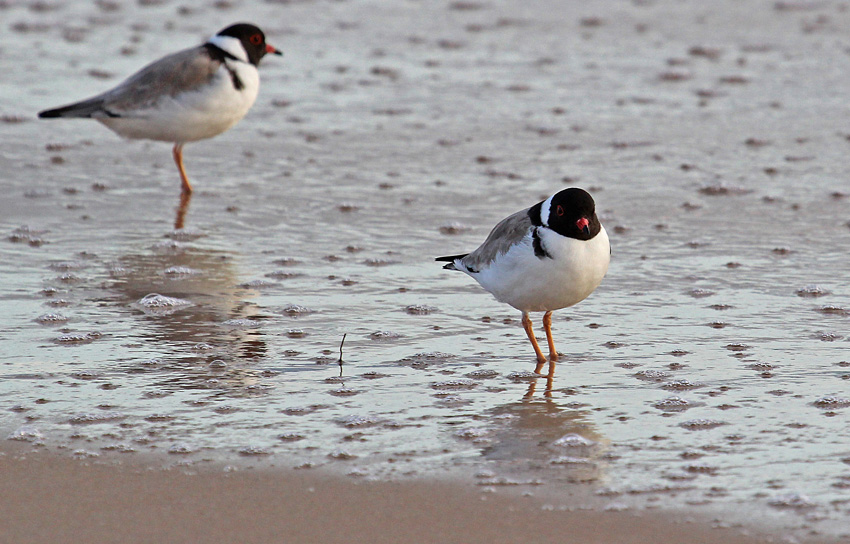
One particular pair stood out amongst the others. I held my breath, refocussed and squeezed off a series of shots, dropped to one knee to better incorporate the water into the background and fired again. I was photographing a pair of hooded plovers, an endangered species that nests on open beaches and a bird that I had only glimpsed at a distance along the Coorong’s extensive beaches further south. As I captured the last image, the wind picked up and the little flock of waders lifted as one and flew further down the beach.

E Hooded Plovers red

Hooded plovers

A sat for a few minutes, smiling inwardly as I reviewed the images then continued down to the trail entrance. As I climbed back up into the dunes I reflected on the extraordinary beauty and diversity of this stretch of coastline, a mere 20 Kms from the city centre. Walking through the dunes was like entering another world made up of: low scrub, wiry grasses and a thick layer of undergrowth fashioned from the skeletal remains of branches and tree trunks. I walked slowly and paused frequently observing a variety of insects, several lizard species and an assortment of birds including: honeyeaters, magpies and crested pigeons.

C View of the beach from the dunes in the afternoon light red

View of the beach from the dunes in the afternoon light

But today it was the ocean that called and as the light started to fade I took another track down to the shoreline and worked my way back to the section of beach where I had encountered the plovers. Sadly, the plovers were long gone but a little group of red capped dotterels remained, bedding down for the night in the footprints that I had left in the sand when I walked this way just an hour ago.

F Red Capped Dotterels bedding down for the night red

Red capped dotterels bedding down for the night

My coffee is finished now and it is time to drive home and share this afternoon with you.

And yes, dear reader, I missed the tide but somehow I think it might have been for the better.

Sincerely
Baz

← Back

Thank you for your response. ✨

Adelaide’s Parkland Rosellas

4 May

Dear Reader Adelaide’s CBD is surrounded by parklands. They are a place for workers to enjoy during a lunch break or cyclists and joggers to traverse on the daily commute. They set the tone for the city and also provide a natural backdrop to the everyday business of the state’s vibrant capital. They were conceived by the city’s founder and first governor Colonel Light and are still treasured and protected by those who live in the city and inner suburbs.

AA bike linear park

Bike riding through the parklands

The ecology of the parklands like the commerce of the city has its own rules and hierarchy. magpies and miner birds aggressively mark out and defend their territories, brushtail possums enjoy the nightlife and screeching rainbow lorikeets seem to know everyone’s business.

AB Noisy Miner feeding on a banksia bloom

Noisy miner feeding on a banksia bloom

One of my favourite animals in this urban ecosystem is the elegant and colourful eastern rosella. They are found throughout the Adelaide and Mount Lofty region and seem to have a preference for open woodland where they can find suitable nesting holes, preferably in old growth trees. There has been a pair raising their young in a white cedar in front of my home this year and when I go for an evening walk I can hear the young ones deep in the tree calling to the adults.

AC Male and Female Adelaide Rosellas feeding

Male and female eastern rosellas feeding

Adelaide rosellas are around 35 cms in length with females being slightly smaller with a faintly orange cast to their plumage and less defined markings. They create a nest up to a metre deep within a tree hollow. Both parents feed the young. Rosellas are mainly seed eaters and feed mainly on the ground.

AD Adelaide Rosella on parkland fencepost feeding on wild grain heads

Eastern rosella on parkland fencepost feeding on wild grain heads

For me, one of the attractions of rosellas is their is its truly unique South Australian connection.  Indeed one particular type, the Adelaide rosella,  only occurs within a few dozen kilometres of the city. It is actually a hybrid of the yellow rosella which inhabits the Murray River valley and the crimson rosella which is more prevalent in the south east of the state.

AE Social interaction between Adelaide Rosellas above nesting hole

Social interaction between eastern rosellas above nesting hole

If you walk through the parklands during the spring and summer months it is not difficult to observe these colourful rosellas exhibiting a full range of behaviours from feeding to nesting and mating.

AF Adelaide Rosella perched on nesting hole entrance

Eastern rosella perched on nesting hole entrance

Cheers Baz

← Back

Thank you for your response. ✨

Arkaroola’s Emus

19 Apr

Dear reader 

This last week has been quite exciting. Old friends visited from Texas and, as is our custom, we headed to one of the most remote areas of the state to indulge our passion for wildlife and wild places. My choice was Arkaroola a place that I had visited many years ago on an indigenous cultures study tour and an environment I was eager to experience again.  

Arkaroola is a world heritage listed site in the northern Flinders Ranges 600kms north of Adelaide. It is a landscape of harsh granite peaks and deep, enchanting gorges; a favourite haunt for off road drivers, bush walkers and naturalists. Despite its isolation, facilities at the visitor centre are first class providing accommodation, a restaurant, supplies and fuel.

C Dry creek bed near Arkaroola with Sturt Desert Pea in the foreground

Dry creek bed near Arkaroola with Sturt Desert Pea in the foreground

The road from Wilpena in the southern part of the ranges to Arkaroola is largely unsealed and traverses an iconic selection of Australian arid zone bushland ranging from wide brown plains and grassland to forested scrub. The road is traversed by numerous ephemeral creeks some of which wind back into interesting rocky gorges. Each time I have driven this route the wildlife that I have encountered has been different; flocks of parrots and red kangaroos one year, sightings of a variety of lizards and raptors another. However, it was my last drive north that was most memorable.

B Driving to Arkaroola

Driving to Arkaroola

The first section of the road from the classical little outback town of Blinman with its pub, art gallery and general store, was largely uneventful. A few wedge tailed eagles soared on thermals in the distance and a couple of small flocks of corellas and galahs screeched at us as they took flight from larger eucalypts in the dry creek beds. The only kangaroos were road kill victims.

A Blinman    the last outpost before a long bush drive

Blinman the last outpost before a long bush drive

Around 50 kms north of the town we drove a little way up one of the creek beds clattering over the flat rock and sand in 4WD then parked in the shade of some taller gum trees for a bite to eat. Almost immediately, a male Eeu guiding his procession of chicks, emerged from behind some bushes where they had been feeding. As we approached he sauntered off up the creek with feathery rump swaying and his little family ‘in tow’.

EA Male emu with brood of young stripy chicks

Male emu with brood of young stripy chicks

Emus are the world’s third largest bird after the African ostrich and Australasian cassowary; they grow to a height of 2 metres and can weigh almost 40 kgs. Emus run at speeds over 60 kph. This bird had to be a male as only males incubate the eggs and care for the young.

A Emu bad hair day

Emu bad hair day

This was the first of many encounters over the next few days. Perhaps the most unforgettable was just a few kilometres outside of Arkaroola. We were rounding a sharp bend in the road when a pair of emus suddenly appeared on the road hurtling towards us. The pair seemed oblivious to our presence and wholly engrossed in some kind of emu ‘high jinks’. They pushed and shoved at each other while still running, one falling sideways, rolling over then leaping into the air to continue the game. We skidded to a halt and watched them cavort privileged to see such a candid display of exuberant animal behaviour. After a minute or so they settled down and wandered up a rocky together slope feeding.

OLYMPUS DIGITAL CAMERA

The boys are back in town

Our final emu encounter occurred near one of the few permanent waterholes in the region. Two large birds suddenly appeared from the scrub and ran alongside the vehicle for a couple of hundred metres then abruptly cut across us and headed for a stand of tall eucalypts. We pulled over and walked slowly down to the trees and watched them join up with another group and start drinking. In the soft evening light, the scene was really quite unforgettable and the Emus though aware of our presence, did not seem uncomfortable allowing us to capture some memorable images.

D Group of Emus at waterhole in the evening

Group of emus at waterhole in the evening

Cheers

Baz

← Back

Thank you for your response. ✨