Tag Archives: parrots

Mt Lofty on a Winter’s Day

12 Jul

Dear Reader:

Last weekend was cool and clear, perfect winter weather for a visit to Adelaide’s highest point, Mt lofty. The bush covered peak is a mere twenty minutes drive from the city along the SE freeway and the viewing deck and restaurant are surrounded by tall eucalypts that are home to a variety of wildlife.

AD A view from the top  (click to enlarge)

A view from the top (click to enlarge)

A selection of walking trails and bike tracks converge on the summit and earlier in the year I had spent some time walking along their lower sections photographing wildlife. However, on this occasion I had decided to see if the distribution of species was different at a slightly higher altitude in the cooler months.

AG Mt Lofty summit - Copy

Mt Lofty summit (click to enlarge)

The summit was quite busy with a smattering of mountain bikers and walkers using the trails and dozens of casual visitors simply enjoying coffee and the view from the observation deck and glass fronted dining areas. As I knelt down by my pack to select a lens I heard the chattering call of some blue wrens that were flitting between some nearby bushes and diving into the undergrowth. I watched their antics for a few minutes before heading off on one of the shorter trails that circle the summit.

AC2 C

Male blue wren surveying his territory(click to enlarge)

AH White backed magpie (click to enlarge)

White backed magpie (click to enlarge)

After walking for several minutes I noticed a sizeable magpie foraging for grubs amongst the grass and rocks. As I paused to take a few shots a group of Japanese tourists stopped and asked about the different birds in this area. We spent an enjoyable few minutes chatting and comparing their native species to ours; it transpired that they were an ornithological party on a study tour.

AE Natve heath - Copy

Native heath (click to enlarge)

AB Rosella feeding in the trees (click to enlarge)

Rosella feeding in the trees (click to enlarge)

A little further along the trail the greens and browns of the understory were enhanced by small patches of bright red flowers belonging to one of the hardy little heaths that flowers in the winter months. But the real splash of colour on this winter’s day was a colourful Adelaide rosella that was feeding on berries high in the branches above me. This was quite unusual as virtually every rosella I have observed feeding has been foraging on the ground for seeds and tubers.

AA Large male koala near the restaurant entrance - Copy

Large male koala near the restaurant exit (click to enlarge)

Mount Lofty, as I have pointed out, is a prime tourism site and in keeping with this status it provided one final surprise. A large male koala, that seemed to be extending a farewell gesture of pure Australiana, was comfortably tucked into the forked branches of a large gum tree alongside to the exit path.

Cheers

Baz

The Paralana Trail

29 Jun

Dear Reader 

It’s winter but you’d hardly know it. The afternoon sky is a clear endless blue and though there’s a hint of the approaching night’s cold desert chill, the temperature is still a comfortable 25 degrees. I am in the Arkaroola Wilderness reserve in the Gammon Ranges some 1000 kms north of Adelaide heading towards the Paralana hot springs. After a hearty breakfast in the resort’s dining room we have loaded our gear into Suzuki GV and locked in 4WD for the 30 km trip along one of the most interesting off road adventures in this world heritage region.

Ochre wall

Ochre wall (click to enlarge)

 We have been crawling over the rugged terrain for about 20 minutes and the stony track has opened into a dry creek bed. One section of the embankment is quite extraordinary; a wave shaped deposit of ochre that contrasts sharply with the surrounding bush. This significant deposit was of great importance to the Adnyamathanha people who used it in ceremonies and to trade with other Aboriginal groups.

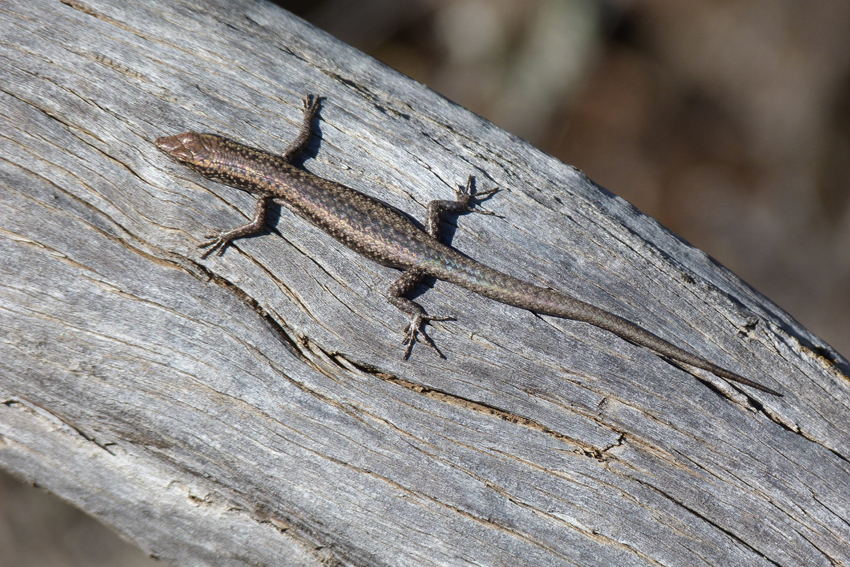
Rock skink

Unknown skink species (click to enlarge)

 While the others break out a little gas stove to brew a ‘cuppa’ I walk along the creek bed camera in hand. The unseasonably warm weather has brought out a few reptiles that would normally be hibernating at this time of the year. They are wary and the only clue to their presence is an occasional rustle in the undergrowth. Finally, one little skink that is basking on a weathered tree trunk decides that remaining motionless is a better option than retreating, offering me a nice clear shot.

(click to enlarge)

Male mulga parrot (click to enlarge)

Femal mulga parrot feeding on blue bush berries

Female mulga parrot (click to enlarge)

 Just as I am about to make my way back to the vehicle a flash of colour amongst the skeletal branches of a long dead acacia tree catches my eye. I peer through the telephoto and focus on the turquoise plumage of a male mulga parrot. If it is the mating season then the female should be nearby and with a little persistence I find her on the ground feeding on some small yellow berries that are the fruit of a low growing saltbush-like plant.

P1010422

Yellow footed rock wallabies on steep cliff (click to enlarge)

 Refreshed, we resume our drive along the trail, slowly climbing into the hills which provide spectacular views across the Gammons. Following a twisting descent down a narrow track we enter the spectacular Baranarra Gorge with its sheer rock walls and boulder strewn pools of clear fresh water.   Our progress has been slower than planned and it is late afternoon when we start to pick our way along the edge of the water hole. Almost immediately I hear the rattle of small rocks skittering down a steep rock face. Almost immediately I hear the rattle of small rocks skittering down a steep rock face. Looking up I catch sight of a pair of yellow footed rock wallabies precariously perched on the sheer cliff face. Once again, I am reminded of the extraordinary adaptations of these beautiful little animals. With their furry back feet perfectly designed for gripping rock surfaces, long counterbalancing tail and subtle camouflage, they are the Aussie equivalent of mountain goats.

P1010408

Chopper based at Arkaroola Village (click to enlarge)

 Unfortunately our stay must be a short one as the light is starting to fade and we must head back to our home base at the village. Tomorrow we have decided to take a helicopter flight over the area to get an overall picture of the terrain before our next off road foray.

Cheers

Baz
Springtime Turtles at Maggie’s Farm

7 Sep

Dear reader

Its early spring in South Australia and everything natural has started to flourish after a rather damp winter. To celebrate the season’s change I decided to take a drive out to Maggie’s in the Barossa Valley. Only an hour’s drive from the city, the Barossa is a favourite destination for urban South Australians. It is characterized by gently rolling hills and open bush-land where fine old homesteads sit amongst seas of vines. The land is not only conducive to what is arguably the finest wine growing area in Australia but also to wildlife. There is always a diverse pageant of bird life and even the odd kangaroo or fox to be seen on the way to visit a winery or two, which makes a drive through the valley a rewarding way to spend a spring afternoon.

AG Open bushland and vines

Open bushland and vines

Maggie Beers is a little pheasant farm situated in the heart of the valley. Maggie is a gourmet chef and she produces a range of fine homemade products ranging from pates and cheeses to ice cream and cooking oils. Visitors to the farm can sit on the decking or in a country styled dining room overlooking a charming little pond while sampling delicacies from quaint wicker baskets. The water is surrounded by tall eucalypts and an olive grove, which attract a variety of birds including rosellas, galahs and waterfowl but Maggie’s special wildlife treat resides in the pond not around it.

B Maggie Beer's from across the lake

Maggie Beer’s from across the lake


As I sat nibbling my pate and biscuits sipping a glass of red I caught sight of my first pond critter. At first it was a mere ripple in the water that caught my attention then two little dark nostrils appeared As the ripples drew closer I could see the little turtle clearly through the water. It was coming to the surface to breathe and probably warm its reptilian body in the sun before heading back to the bottom to search for yabbies, worms and other invertebrate goodies.

A Enjoying good food and wine while watching the wildlife

Enjoying good food and wine while watching the wildlife

The turtle stayed on the surface for at least 10 minutes stretching out its long snake neck and paddling closer to the shallows by the edge of the decking. Before the indulgences of dessert and coffee were complete I had watched half a dozen snake necked turtles appear and disappear in the area where I was sitting.

D Turtle in shallow water emerging to take a breath

Turtle in shallow water emerging to take a breath

Freshwater turtles belong to the family Chelidae and there are 24 species living in Australia’ rivers and wetlands. Interestingly, there are no land-living tortoises in Australia.  Maggie’s pond turtles are eastern long-necked tortoises (Chelodina longicolis). They grow to a carapace (shell) size of around 25cms and the neck can be a little over half the size of the carapace.

C underwater view of freshwater turtle swimming

Underwater view of freshwater turtle swimming


Watching wildlife in such ‘trying circumstances’ requires both stamina and endurance but my next step epitomized the daring and courage of the dedicated wildlife writer and photographer. Yes, you guessed it ‘Dear Reader’, I left the safety of my secure hide, shouldered a camera and walked around the pond. The goal: to try and get a little more insight into the behaviour of the turtles and see if there were any interesting birds in the trees.  

AF Turtle basking on the surface

Turtle basking on the surface


Apart from simply enjoying some different views of the turtles and being serenaded by a pair of affectionate sulphur crested cockatoos, my walk did not provide any new insights though one large turtle did appear to be munching a tadpole or small fish when it surfaced.

E A pair of affectionate sulphur crests

A pair of affectionate sulphur crests

On balance, a day sipping wine, eating fine food and photographing turtles did not seem to be a bad way to kick off spring.

Until next time

Baz

Adelaide’s Parkland Rosellas

4 May

Dear Reader Adelaide’s CBD is surrounded by parklands. They are a place for workers to enjoy during a lunch break or cyclists and joggers to traverse on the daily commute. They set the tone for the city and also provide a natural backdrop to the everyday business of the state’s vibrant capital. They were conceived by the city’s founder and first governor Colonel Light and are still treasured and protected by those who live in the city and inner suburbs.

AA bike linear park

Bike riding through the parklands

The ecology of the parklands like the commerce of the city has its own rules and hierarchy. magpies and miner birds aggressively mark out and defend their territories, brushtail possums enjoy the nightlife and screeching rainbow lorikeets seem to know everyone’s business.

AB Noisy Miner feeding on a banksia bloom

Noisy miner feeding on a banksia bloom

One of my favourite animals in this urban ecosystem is the elegant and colourful eastern rosella. They are found throughout the Adelaide and Mount Lofty region and seem to have a preference for open woodland where they can find suitable nesting holes, preferably in old growth trees. There has been a pair raising their young in a white cedar in front of my home this year and when I go for an evening walk I can hear the young ones deep in the tree calling to the adults.

AC Male and Female Adelaide Rosellas feeding

Male and female eastern rosellas feeding

Adelaide rosellas are around 35 cms in length with females being slightly smaller with a faintly orange cast to their plumage and less defined markings. They create a nest up to a metre deep within a tree hollow. Both parents feed the young. Rosellas are mainly seed eaters and feed mainly on the ground.

AD Adelaide Rosella on parkland fencepost feeding on wild grain heads

Eastern rosella on parkland fencepost feeding on wild grain heads

For me, one of the attractions of rosellas is their is its truly unique South Australian connection.  Indeed one particular type, the Adelaide rosella,  only occurs within a few dozen kilometres of the city. It is actually a hybrid of the yellow rosella which inhabits the Murray River valley and the crimson rosella which is more prevalent in the south east of the state.

AE Social interaction between Adelaide Rosellas above nesting hole

Social interaction between eastern rosellas above nesting hole

If you walk through the parklands during the spring and summer months it is not difficult to observe these colourful rosellas exhibiting a full range of behaviours from feeding to nesting and mating.

AF Adelaide Rosella perched on nesting hole entrance

Eastern rosella perched on nesting hole entrance

Cheers Baz
← Back

Thank you for your response. ✨

Golf Course Birdies

9 Mar

Dear Reader

Adelaide has a diverse collection of golf courses. They wind along the coast, straddle the hills face and even overlook the heart of the city. Their well-watered fairways, native bushes and towering trees provide an attractive habitat for a wide variety of wildlife ranging from kangaroos and possums to waterfowl and colourful parrots.

Well watered fairways and a diverse collection of shrubs and trees provide an enticing array of niches for different bird species

Well watered fairways and a diverse collection of shrubs and trees provide an enticing array of environments for wildlife

This week’s story comes from one of the two inner city courses that stretch between the Torrens Lake and the fine old villas and tree-lined streets of North Adelaide. They are back to back public courses that are used by walkers, golfers and, of course, the occasional wildlife photographer.

An Adelaide rosella nonchalently feeds on seeds as a golfer strolls past

An Adelaide rosella nonchalantly feeds on seeds as a golfer strolls past

My morning walk started around eight and my quarry was the various groups of cockatoos that I had noticed feeding on the fairways earlier in the week. Although the birds are up and about just after dawn the light is not really conducive to capturing quality images in the early hours. As I strolled past the clubhouse towards one of the greens near the end of the course I heard the unmistakeable chatter of galahs (rose-breasted cockatoos). A quick glance around the area and I discovered half a dozen birds in a nearby patch of rough using their powerful, curved beaks to dig out tubers and crack open fallen seeds.

Galah searching for seeds amongst leaf litter below pine trees 2

Galah searching for seeds amongst leaf litter below pine trees

After a few minutes I left the cockies to their morning meal and moved across the course to a stand of tall, pale Eucalypts. As I scanned the canopy for movement several of the feeding birds flew onto a branch and started to groom each other. This was an unusual behaviour that I had not previously observed in galahs though I am sure these gregarious parrots interact socially in many ways. Perhaps they were a nesting pair and an older offspring. The grooming continued for a few minutes then escalated into a good natured session of sparring with beaks and wings that looked remarkably like a wrestling match.

Galahs socialising after flying into a Eucalyptus tree

Galahs socialising after flying into a Eucalyptus tree

My final cockatoo encounter was with a small group of little corellas near the car parking area. They were using their powerful beaks and claws to break up pine cones and extract the seeds. The birds seemed oblivious to me as they worked away at their hard won meal and I was able to sit and watch them for some time.

Little Corella demolishing a pine cone

Little corella demolishing a pine cone

Cheers

Baz
← Back

Thank you for your response. ✨

Solandra Wetland’s Musk Lorikeets

4 Jan

Dear Reader

Last week, on a warm summer afternoon, I decided to walk down to the pond at the bottom of the street to photograph a pair of nesting Australian grebes. The pond is part of a chain of wetlands that feeds off the nearby creek and filters stormwater for use on local parks and gardens around Tea Tree Gully. It provides a welcome oasis for many species during the dry summer months and supports a small semi-permanent population of water birds.

Local pond

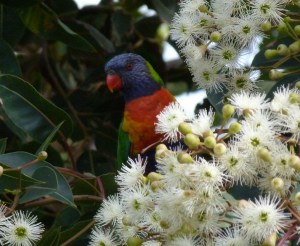
On the edge of the pond there are a few medium sized eucalyptus trees that flower this time of year. They have broad canopies adorned with either cream or coral blossoms and are a favourite destination of the local rainbow lorikeet tribe. As I passed the trees I could hear the raucous screech of feeding birds but the tone seemed a little different to the cacophony of sound that frequently greets me.  A quick glance confirmed that most of these parrots were musk lorikeets with just a smattering of rainbows amongst them.

Rainbow Lorikeet amongst white gum blossoms

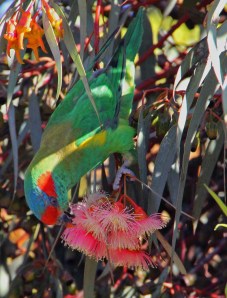
Musk lorikeeets ( Glossopsitta concinna) are medium sized lorikeets between 20-30cms from head to tail. They use their brush tipped tongues to feed on pollen and nectar but will also eat some seeds, fruits and insects. They often travel in flocks and are usually found in dry woodlands where they nest in hollow branches. They are slightly smaller than rainbows and less common in this area.

Musk Lorikeet feeding on coral gum blossoms

I decided that the grebes could wait. And, while I have quite a good collection of rainbow pictures I rarely see more than a few Muskies and the chance to photograph them while feeding does not come along too often. They were endearing little animals to watch as they performed an extraordinary range of acrobatic movements. Sometimes they hung upside down to get their beaks into a bunch of blossoms; at other times they used it as a prehensile tool to climb along spindly branches. Despite their preoccupation with feeding they were still a little nervous and as I moved cautiously around the trees they scattered into the denser parts of the foliage making photography somewhat difficult.

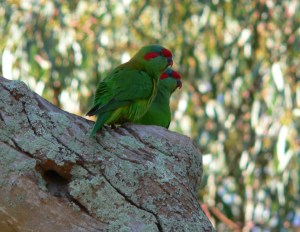
Pair of Musk Lorikeets

I tried sitting quietly in some of the surrounding bushes closer to the pond and using the telephoto on full zoom. An equally unsuccessful manoeuvre, as the birds seemed to rarely feed on the outer blossoms as doing so would probably increase their exposure to local predators like harriers and falcons. Finally I adopted a more professional and scientific approach to the problem; walk slowly, keep shooting and hope for the best.

Musk Lorikeet pair bonding near nest hole

Dozens of frames later, with the light diminishing and more than a few bird droppings adorning my jacket, I left my flock of musk lorikeets to their meal and walked down to the pond for a quick look at the pair of grebes. One was repairing the nest and the other half hidden in the reeds at the edge. Australian Grebe building nest

Another post for another day

Cheers

Baz

← Back

Thank you for your response. ✨