Archive | Adelaide suburbs RSS feed for this section

Wynne Vale Dam Walk

17 Feb

The sulphur crested cockatoos are perched up high in the river gums that surround the dam. Their loud and raucous calls fill the air and drown out the sounds of the other birds that live and feed around the water’s edge. Every few minutes some of the large, white parrots fly down into the acacia bushes that grow along the pathway in search of food. They tear off some of the brown, elongated pods and fly back into the higher branches where they manipulate them with their feet and beaks to extract the seeds.

Acacia pods with seeds exposed

Acacia pods with seeds exposed


Sulphur crested cockatoo eating acacia seeds

Sulphur crested cockatoo eating acacia seeds


Wynne Vale Dam is just a fifteen minute bike ride north of Tea Tree Plaza along the Dry Creek trail which can be easily accessed from the bridge over Ladywood Road near the Modbury Hotel. It is a great way to break up the shopping chores or get some exercise after lunching at one of the nearby hotels and restaurants. The small lake is part of a stormwater reclamation and creek improvement project and is surrounded by a track with viewing platforms, interpretive signs and a sizeable earthen dam on the southern edge.
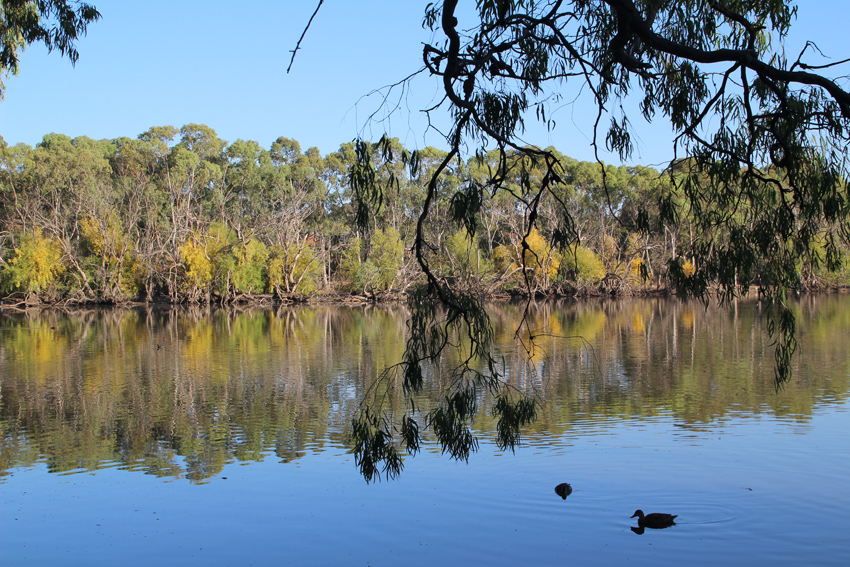
Wynne Vale Dam from the viewing platform

Wynne Vale Dam from the viewing platform


After watching the birds feeding for a few minutes I climb back on my bike and cycle round to the other side of the dam. Leaving the pathway I shift the mountain bike into low gear and pedal along an exposed stretch of the embankment bumping over a tangle of roots that radiate from a stand of partly submerged trees. Their skeletal trunks and branches are the perfect vantage points for a white faced heron to scope out its prey and a freshwater turtle to bask in a patch of early morning sunshine. White faced herons are quite common along the banks but the turtle is a more unusual sighting.

White faced heron survey its kill zone

White faced heron surveys its kill zone


Short necked turtle on a tree branch

Short necked turtle on a partially submerged tree branch


Just as I start to move off to my next location I catch site of a medium sized bird roosting high in one of the old willows that overhang the water. It is a nankeen night heron. Easily recognised by their cinnamon plumage and shorter powerful, beaks these herons tend to stay hidden during the day feeding in the morning, evening and sometimes at night; a behaviour that is referred to as crepuscular.

In the winter months the water level rises considerably covering the embankment

In the winter months the water level rises considerably covering the embankment


Nanakeen night herons feed on aquatic invertebrates and small fish

Nankeen night herons feed on aquatic invertebrates and small fish


After photographing the heron I cycle around the lake once more to make sure that I haven’t missed anything too obvious then head back down the western side of the creek. Where the dam ends and the creek re-emerges there is a line of exceptionally tall river gums. And there, right in my line of vision, are two koalas climbing up into the branches. Koalas, nankeen night herons and a turtle on one short ride. Not a bad morning’s work.

A pair of koalas climbing. Probably an adult fmale and mature joey.

A pair of koalas climbing. Probably an adult female and mature joey.


Thanks for reading this post.

I hope you enjoyed it.

Tell a friend who might be interested.

Cheers

Baz

Marion’s Warraparinga wetlands

24 Jan

Dear Reader:

There is a Kookaburra high in the red river gum near the entrance to the Warraparinga wetlands. It chortles out its laughing call alerting just about every wild creature in the area. However, the main purpose of its famous laugh is proclaiming to other kookaburras whose turf it is and how eligible one is for mating. As I sit and listen I cannot help but wonder what the original people who inhabited this land thought about these iconic Australian birds and the other animals that lived here.

A kookaburra sits in the old gum tree

A kookaburra sits in the old gum tree (click to enlarge all images in this post)


For tens of thousands of years before European settlement the Kaurna people roamed the Adelaide plains and south coast. They used both forest and grasslands to hunt for kangaroos, possums and birds. The creeks and wetlands provided turtles, yabbies and fish. Reeds and other plants were a source of food, medicinal remedies and the raw materials for weaving and building.

A timeline describing aspects of Kaurna culture

A timeline describing aspects of Kaurna culture


 Although Aboriginal peoples used symbols, they never developed writing. Their laws, ideas, family histories and seasonal maps were passed from one generation to the next by a series of stories some of which are referred to as Dreaming Stories and often relate to spirit ancestors. One such story is that of Kulutuwi a young boy who is killed by his stepbrothers and carried to his resting place by his uncle Tjilbruke. It describes how the tears that Tjilbruke shed formed the little creeks along the Fleurieu Peninsula. Warraparinga, which comes from the Kaurna warri parri and means windy place by the river is on Sturt Creek near the start of the Tjilbruke trail in the suburb of Marion. It is a wetland complex and home to the Living Kuarna Cultural Centre which has interpretive displays, an art gallery, performing space and cafe.

The creek flowing freely after summer rain

The creek flowing freely after summer rain


An acrobatic white plumed honeyeater feeding on small insects

An acrobatic white plumed honeyeater feeding on small insects


 Leaving the kookaburra to its vocal gymnastics, I walk through a sculpture garden and down to the creek which is flowing quite swiftly as it has rained heavily in the last week. The rain has also stimulated some plants to flower and there is a healthy population of insects in the bushes and trees. The typical ‘wick wicky’ call alerts me to several white plumed honeyeaters that are energetically picking off lerps and ants high in the tall eucalyptus trees by the water. I spend a good ten minutes trying to get a definitive shot that shows their hunting strategies.

Galah feeding on the ground

Galah feeding on the ground


Rose breasted cockatoo or galah performing beak maintenance duties

Rose breasted cockatoo or galah performing beak maintenance duties


In the same stand of trees both rosellas and cockatoos are sheltering amongst the foliage. The cockies are particularly interesting as they have been feeding on the ground pulling up tubers and searching for seeds then returning to the trees to wipe their beaks on the branches; whether to clean, sharpen or what?…I am not sure.

Reeds by the banks of a small lake help filter out pollutants

Reeds by the banks of a small lake help filter out pollutants


Purple swamp hens are often seen using their huge feet to climb over reeds

Purple swamp hens are often seen using their huge feet to climb over reeds


Eurasian coots are found in Asia, Australia, Africa and Europe

Eurasian coots are found in Asia, Australia, Africa and Europe


 The trail is well defined and leads me past several different ecosystems. One of these is a chain of ponds that are surrounded by reeds. South Australia’s urban wetlands have been developed to help filter storm water run-off and improve the health of our creeks but they also serve as a wonderful habitat for water birds. Eurasian coots, purple swamp hens and dusky moorhens are all feeding close to the reeds and these birds would have been part of the diet of the Kaurna people who hunted along the nearby Sturt Creek.

The lobby of the Living Kaurna Cultural Centre

The lobby of the Living Kaurna Cultural Centre


Having spent a couple of hours exploring the trails and stopping to capture a representative batch of images, I wind up back at the cultural centre for a well earned cup of coffee and a pastry. In the next room there is a wonderful display of indigenous art and a timeline displaying the history of the Kuarna people. It seems a fitting and reflective way to end my first visit to this rather special park in the heart of Adelaide’ southern suburbs.


Until our next adventure

BAZ

Henley Square……Crabs, Coffee and Coastline

13 Jan

Dear Reader:

The morning is warm and still with hardly a breath of wind. Although the water is not as clear as I would have liked it is worth putting on a mask and flippers to explore the shallows alongside the jetty.

Henley jetty on a summer's day

Henley jetty on a summer’s day (click to enlarge all images)


As I swim into the shadows beneath one of the jetty piles I can just make out a school of sizeable bream with a few silver whiting scattered amongst them. They are massing near the wooden posts directly below several fishermen who have empty buckets and a look of ‘no luck today’ on their faces.


School of bream under the  jetty

School of bream under the jetty


The wind is strengthening a little which often stirs up the sand and makes underwater photography challenging to say the least. It is time to switch to macro settings and look for small organisms on the sandy bottom. Numerous furrows snake across the undulating sand like roads through desert dunes. I follow one trail and probe the end point gently with my dive knife to see if I can reveal the perpetrator…no luck. But my digging does annoy a swimmer crab half buried in the sand only an arm’s length away. The little creature immediately strikes an aggressive pose angling up towards me with nippers spread and ready to attack.

Sand crab, note the swimming paddles on the rear legs and the faint furrow in the sand made by a sea snail

Sand crab, note the swimming paddles on the rear legs and the faint furrow in the sand made by a sea snail


Anemone, sea squirt and green algae attached to a jetty pile

Anemone, sea squirt and green algae attached to a jetty pile


I spend a few more minutes exploring the various organisms that cling to the jetty piles. Satisfied with a few close up shots of anemones and sea squirts, I head for the change rooms and outdoor shower to wash off my gear. And then, the all important decision…. which of the beachside al fresco restaurants for coffee and breakfast? Henley Square at the foot of the jetty is one of Adelaide’s favourite beachside haunts where you will invariably find an eclectic collection of walkers, cyclists, fishers and even the odd naturalist; all enjoying the coastal ambience and quality restaurants.

Cafe culture on a sunny morning

Cafe culture on a sunny morning


Coastal strip of dune vegetation including the pine used as vantage point by a nankeen kestrel

Coastal strip of dune vegetation including the pine used as vantage point by a nankeen kestrel


Refuelled and refreshed by my morning dip I walk south along the bikeway that skirts this section of coastline. Between the beach and the path there is a long stretch of low coastal dunes that have been revegetated over the last decade providing an interesting ecosystem that is home to a variety of plant and animal species.

Nankeen kestrel in flight. one of the more common raptors that feeds mainly on ground dwellers but will attack other birds

Nankeen kestrel in flight. one of the more common raptors that feeds mainly on ground dwellers but will attack other birds


Several small groups of sparrows and some honeyeaters are flitting through the foliage but they seem extremely nervous. The reason for their apprehension soon becomes obvious as a nankeen kestrel perches on a tall pine tree to survey its hunting zone. The bird of prey, however, does not go unnoticed by a pair of noisy miners that dive bomb the predator and force it to take to the air again.

Blue bees are a small native species that have a more errtic, zippy flight pattern than common honey bees

Blue bees are a small native species that have a more erratic, zippy flight pattern than common honey bees


A spcies of White butterfly feeding on coastal blooming plants

A species of white butterfly feeding on coastal blooming plants


The temperature is rising and the chance of spotting larger animals diminishing as the day progresses and they seek shelter from the sun. I turn back towards the jetty and focus my attention on the unique coastal plant life and the bees, wasps and butterflies that feed on the various flowering shrubs. Near one of the sandy tracks that lead down to the water a thick stand of acacias, with delicate blue flowering grasses growing amongst them, is attracting native blue bees and several varieties of butterflies. Tricky images to capture as the bees are speedy, erratic little creatures and the butterflies are only landing on the blossoms for a few seconds.

Despite their bulk pelicans are graceful in flight.

Despite their bulk pelicans are graceful in flight.


Australian pelicans have a wingspan of around 2 metres

Australian pelicans have a wingspan of around 2 metres


By the time get back to the square I am ready to sit under one of the square’s cafe umbrellas and sip a long cool drink while watching the locals enjoying another warm South Aussie day at the beach. It’s hot now and time to drive home and sort my pictures. I slip the camera strap over my shoulder ready to leave as one final image presents itself. An Australian pelican glides in low over the water and gracefully deposits itself on one of the jetty light poles and glances in my direction…..thanks!!


Until we chat again

Baz  

Crossing the Creek

30 Nov

Dear Reader:

In my other life I am a teacher and my school has the unique advantage of having a creek running through the centre of the campus neatly dividing us into two quite distinct entities. I say advantage but to those less enamoured by the lure of nature it is seen, more as a barrier; to each their own. Every day I cross the creek on at least a half dozen occasions and every day I see something interesting that I point out to my students in the hope that it might promote a little engagement with the non-digital world. Duelling magpies, mating dragonflies and the occasional brown snake have all been prime time features.

Baz teaching creek studies on the bridge

Baz teaching creek studies on the bridge (click all images on page to enlarge)


Education aside, the creek is a wonderful resource for the people who live in the area and walkers, joggers and cyclists alike use the pathways that run along the banks. Currently, the creek is starting to dry out as spring fades and summer breathes its hot northerly winds across the city. But there is still a diverse mixture of wildlife taking advantage of the receding water. Both black and maned ducks have raised their ducklings in the small pools near the school bridge and chestnut teal with their striking markings are not uncommon.

Black ducks and chestnut teal

Black ducks and chestnut teal


My creek runs through the suburb of Mawson Lakes which has been fashioned around a series of artificial lakes that in themselves are home to various water birds, turtles and huge carp. The central shopping area is a good place to start a walk as it has a nice little cafe overlooking the main stretch of water and the coffee is good. Mawson Lakes is a twenty minute train or bus ride from the city and the train station sits on the northern edge of quite a sizeable expanse of swampy wetland.

Mating dragonflies

Mating dragonflies


The local council have planted bushes and trees along the length of the creek which attract a variety of birds. Rainbow lorikeets seem to be around the area throughout the year with the greatest numbers occurring when the eucalyptus trees are flowering. They provide these raucous little parrots with the nectar, seeds and blossoms that are the bulk of their diet.

Rainbow lorikeet feeding on eucalyptus blossoms

Rainbow lorikeet feeding on eucalyptus blossoms


During my most recent foray across the creek it was large water birds that dominated the reedy watercourse. Ibis and herons are quite common but one of the children rekindled my faith in the observation abilities of twelve year olds when she noticed that one of the ibises had a different shaped beak which it was swinging through the water rather than probing. It turned out to be our first spoonbill for the year.

Spoonbill feeding

Spoonbill feeding


Until our next chat

Baz

A Stroll with a New Camera

1 Nov

Dear Reader:

Like all photographers I enjoy equipment. Every so often I can even justify buying a new camera. With an overseas trip to Italy looming I needed a light compact zoom that would fit easily into my pocket. In truth I had been thinking of getting the same kind of equipment to carry when cycling along the parkland trails that I enjoy each weekend. Too often, I had decided not to take my DSLR or super-zoom because thy were that bit too cumbersome or the weather looked threatening. And on nearly every occasion some exquisite little wildlife moment went un-recorded.

Small lake near McIntyre Rd f3.3 @1  320 sec ISO100, click to enlarge

Small lake near McIntyre Rd; f3.3 @1 320 sec ISO100, click to enlarge all images on this page.

Australan grebe f6.4 @ 1 200th sec ISO  400; click to enlarge

Australian grebe; f6.4 @ 1 200th sec ISO 400


A little compact would serve both purposes and popping a plastic bag in my bike pants (not the lycra variety I assure you) would take care of any wet weather problems. My camera of choice was a Panasonic TZ40, a pocket sized camera with a respectable 20x zoom. They were on special with a new model coming out and my old Pana’ FZ40 had always proved a reliable unit capable of producing some extremely sharp images.

Sacred Ibis reflections f5.9 @ 1 320th sec ISO 100

Sacred Ibis reflections; f5.9 @ 1 320th sec ISO 100

Red flowering gum, f5.9 @1 200 th sec ISO  100

Red flowering gum, f5.9 @1 200 th sec ISO 100


Armed with my new acquisition, I chose some familiar turf to see what the little camera could do. Tea tree Plaza is a large shopping mall on the north eastern fringe of Adelaide’s suburbs. There are some nice cafes to get an early morning ‘cuppa’ before you set off across the adjacent park to intersect Dry creek by the bridge over Montague Road. From there, a network of paths, trails and tracks wind south along the creek towards the coast or north into the foothills.

Rainbow lorikeets examining tree hollow f6.4 @1 125  th sec ISO 250

Rainbow lorikeets examining tree hollow; f6.4 @1 125 th sec ISO 250

Mudlark collecting nesting material;  f2.9 @ 1 125th sec ISO 400

Mudlark collecting nesting material; f2.9 @ 1 125th sec ISO 400


I decided to take the southern bike trail that follows the creek down to McIntyre road then work my way back to the bridge along the bush tracks that hug the other side of the waterway; a nice journey of around 3kms that includes several small lakes, patches of quite dense scrub and some towering old river gums.

Maned duck with chicks;   f5.6 @ 1 80sec ISO 160

Maned duck with chicks; f5.6 @ 1 80sec ISO 160

Black duck taking off;  f6.4  @1 250 th sec ISO 100

Black duck taking off; f6.4 @1 250th sec ISO 100


In this post, I will not describe each particular wildlife encounter, instead the pictures and brief captions can tell the story. There was a little post image tidying up through Photoshop but in my humble opinion the little camera did a good job as a backup and will certainly sit in my pocket on many a bike ride or travel adventure in the future.


Until our next chat

Cheers

Baz  

Wildlife and Pub Food at the Port

25 Oct

Dear Reader;

It is a mild spring afternoon and there is barely a breath of wind to ruffle the waters of the inner harbour. A pair of sooty oyster catchers are foraging between the exposed rocks on the southern embankment. They are using their powerful blade-like beaks to prise shellfish from the rocks and dig in the sand for worms and crabs. The bright red beaks and eyes look like they have been painted by an artist with an exaggerated disposition for contrast.

IMG_4312

Sooty oyster catchers foraging at low tide (click on all images to enlarge)

IMG_4326

Soon to be lunch


I am walking around the wharves and shoreline of Port Adelaide. Originally nicknamed Port Misery by the early settlers who came ashore amongst the mangroves, mud and mosquitoes that once dominated the area; the Port has undergone many changes. Once a lively harbour that berthed dozens of ships delivering the provisions to establish a new colony; it is now a quieter, quayside community. People now come to the Port from the city, just 15 minutes away, to visit the maritime museum, shop at the weekend markets or go for a cruise along the Port River to catch sight of the world’s only urban dolphin pod.

IMG_4337

Dolphin cruise ship moored at the wharf


From the foreshore I walk past the pub and on to the old Birkenhead Bridge, the first bascule or lifting bridge in Australia. Glancing down at the old jarrah poles, driven hard into the river bed where they once stood as moorings, I notice that several silver gulls have chosen the iron clad posts as nesting sites. Every so often one of the birds lifts off its scruffy nest and checks the eggs, sometimes giving one a little push with its beak, perhaps to keep the distribution of heat even.

P1060700

Nesting silver gull

P1060692

Silver gull adjusting egg position


I watch the birds for half an hour. While one sits on the nest the other flies off in search of food further along the shoreline amongst the same rocks the oystercatchers were exploring just a little while ago. The foraging gull tugs on the end of a tube worm protruding from the fine sand and mud. It is about to extract the hapless invertebrate when a mudlark, usually a woodland species, emerges from a clump of nearby bushes and relieves the seabird of its prize.

IMG_4342

Mudlark feeding along the shoreline


Like the gull and mudlark I figure it’s about time for lunch and head for the Birkenhead Tavern and one of the best chicken schnitzels the Port has to offer.

the pub

Birkenhead tavern

Sorry, only one post this month!!!!!

Have been travelling overseas

Until next time

Cheers

Baz

A Bite at Grange

19 Sep

Dear Reader:

A lone silver gull is flying parallel to the shore just above the Norfolk pines that grow along the Grange beach front. Suddenly it veers off course, dipping towards one of the trees and letting out a loud, raucous shriek. This unusual behaviour encourages me to stop and take a closer look through the telephoto lens. And there, perched serenely on the topmost branch is a beautiful nankeen kestrel surveying its stretch of prime coastal real estate.

Nankeen kestrel looking for prey

Nankeen kestrel looking for prey (click all images to enlarge)


Nankeen kestrels are small falcons that are widely distributed across the country. They usually live in rural or outback regions where they hover over fields and open bushland preying on small mammals, reptiles and occasionally taking birds in the air; which explains the gull’s nervous disposition. Seeing one in an urban area is a really quite unusual. For the next half an hour I follow the raptor as it patrols the shoreline and dunes moving from tree tops to fence posts to survey its territory.

The Marines, beachside heritage homes

The Marines, beachside heritage homes


Grange Beach is just 15 minutes from the centre of Adelaide. An old wooden jetty, classic golden sands and heritage buildings make it an ideal place to go for a walk and grab a bite to eat summer or winter! A walking &cycling trail passes through the area winding between the seafront properties and coastal revegetation zones providing a unique blend natural and urban habitats that encourages a wide variety of wildlife.

Spotted dove

Spotted dove

Singing honeyeater in coastal scrub

Singing honeyeater in coastal scrub

The unfortunately named pigface

The unfortunately named pigface


After watching the kestrels I follow the track south. The delicate shrubs and grasses that stabilise the dunes are home to many different bird species from common house sparrows to spotted doves and singing honeyeaters. Although it is a coolish day and the insect life is in short supply a few bees and butterflies are congregating around some early blooming pigface, a common succulent in the dunes.

Grange jetty at low tide showing worm casing encrustaceans

Grange jetty at low tide showing worm casing encrustaceans


For a little variety I walk back along the beach. The tide is out exposing concrete-like encrustations of tube worms cemented to the jetty piles. A track leads from the beach to the old kiosk which is now a fashionable restaurant. My day ends with a glass of white, salt and pepper squid with sautéed scallops in the shell accompanied by a generous serve of crusty bread.

Grange Kiosk

Grange Kiosk


Until our next adventure

Baz          

I Wonder What the Neighbours are Doing?

11 Sep

Dear Reader:

It is a cool, early spring afternoon. I can hear annoyingly cheerful birds singing in the white cedars that line my street but I am bored stupid. Home from work with a cold but certainly not sick enough to stay in bed. What to do? Going for a walk along the beach or up in the hills would be foolish and daytime television is just one step above poking my eyes with a sharp stick. Decision made! I shall stroll up to the main road, pick up a magazine and have a cup of coffee with an inordinately unhealthy pastry at one the cosy little cafés that are dotted along Prospect Road.

IMG_4175

A mudlark finds grubs in the gutter (click all images to enlarge)


I am halfway through the door when I stop and think that it might be worth taking the camera along, though the chance of seeing something unexpected on a quiet suburban street at midday; is not very likely. It turns out that I am quite mistaken and my two hundred metre walk to the main drag is filled with interesting moments.

IMG_4174

Rainbow lorikeet feeding on a late flowering gum


First encounter; a pair of rainbow lorikeets are alternately feeding on a late flowering gum and taking turns to performs some trade-like renovations on a hollow branch in a nearby cedar. One of the parrots uses its powerful, curved beak to scour the edge of the entrance while the other pops in out and removing old bits of nest lining. They seem quite oblivious to my presence and allow me to get quite close.

IMG_4185

Rainbow lorikeets house hunting


I leave the rainbows to their reno-project and move further up the street. A Murray magpie is sorting its way through the leaf litter and other detritus deposited in the gutters by recent rains. Every so often it stops, cocks its head to one side and gulps down a worm or bug. Ironically, there is a classic white backed magpie sitting on the power line above watching its little namesake. Despite their titles, the two species are unrelated and it is only their colouring that encouraged early settlers to name the birds after the black and white European magpies. Although it is a large imposing bird this particular magpie has a serious handicap which is revealed when I take a look at its magnified image on the viewfinder. The powerful beak has been badly damaged making both feeding and defence a ‘tough ask’.

A busted beak makes life on the streets tough

A busted beak makes life on the streets tough


Even the cafe has its wildlife component as a squadron of New Holland honeyeaters perched in a courtyard tree argue over territory with the ever present miner birds and several sparrows and pigeons patrol beneath the tables in search of crumbs. But the standouts are still the rainbows and their nesting antics, which simply confirmed an unwritten rule that every wildlife photographer knows; take your camera, something will almost always surprise you.

IMG_1446

Juvenile miner bird watching out for new Holland honeyeaters


Until our next chat

Baz

Burnside’s Hidden Creek

6 May

Dear Reader: 

The wattle bird seems to be totally absorbed and indifferent to my presence as it feeds on the tiny white lerps that dot the leaves of a creek-side eucalyptus tree. Usually these large members of the honeyeater group are quite nervous and hard to approach. This one, however, is determined to provide me with a ringside display of its acrobatic ability as it hangs upside down and hops from branch to flimsy branch in pursuit of its lunch. The tiny white lerps look like an arborial version of measles. In fact they are the early stage of a parasitic bug called a psyllid, an introduced insect pest that sucks the ‘juice’ from the trees.

A wattle bird pecks tiny insects from the leaves of a blue gum near the river bank

A wattle bird pecks tiny insects from the leaves of a blue gum near the river bank.


I am walking along the banks of second creek in the Michael Perry Botanical Reserve. This charming little park is easily accessed from a small lane called Andrew’s Walk at the southern end of Hallet Road, in the hills face suburb of Burnside. The shady banks, trickling stream and little ponds have a European flavour to them affording a cool retreat in the drier summer months. Before setting off on my short walk to investigate the creek’s wildlife I made a couple of crucial stops to provision my pack for a bite to eat on the river bank. At the nearby Stoneyfell Winery I found a fine bottle of white while ‘Taylor Blend’, a fashionable little eastern suburbs coffee shop on Hallett Road, provided a wide selection of gourmet paninis and local beesting cake. When one has to sit by a river bank for an hour or so to wait for the wildlife it might as well be done in style.

The brook cascades over a small ford made from slate and sandstone rocks

The brook cascades over a small ford made from slate and sandstone rocks


Leaving the wattle birds to finish their meal I work my way along the creek, pausing frequently to try and catch sight of the small birds that I can hear chirping and rustling deep in the cover of the reed beds. Without warning a grey faced heron explodes from the tangle of branches a couple of metres in front of me. The birds wheels in flight and settles on a branch high in a nearby pine tree where it can keep a sharp eye on its human intruder. As I point the camera at the perching water bird I catch site of a pair of Kookaburras in a huge eucalypt further up the opposite embankment. Two predatory birds; now it’s time to take a look for the prey animals that sustain them.

A white faced heron watches the creek from its vantage point in a pine tree

A white faced heron watches the creek from its vantage point in a pine tree


The first interesting small animal that I notice is a water skink which is sunning itself on a log. Being mid autumn I am surprised to see a reptile as most would now be ‘dug in’ for the winter months ahead. As I sit quietly and prepare to watch the lizard, a green eyed dragonfly lands on a boulder in the middle of the creek. And, where the water has formed a small clear pool I can see tiny fish or tadpoles swimming close the reeds and water striders skating across the surface: like my lunch, a gourmet larder for a range of feathered predators.

A water skink basking on a log amongst the reeds

A water skink basking on a log amongst the reeds

A dragonfly pauses for a moment on a warm rock in the creek

A dragonfly pauses for a moment on a warm rock in the creek


A fence marks the end of the reserve and I cross the creek to return on the northern bank. The tiny reed birds still elude me but in a shady stretch of water a single black duck is swimming against the current as it dabbles for food. A common enough species in southern Australia but the light is particularly good and on reviewing the shot it seems to encapsulate the mood of this lovely little waterway.

Black duck are common along the waterway

Black duck are common along the waterway


Until the next time

Baz