Archive | Adelaide’s parklands RSS feed for this section

Adelaide’s Frome Road Bikeway

16 Aug

Adelaide’s Frome Road Bikeway 

Dear reader:

One of my favourite bike rides starts in north Adelaide at the junction of Barton and LeFevre Terraces. From the roundabout, a dedicated bike lane follows Le Fevre Terrace which is flanked by open parklands on one side and lovely colonial homes on the other. For the marginally more adventurous, there are several paths through the park that run almost parallel to the road. Noisy miners, honeyeaters, magpies and lorikeets are common here and in the evening you might see brush-tailed possums in the trees.

miner bird5

Noisy miners are a species of honeyeater

1

Nice little house with a good view of the parklands


The bike lane curves down towards the city through more parklands and playing fields. Huge Moreton Bay Fig Trees dominate the parklands providing a vantage point for both rose breasted and sulphur crested cockatoos that often fly down to the grass in search of food.

2a

Galahs having a bite to eat


Just over the Frome Road Bridge, Adelaide Zoo’s classic entrance marks the end of the parklands. Tucked between the zoo and the Botanic Gardens there is a stand of huge pine trees. Look up and it’s hard not to notice a large colony of fruit bats (flying foxes) that call these trees home.

2b

Entrance to the zoo

2c

Fruit bats in the trees


After the zoo there is a well marked bike lane that runs up Frome Road past the medical school and hospital. The lush lawns around these buildings are a favourite haunt of Sacred Ibises that probe the soft ground with their long curved beaks in search of worms and grubs.

12

View of the Torrens from the Frome Road Bridge


3

Sacred ibises feeding


As Frome Road crosses North Terrace you enter a purely urban environment with a wide bikeway that cuts all the way across the city towards the southern parklands. This charming region of the city has many unique little houses and flats decorated with native plantings providing a rich urban ecosystem that supports common bird species such as sparrows, blackbirds and magpies.

10

Magpies carolling in an urban environment

11

Stopping for a coffee along the way


The bikeway finally emerges at the Himeji Japanese Gardens. These gardens are dedicated to Adelaide’s sister city on the Japanese island of Honshu. In keeping with the rest of Adelaide’s green belt parklands the signage also relates to the aboriginal heritage of the area. Rosellas and lorikeets are common inhabitants in the ancient eucalypts that characterise this southern edge of the city.

5

Japanese garden

6

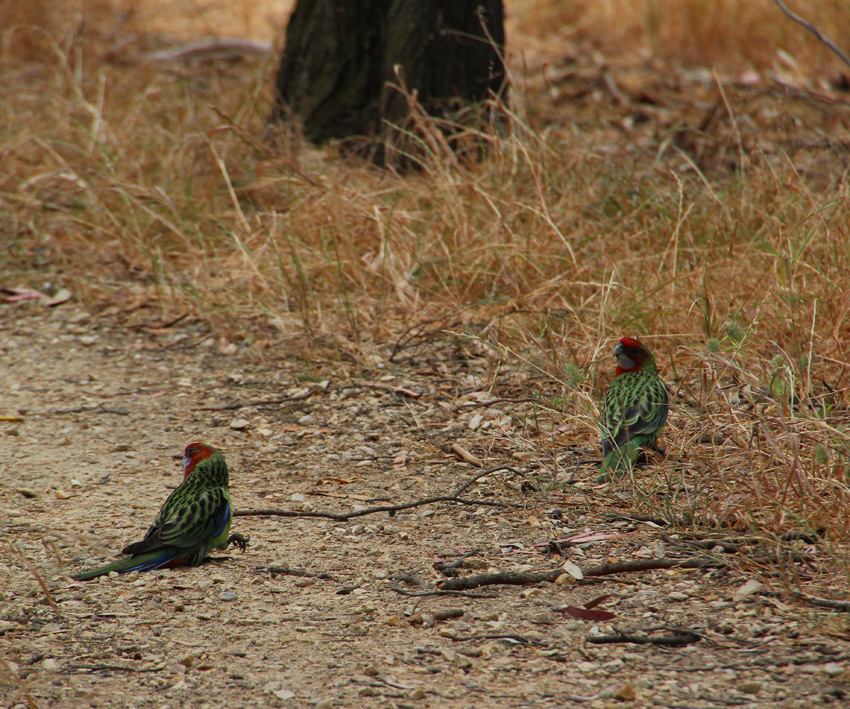
White cheeked eastern roesella


From the Japanese Gardens there are bike paths that meander through all of the southern parks but their wildlife and charms will be the subject of a further post in the warmer months to come.


Cheers

Baz

Brougham Park on a Winter’s Afternoon

7 Jun

Dear Reader:

It is late in the afternoon and a bit on the chilly side. Grey skies and showers have alternated all day with patches of blue and occasional bursts of sunshine through the clouds. My car is parked in O’Connell Street where I am meeting friends in an hour for a bite to eat then a movie at the art deco Piccadilly Theatre. Typically, and despite the weather, I have arrived a tad early with camera in hand, hoping that I might encounter a little urban wildlife.

O'Connell street has a woderful collectionof cafes and restaurants

O’Connell street has a woderful collectionof cafes and restaurants


At the end of O’Connell St the road curves down into the city through a little patch of parkland. Asphalt paths cross this little green oasis which is dotted with tall eucalypts, pines and several large Moreton Bay Figs. I can hear parrots calling in the tree tops and eventually I spot a rainbow lorikeet shuffling along a branch high in the crown of one of them. With a flourish of feathers, a second bird appears and the parrots start to preen and gently peck at each other. They seem to be a mating pair settling in for the night. Nearby a lone eastern rosella appears to be looking on with a touch of sad envy…anthropomorphic, I know.

Just dropped in to say Hi

Just dropped in to say Hi

A lone eastern rosella sillhouetted against the late afternoon sky

A lone eastern rosella sillhouetted against the late afternoon sky


I sit and watch the birds for a few minutes while scanning the rest of the tree with my telephoto lens when I notice the furry coat of a possum wedged in a hollow. I toss a couple of pebbles against the branch. The brown patch moves and a tail appears for a second as the owner moves further into the tree; definitely a possum, probably a brush tail as they are far more common than their ring tail cousins.

Daytime view of a brushtail possum

Daytime view of a brushtail possum

Parkland possums forage at night

Parkland possums forage at night


On the eastern side of the park the imposing facade of the Brougham Place Uniting Church is framed by the massive leaves of an old fig tree. There are birds flitting though the foliage but in the afternoon shadows it is impossible to identify, let alone photograph them.

Brougham Place Uniting Church across park

Brougham Place Uniting Church across park


Before heading back up to my parked car I walk further down Brougham Place alongside a red brick wall that cordons off one of the area’s classic old mansions. A tangle of olive tree branches straddle the top of the wall and deep in their shadows a pair of crested pigeons are finding a sheltered place to roost.

Classic homes and businesses surround the park

Classic homes and businesses surround the park

Crested pigeons in olive tree

Crested pigeons in olive tree

Even on a cloudy winter’s afternoon, Adelaide has yet again delivered a memorable wildlife experience; a fascinating and ever-changing urban ecosystem available to anyone who takes a few moments out of their busy day to stop and look.


Thanks for reading my work

Cheers

Baz

North Adelaide……the lion circuit

8 May

Dear Reader:

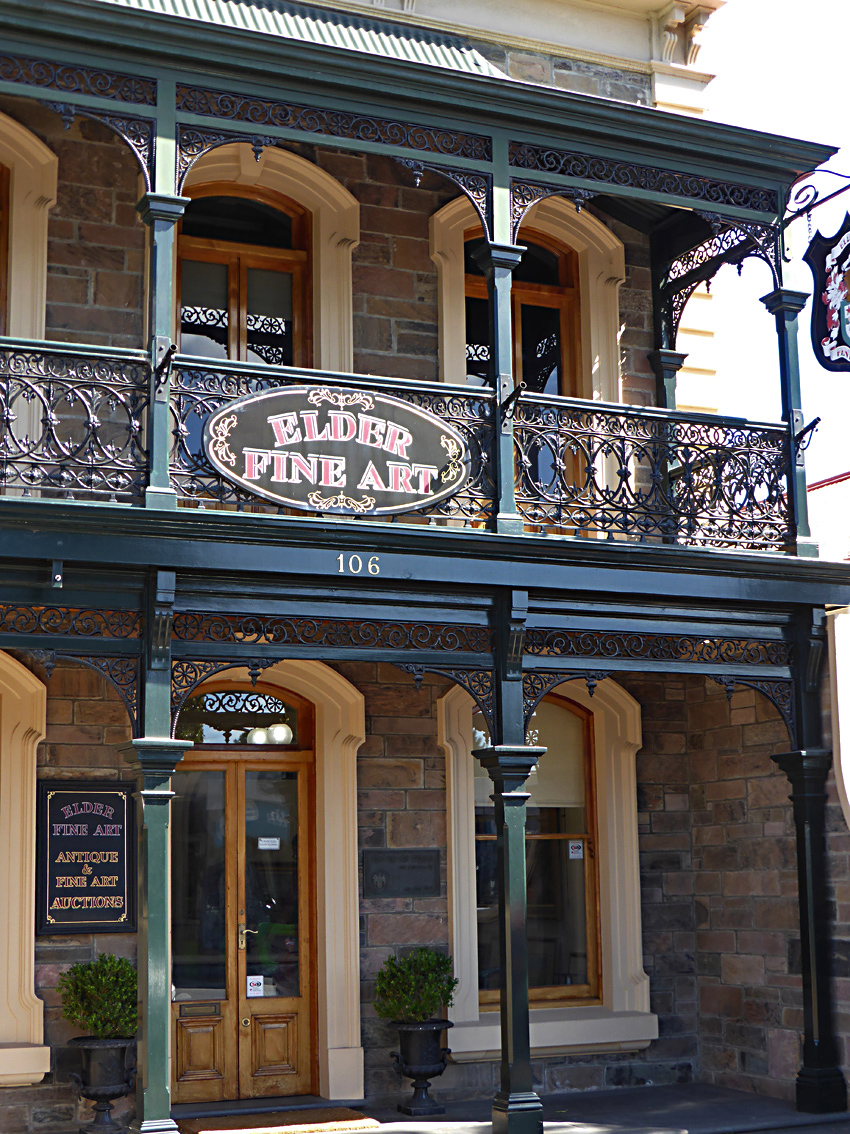
It is a mild sunny morning and I am enjoying one of my favourite bike rides. Starting at The Lion Hotel I ride away from the city along Melbourne Street to the Park Terrace intersection. The street is an eclectic mixture of cafes and niche retailers selling anything from clothes to antiques and Persian rugs.

2

Classic old building converted into shops and galleries


Crossing Park terrace I wind my way through narrow streets and past some lovely old homes to intersect the path that runs alongside the Torrens River before it hits the city proper. The river has cut a narrow gorge through the ochre coloured rocks and tall eucalypts dominate the trail. A pair of rainbow lorikeets is fussing around a nesting hole and one bird takes flight as I dismount to take a closer look.

P1030399

Rainbow lorikeets nesting


A wooden boardwalk descends towards the river and the weir that controls the water flow. Common pigeons can often be seen foraging along the steep hillside early in the mornings. I think that the clay might supplement their diet and aid digestion.

5

Boardwalk trail along the river


6

Common pigeon feeding on cliff-side


Where the walkway levels out a small bridge splits the trail with one path leading back into the city and the other north east to the foothills. I head for the city. The track is flatter here and I pass numerous joggers and other cyclists all enjoying the fine weather.

7

Foot and cycle crossing near St Peters


4

Large dragonfly resting in a bottle brush near the river bank


Just past the little foot bridge the path sweeps under the much larger Hackney Road Bridge that carries the majority of traffic into the eastern side of the city. Here, the river widens, slows and becomes the Torrens Lake. As if to herald the change, a graceful snowy egret stands sentinel-like amongst the reeds watching for prey. Further along the waterway, a great cormorant perches close by with similar intent. These larger predatory water birds seem to indicate a greater abundance of prey in the lake.

8

Signage explains Aboriginal connections and other historical facts


9

Great Cormorant perching on the lake behind the zoo


egret edit

Egret hunting in reeds


Although the path follows the lake right along the northern edge of the city, I only ride a couple of hundred metres further to the Frome Road Bridge. Pausing briefly to take in the view of the lake, city and zoo from the top of the bridge, I turn right and head past the playing fields riding parallel to Mackinnon Parade through an avenue of massive, stately eucalypts. Cyclists, joggers and football players of all codes share this green space with cockatoos and other parrots that squawk in the trees and feed in the grass.

10

Cockatoo foraging on the oval near McKinnon Parade


Left near the end of the tree line and I’m back where I started and ready for coffee or breakfast at The Lion.

1

Back at The Lion


A brilliant way to spend the morning!!

Try it some time!!!

Cheers

Baz

A Morning at the Zoo with Quinn

27 Feb

Dear reader: 

It is a warm Adelaide morning and the shady paths of the zoo are a labyrinth of intrigue for a nearly three year old. Around every turn there is a new enclosure full of sights, sounds and animals that she had only previously experienced in picture books.

7

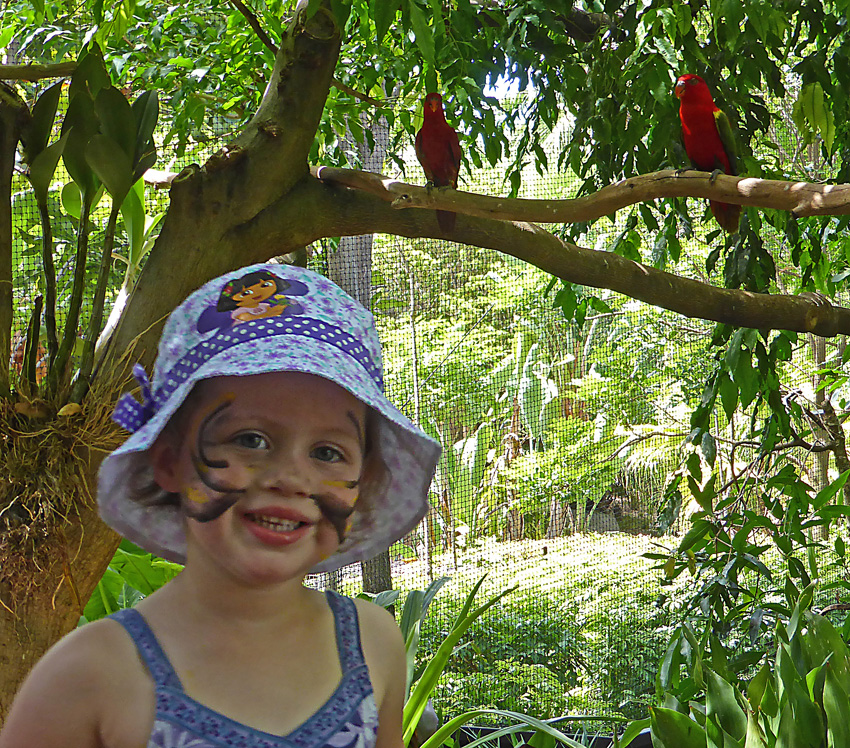
A pair of king parrots provide a suitable backdrop for a tiger striped Quinn


3

The zoo is situated by the river just over the Frome Road Bridge


A misty spray of water shrouds the koala and Tasmanian devil enclosures in anticipation of the midday heat. It proves irresistible to our little granddaughter and sends her squealing down the path shouting, “bear, bear, bear!” I stand and watch the ‘really not bears’ as they stoically munch on eucalyptus leaves and fire off a couple of frames. Sometimes the images that can be taken in a zoo are invaluable additions for later projects.

1

A koala chews on eucalyptus leaves that would be inedible even toxic to any other species of marsupial


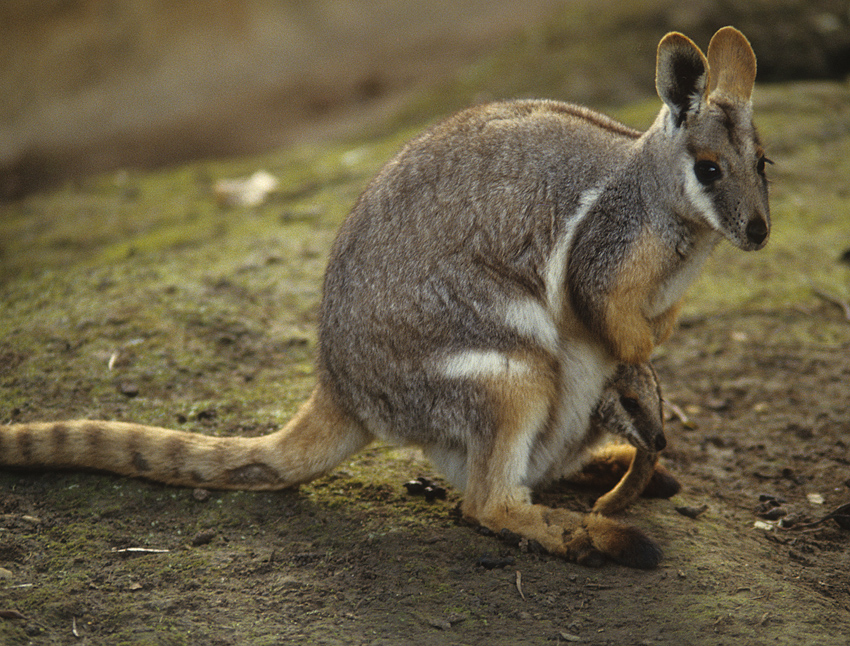
Half a vegemite sandwich and an ice cream later a little hand tugs mine and a voice whispers, “ Pop, kangaroo”. She is almost right, as a pair of yellow footed rock wallabies emerge from behind a tree in an open enclosure a few metres away. One of the little marsupials has a joey in its pouch; a difficult image for any photographer to catch in the wild.

6

A young yellow footed rock wallaby peering out from the safety of its mother’s pouch


The nocturnal house proves to be a real challenge. Try telling a toddler to be quiet as she goes through a dark tunnel lined with glass exhibits featuring bats and other night time wildlife. Near the entrance there are some aquariums which she finds quite fascinating (translate as…actually stops moving for a few seconds) giving me the opportunity to photograph some purple spotted gudgeons, one of our threatened native fish species. Yet another example of the pictorial opportunities that only captive animals can provide the amateur photographer.

2 purple spotted gudgeon

Purple spotted gudgeon are found in South Australia’s freshwater streams and lakes


Ironically, our final wildlife moment is not one that the Royal Zoological Society can claim credit for. Just as we are leaving and wandering past the hippos, Nan’s favourite exotic animal, we hear a family excitedly chattering about a spider. And there, strung in front of the hippo pool is last night’s tattered web of a sizeable orb weaver with the resident arachnid devouring a hapless dragonfly. Quinn says “yuck”, Nan scoops her up and I click away merrily wishing that I had brought the DSLR instead of popping the point and shoot in my pocket to ensure hands free, child minding capabilities.

4

A large orb weaver makes short work of an unfortunate dragonfly


By now the temperature is getting into the mid thirties and it is time to leave. She does not want to go. “More animals Pop.” A good sign for the future.


Cheers

Baz (and Quinn)

Marion’s Warraparinga wetlands

24 Jan

Dear Reader:

There is a Kookaburra high in the red river gum near the entrance to the Warraparinga wetlands. It chortles out its laughing call alerting just about every wild creature in the area. However, the main purpose of its famous laugh is proclaiming to other kookaburras whose turf it is and how eligible one is for mating. As I sit and listen I cannot help but wonder what the original people who inhabited this land thought about these iconic Australian birds and the other animals that lived here.

A kookaburra sits in the old gum tree

A kookaburra sits in the old gum tree (click to enlarge all images in this post)


For tens of thousands of years before European settlement the Kaurna people roamed the Adelaide plains and south coast. They used both forest and grasslands to hunt for kangaroos, possums and birds. The creeks and wetlands provided turtles, yabbies and fish. Reeds and other plants were a source of food, medicinal remedies and the raw materials for weaving and building.

A timeline describing aspects of Kaurna culture

A timeline describing aspects of Kaurna culture


 Although Aboriginal peoples used symbols, they never developed writing. Their laws, ideas, family histories and seasonal maps were passed from one generation to the next by a series of stories some of which are referred to as Dreaming Stories and often relate to spirit ancestors. One such story is that of Kulutuwi a young boy who is killed by his stepbrothers and carried to his resting place by his uncle Tjilbruke. It describes how the tears that Tjilbruke shed formed the little creeks along the Fleurieu Peninsula. Warraparinga, which comes from the Kaurna warri parri and means windy place by the river is on Sturt Creek near the start of the Tjilbruke trail in the suburb of Marion. It is a wetland complex and home to the Living Kuarna Cultural Centre which has interpretive displays, an art gallery, performing space and cafe.

The creek flowing freely after summer rain

The creek flowing freely after summer rain


An acrobatic white plumed honeyeater feeding on small insects

An acrobatic white plumed honeyeater feeding on small insects


 Leaving the kookaburra to its vocal gymnastics, I walk through a sculpture garden and down to the creek which is flowing quite swiftly as it has rained heavily in the last week. The rain has also stimulated some plants to flower and there is a healthy population of insects in the bushes and trees. The typical ‘wick wicky’ call alerts me to several white plumed honeyeaters that are energetically picking off lerps and ants high in the tall eucalyptus trees by the water. I spend a good ten minutes trying to get a definitive shot that shows their hunting strategies.

Galah feeding on the ground

Galah feeding on the ground


Rose breasted cockatoo or galah performing beak maintenance duties

Rose breasted cockatoo or galah performing beak maintenance duties


In the same stand of trees both rosellas and cockatoos are sheltering amongst the foliage. The cockies are particularly interesting as they have been feeding on the ground pulling up tubers and searching for seeds then returning to the trees to wipe their beaks on the branches; whether to clean, sharpen or what?…I am not sure.

Reeds by the banks of a small lake help filter out pollutants

Reeds by the banks of a small lake help filter out pollutants


Purple swamp hens are often seen using their huge feet to climb over reeds

Purple swamp hens are often seen using their huge feet to climb over reeds


Eurasian coots are found in Asia, Australia, Africa and Europe

Eurasian coots are found in Asia, Australia, Africa and Europe


 The trail is well defined and leads me past several different ecosystems. One of these is a chain of ponds that are surrounded by reeds. South Australia’s urban wetlands have been developed to help filter storm water run-off and improve the health of our creeks but they also serve as a wonderful habitat for water birds. Eurasian coots, purple swamp hens and dusky moorhens are all feeding close to the reeds and these birds would have been part of the diet of the Kaurna people who hunted along the nearby Sturt Creek.

The lobby of the Living Kaurna Cultural Centre

The lobby of the Living Kaurna Cultural Centre


Having spent a couple of hours exploring the trails and stopping to capture a representative batch of images, I wind up back at the cultural centre for a well earned cup of coffee and a pastry. In the next room there is a wonderful display of indigenous art and a timeline displaying the history of the Kuarna people. It seems a fitting and reflective way to end my first visit to this rather special park in the heart of Adelaide’ southern suburbs.


Until our next adventure

BAZ

An Island in the Lake

17 Dec

Dear Reader:

Sunday morning is for bike riding. A time to drop my little point and shoot into the non-lycra shorts, haul the mountain bike out of the shed, and cycle through Adelaide’s extensive parklands or along the linear park trail which follows the Torrens River.

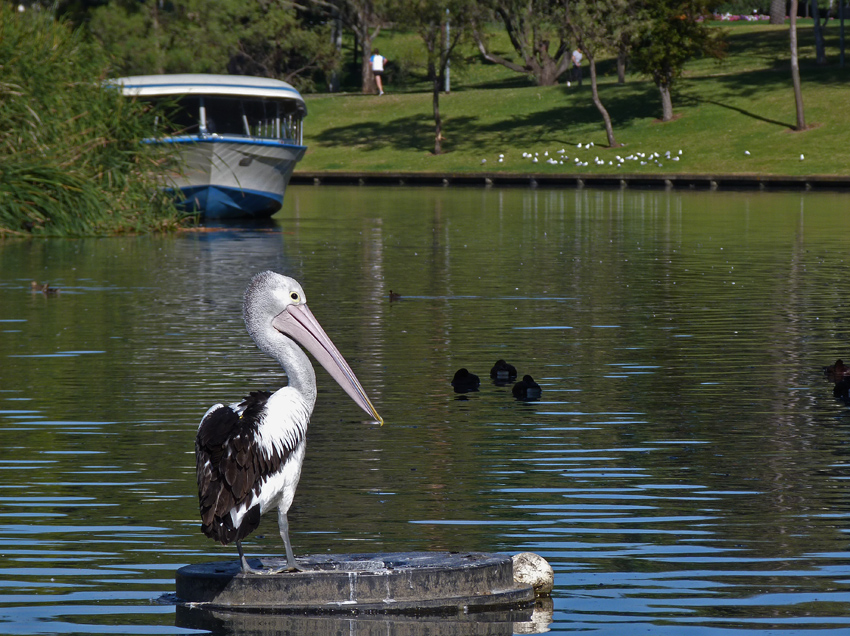
Torrens lake with Popeye and pelican

Torrens lake with Popeye and pelican (click to enlarge all images on this page)

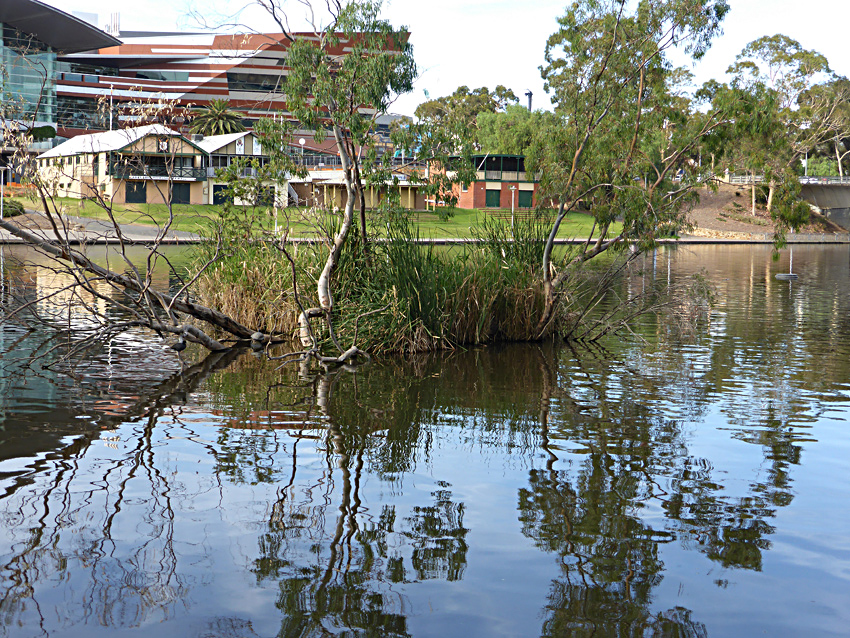
On this particular morning I thought it would be nice to ride around the Torrens Lake which sits on the northern edge of the city by the picturesque Adelaide oval. There is always a wide variety of wildlife on the banks of the lake and my long-time photographic adversary, the water rat, can sometimes be found near the tiny island opposite the paddle boats. In fact, on my last excursion around the lake I caught sight of one of the elusive little rodents paddling into the reeds that form the bulk of this tiny refuge.

Island with convention centre in the background

Island with convention centre in the background

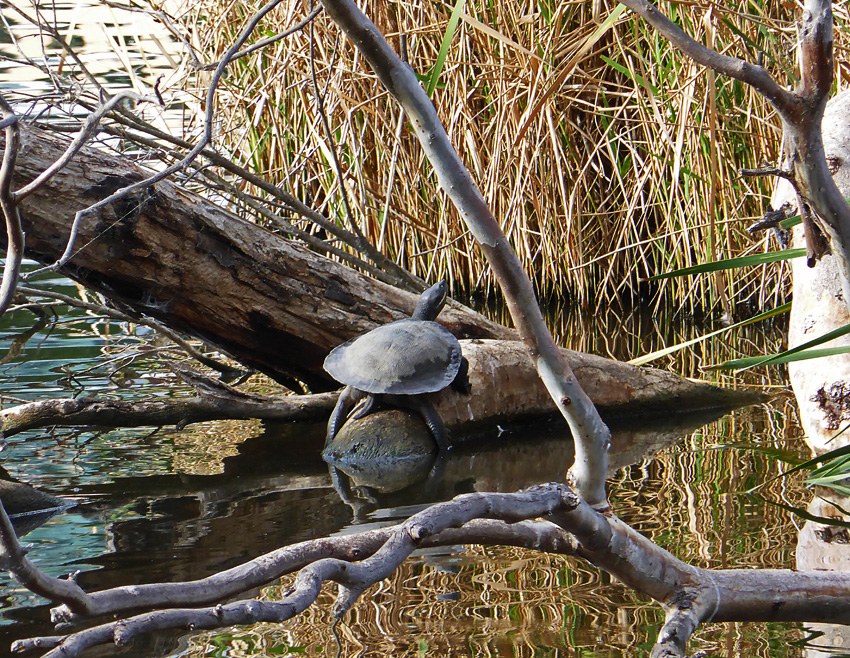
Unfortunately my journey past the island yielded no results on the water rat front but it did turn up a couple of quite unexpected visitors; a pair of nesting mudlarks with fully fledged young and a long necked turtle basking on a partially submerged tree branch. However, as the island is a good 40 metres from the bank and the targets fairly small, capturing good, clear images was always going to be a problem. Nevertheless, I fired off a series of shots as the birds and certainly the turtle might be gone before I could return later in the day armed with a DSLR and long lens.

Snake neck turtle basking

Snake neck turtle basking

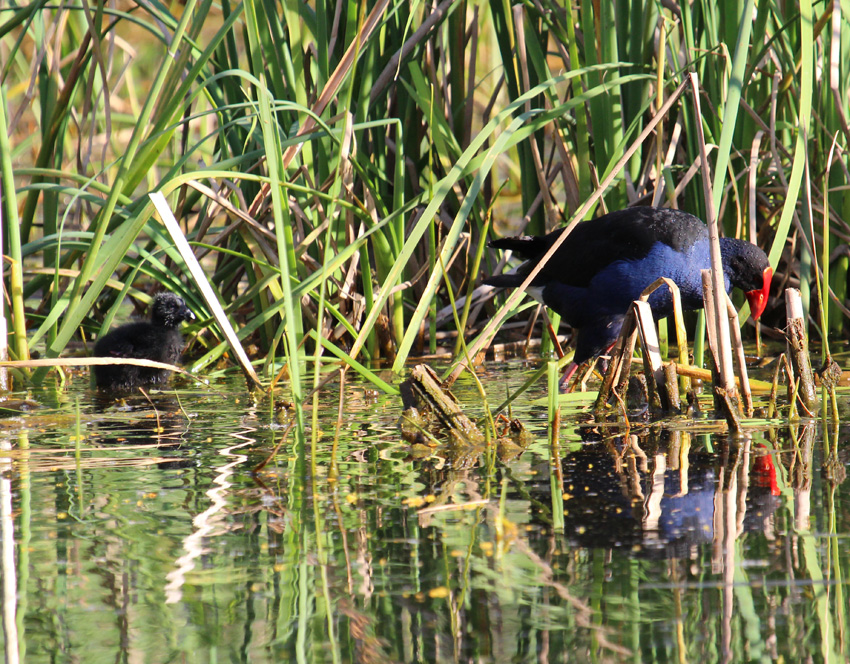
Several hours later, in somewhat overcast conditions, I parked my car by the weir alongside the golf course and iconic Red Ochre restaurant at the northern end of Memorial Drive and walked along the path towards the little island. The banks along this part of the lake are thick with tall reeds and both purple swamp hens and dusky moorhens use them for shelter and nest building materials.

Purple swamp hen with chick near reed bed

Purple swamp hen with chick near reed bed

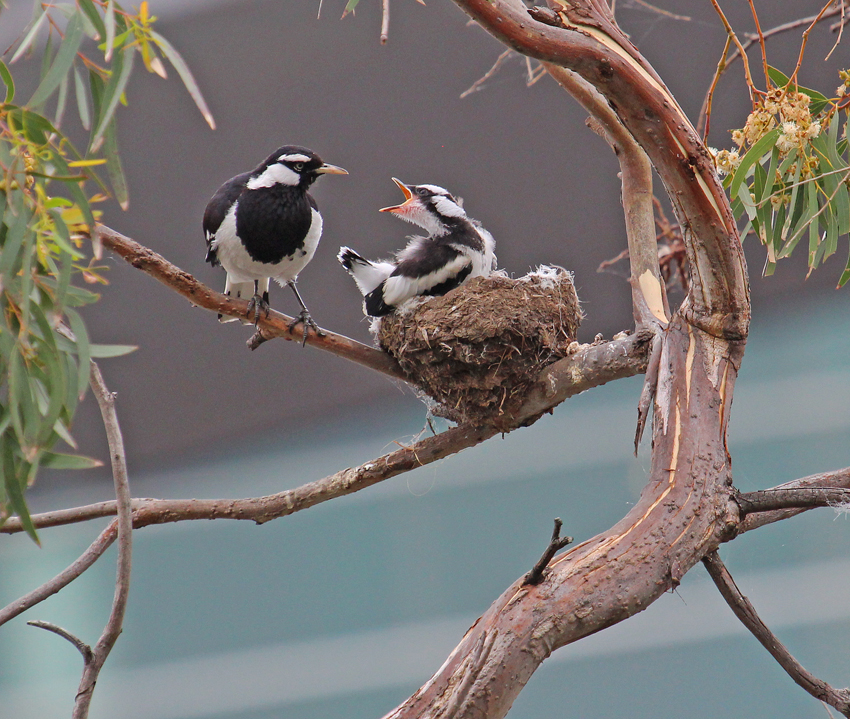
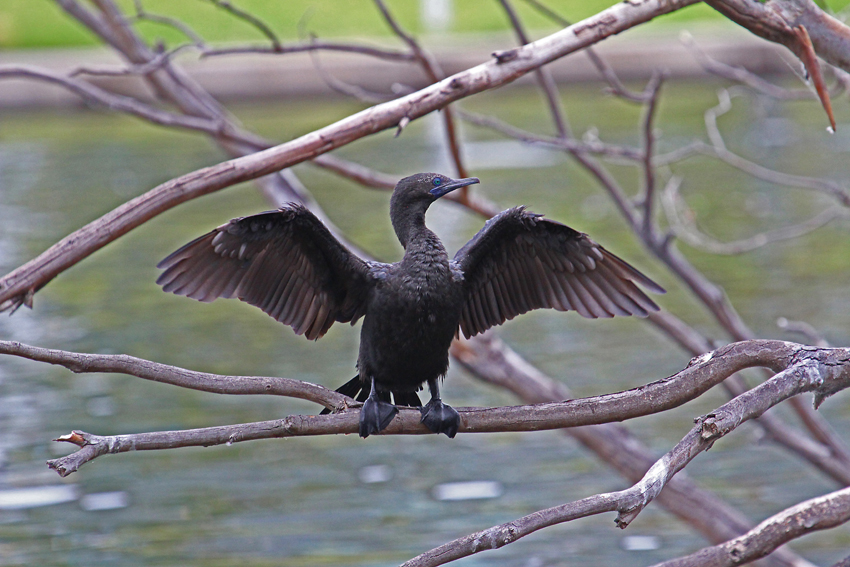
Despite many distractions, I finally reached the section of bank opposite the island and set about photographing the magpie family. The adults were fossicking for grubs in the muddy banks close to where I was sitting and feeding the young as they squawked for food in the crowded nest. Below the nest, a pair of black cormorants perched delicately on a dead branch stretching out the­­ir wings to dry after hunting carp in the lake.

More please

More please


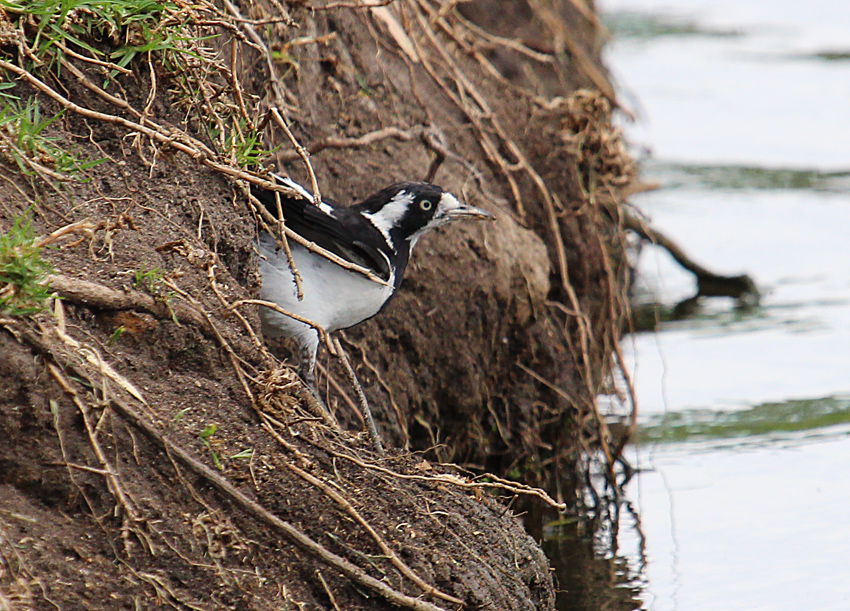
Mudlark or Murray magpie forging in the bank for grubs to feed young

Mudlark or Murray magpie forging in the bank for grubs to feed young


Little black cormorant drying wings

Little black cormorant drying wings

After about 30 minutes, a large black swan that had been cropping the grass nearby waddled over to keep me company. Swans can be aggressive and this one certainly had something in mind as it settled no more than a metre away and glared at me intently. Over the years I have often observed large groups of birds congregating around a local personality who       I refer to as John Swan. He does not feed them but simply spends time with the birds; perhaps this particular swan mistook me quietly sitting on the bank for John. Finally the swan’s enthusiasm waned and it nonchalantly wandered off to crop the grass leaving me to finish documenting the tiny island’s wildlife community.

What's your problem

What’s your problem

Enjoy the festive season

Cheers

Baz

Fur, Feathers and Football

2 Aug

Dear Reader:

Winter in Adelaide brings its own special pleasures. The hills lose their brownish tinge, the sea is wilder, different flowers are in bloom and the wildlife changes as some species head to warmer climes and others replace them. But to many Adelaideans, winter also heralds the footy (AFL) season and a rather spectacular upgrade to the already picturesque Adelaide oval has added a new dimension to the watching this uniquely Australian sport. The venue has also brought up to 50 000 spectators to the banks of the Torrens Lake on a weekly pilgrimage to support their teams.

IMG_4018

Footy fans on the new bridge to the stadium

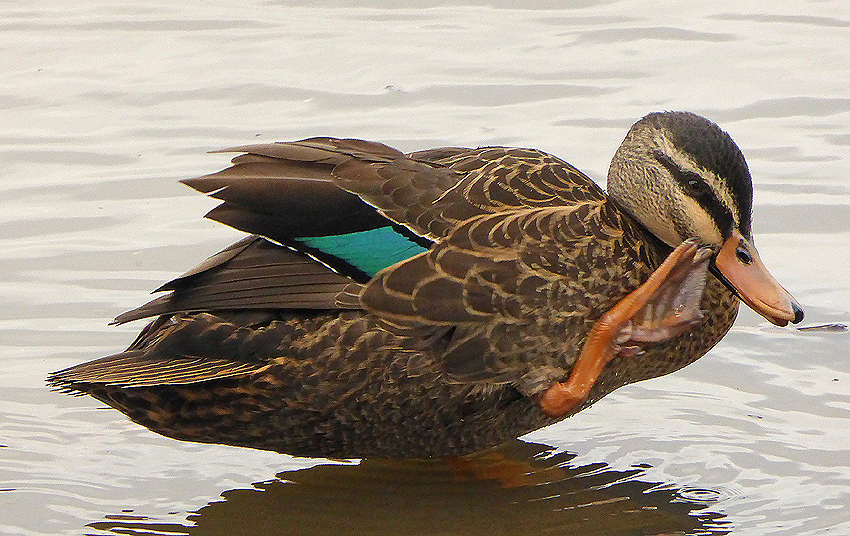
Today the crowd is flowing over the lake on the glass and steel bridge with their silver, black and teal scarves whipping in the breeze while I am under it with the teal wing flashes of a black duck locked into my viewfinder. Just a few moments earlier I had also been on the receiving end of a severe telling off from a pied cormorant that took exception to my presence near its favourite fishing spot on the river bank.

P1010199

Black duck

P1010228

Get away from my patch

I had cycled into town just prior to the match to take some pictures of the new stadium to promote it as one of the many attractions the city boasts. As I walked along the river bank I was distracted by the abundance of winter wildlife and the various animals’ indifference to the huge influx of people above them. And the thought occurred to me; if a few fans arrived early or stayed later they could take in some of the natural wonders that the city has to offer as well as enjoying the sport.

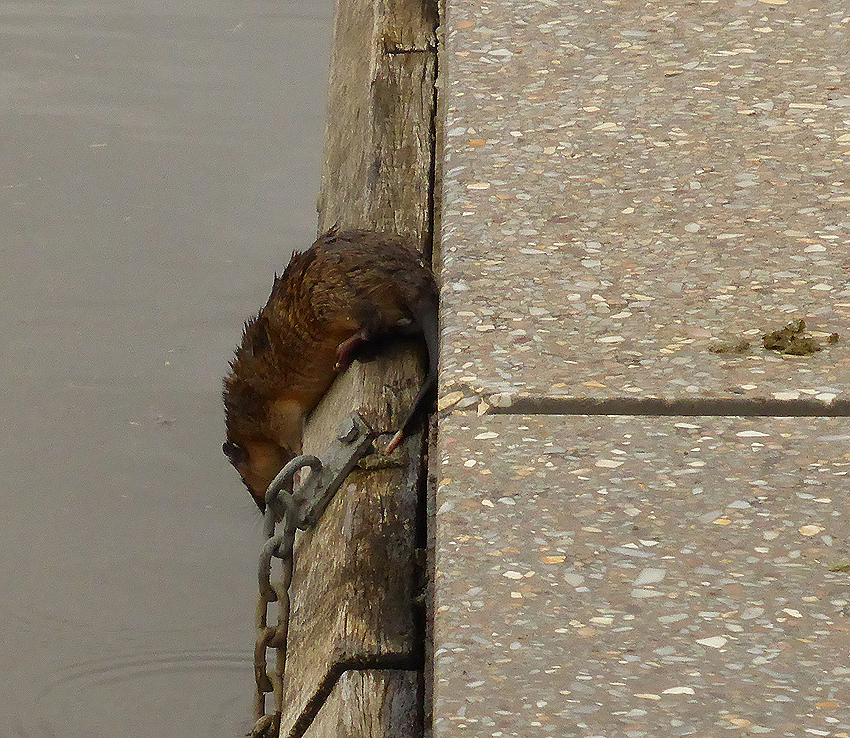
wrat3

Australian water rat heading back into the lake.

Leaving the cormorant to its protestations, the duck to its scratching and the crowd to their game, I decide to work my way along the eastern bank of the lake towards the weir. No more than two meters in front of me I can see the tell tale V shape ripples of an Australian native water rat hunting close to the dock that fronts the rowing club. The little mammal hops up on the wooden edge every few minutes to eat a freshwater mussel, yabbie or frog that it has caught. An extraordinary encounter with a very shy Australian native mammal.

IMG_4073

Australian pelican foraging along the bank

IMG_4067

Black swan in nest made from twigs, reeds and debris

Closer to the weir the reeds are quite dense providing a perfect habitat for Australian pelicans and black swans. The pelicans forage along the banks for fish and invertebrates while the swans have constructed a nest alongside some protective netting that is being used to re establish native aquatic plants.

My winter walk along the Torrens has been more than a little rewarding and I am looking forward to a cup of coffee at the little café by the weir where I will check on the footy scores while I can still hear the  intermittent roars of the crowd in the background.

Until next time

Cheers

Baz

Breakout Creek’s Herons

22 Jun


Dear Reader

It is a typically South Australian winter’s afternoon; cool, clear and sunny with a light breeze coming off the ocean.

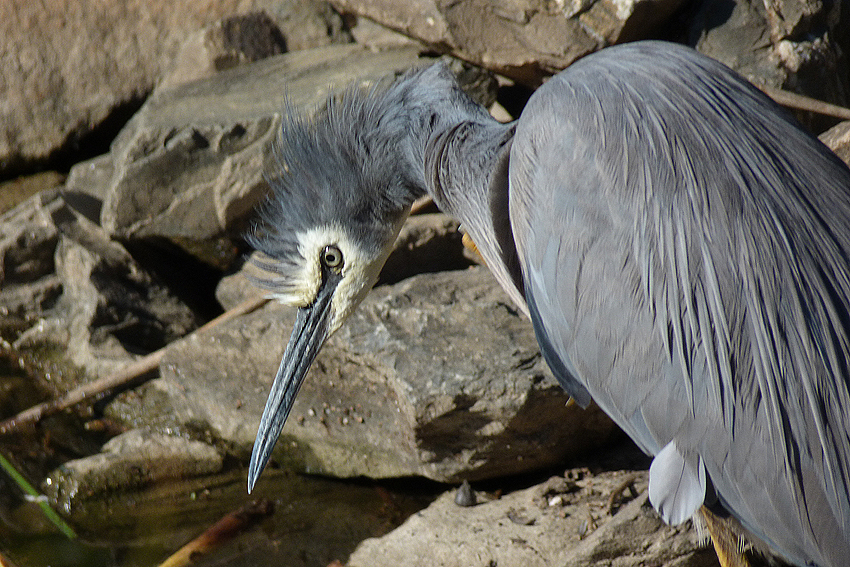
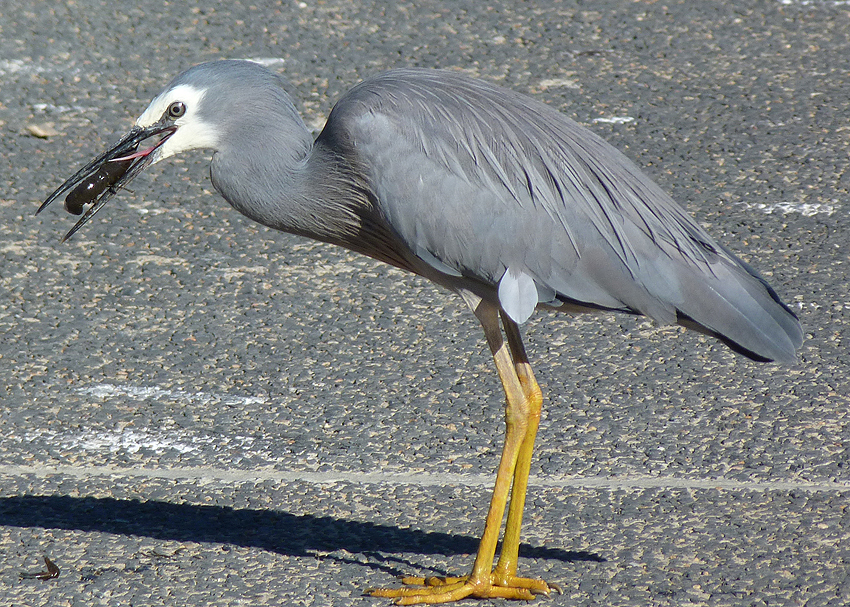
5 heron poised to strike

Grey faced heron poised to strike….click to enlarge image

4 heron and yabbie

Heron and yabbie (freshwater crayfish)….click to enlarge image


The white faced heron is hunting amongst the shallow reed beds and rocks along the edge of the river bank. It moves slowly, carefully placing each of its long, spindly legs before freezing to stare into the water in search of prey. The long neck coils back slowly and then with disarming speed the dagger beak flashes into the water to snatch an unsuspecting yabbie. The bird rearranges the unlucky crawfish in its beak then strides onto the causeway to enjoy its catch.

3 white faced heron in flight

White faced heron in flight….click to enlarge image


Over the next few minutes I watch the heron as it continues to hunt in the same area. I am trying to capture some images that depict its hunting style but the wader is becoming more nervous and eventually takes to the air.

Breakout Creek looking south

Breakout Creek looking south….click to enlarge image


I am at Breakout Creek, a section of the Torrens where the river broadens and significant environmental work has been done to improve aquatic habitats. Over the years I have seen water rats, lizards, frogs, possums as well as a wide variety of birds in this area. It is a favourite destination when I go for a bike ride along Linear Park and one that I would recommend to any visitor who enjoys the outdoors and a little mild exercise. Free bikes are available at the weir near the golf course and the ride to Breakout Creek and back is an easy one hour pedal.

7 greater egret

Greater egret….click to enlarge image


From the causeway I cycle back towards the city for a couple of hundred metres then dismount where the reeds are thickest. Between a small island and the bank a lone greater egret is hunting, half concealed by the brush. Like the grey face the egret uses its long bill to snatch small prey from the water and while I am watching it snaps up several small fish.

2 Nankeen night heron

Nankeen night heron….click to enlarge image


Close by the reed bed some tall eucalypts overhang the creek and, as luck would have it, there is a far more unusual heron roosting in the topmost branches. The nankeen night heron is a nocturnal hunter and it spends the days resting before hunting for its prey when the sun goes down. This one is becoming a little more active as it is now late afternoon. Night herons are one of my favourite birds and though they are not exactly rare along the river seeing one is a bit of a treat.

6 red ochre grill

Red ochre grill….click to enlarge image


Three herons in one day (egrets are a kind of heron )……nice; but the day is not done and I have planned to meet a friend for dinner at the Red Ochre Grill, a fabulous restaurant adjacent to the weir, golf course and bike hire station where I started my ride. Their menu, which sources local ingredients and is a kind of upmarket take on the bush tucker concept, is certainly something to look forward to.


Until next time

Baz    

Birds with Attitude

3 Dec


Dear Reader:

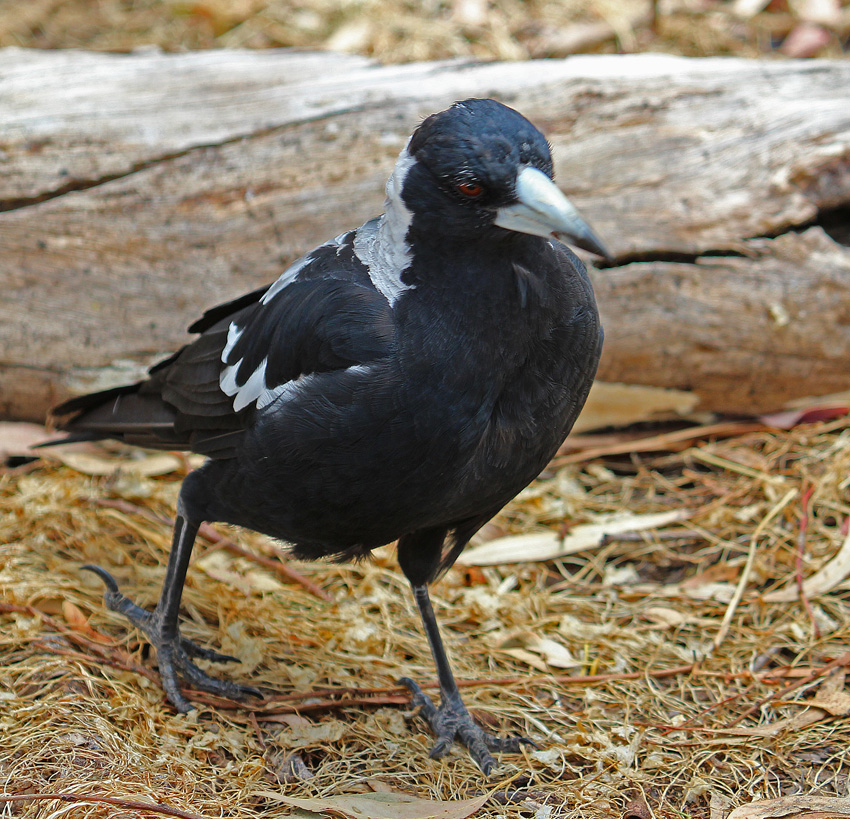
There were magpies scattered through the little park. I had seen them high in the trees and foraging nervously amongst the undergrowth. Every time I came close to one it would fly off and perch on a branch and watch me suspiciously. Suddenly, a small group of what I surmised must be sub-adults because of their grey flecked backs, decided to congregate in the understory just a few metres away from where I was sitting. They warbled and strutted and then seemed to organise themselves into a group.

E Magpie with attitude

The magpie strut


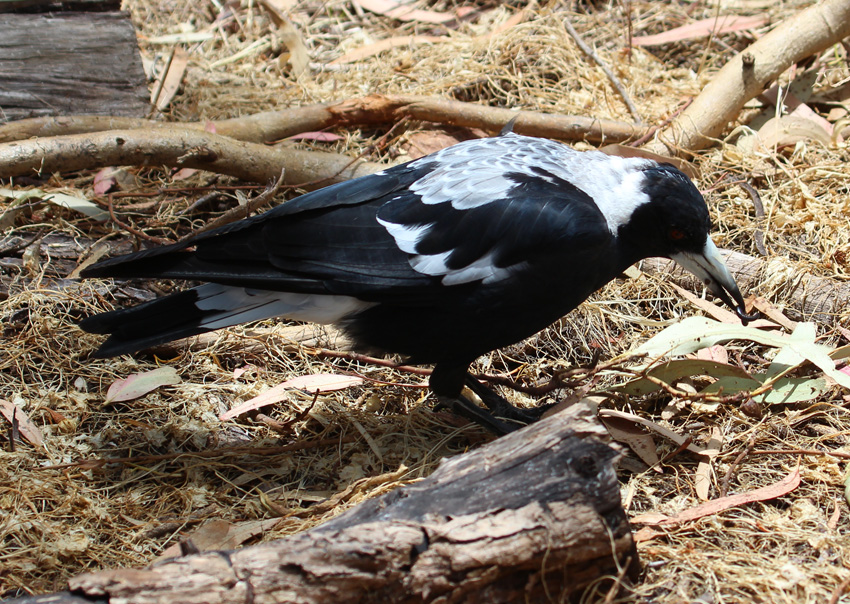
The birds moved in a skirmish line through the leaf litter chasing butterflies and raking through the ground with their powerful beaks. Every so often one would lift up its head and gulp down a grub then return to the hunt. I was perched on a fallen tree branch, clearly in their way but the birds just kept coming closer, brimming with the confidence that youth and inexperience bestows on many species including our own.

D Magpie with grub

Magpie about to swallow grub


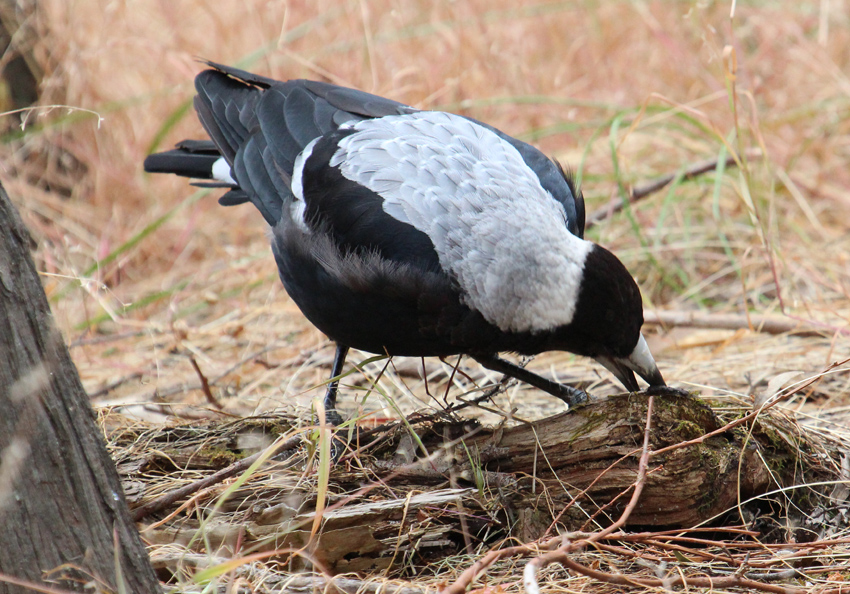
Australian magpies (Gymnorina tibicen) are actually a member of the butcherbird family. They are medium sized, robust birds growing to around 44 cms in length with powerful stabbing beaks that are used for digging out ground based prey and for defence. Magpies live in groups of 2-24 birds with distinct social stratification- several high status females usually breed with a dominant male and the remainder live on the periphery helping to protect nests. They are extremely territorial during the breeding season and many a cyclist, golfer or innocent pedestrian crossing the parklands will tell tales of being attacked by dive bombing magpies.

F Magpie cleaning beak

Magpie cleaning beak while foraging


My far less adventurous magpie moment occurred inside a little conservation park in Burnside, one of Adelaide’s more affluent eastern suburbs quite close to the hills face. The park is classic scrub reminiscent of the way the plains would have been before European settlement. Tall eucalypts and native pines dominate the upper story and a variety of low bushes including spiky acacias form the mid range vegetation. Being the end of spring, there were still quite a few flowering plants amongst the leaf litter and fallen branches. And when I sat quietly and watched intently it was possible to catch glimpses of tiny brown skinks searching for prey in the jumbled layer of leaves and bark.

C Adelaide rosellas

Adelaide rosellas on the track near the park entrance


However, magpies were not the only birds using the park. As I entered through a side gate I watched a pair of Adelaide rosellas nibbling grass seeds on the path a mere 20 metres away. And the usual suspects; noisy miners, new Holland honeyeaters and some tiny, twittering finches, all added to the sounds and sights of my walk in the park.

B Meadow argus butterflies

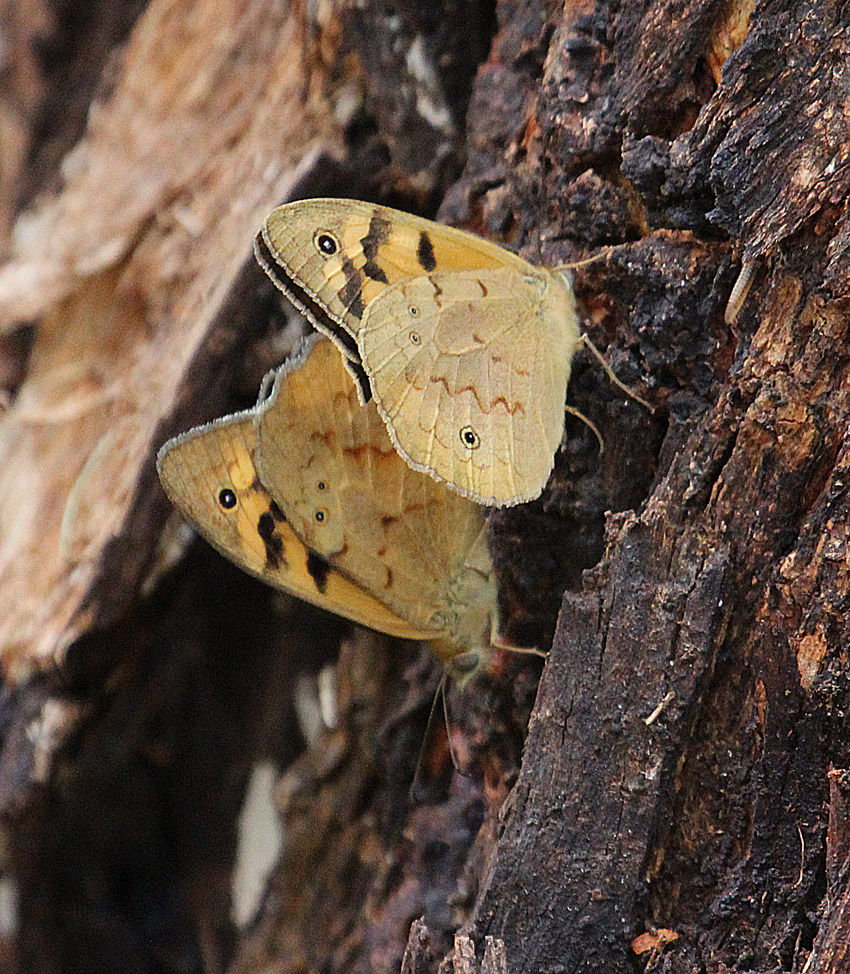
Meadow argus butterflies


Cheers

Baz


Misty Morning Rats

9 Jun

 This year, the first few days of winter have been a little cloudy with a light mist over the city in the early hours. It is the kind of weather that encourages a cup of coffee, at the Par 3 Cafe by the Torrens Weir, before my weekend bike ride around the river trail. But the cool quiet mornings do have one distinct advantage. Some of the more reclusive creatures that inhabit the river banks seem a little less wary and easier to find; most notably…The Australia water rat…one of my favourite species.


AFF Torrens Weir in winter feeding the river below

Torrens weir in winter feeding the river below


As you can imagine, misty mornings, shy wildlife and carrying a camera on a bike does present a few challenges. My digital SLR and long lens are too heavy and the low light conditions push the compact super zoom that I can comfortably wear on my hip, to its absolute limits. Consequently, please excuse a couple of the rather grainy images that I have included later in this post. However, the mere fact that I was able to capture these pictures encourages me to share them and their story with you.


AA Willy Wagtail lookin for insects amongst the reeds

Willy wagtail looking for insects amongst the reeds


Over the many years that I have walked or cycled around our permanent creeks and wetlands I have only caught the occasional glance of Australian water rats. The tell tale ‘V’ shaped wake that they leave and their low profile in the water make them unmistakable. Unfortunately, after a brief appearance they invariably dive or disappear into the tangle of reeds and grasses on the water’s edge. It is also quite easy to confuse them with common rats, which swim well and often live close to waterways. Unlike their terrestrial cousins, water rats are a little more robust have a slightly blunter face with a heavier covering of whiskers. Their back feet are also webbed and they have a white tip to the tail.


AG Common rat scavenging close to the river

Common rat scavenging close to the river


Back to my tale of coffee and misty mornings; last Saturday I had cycled from home to the weir and was peddling along the track that runs south above the river when I noticed a classic ‘V’ shaped wake in the water. I quickly dismounted, whipped off my helmet and gloves and pulled out my camera. The water rat swam upstream diving periodically and I was able to walk slowly along the trail watching it for around 5 minutes. Eventually it disappeared into the undergrowth near the bank but not before another one paddled close by affording me a rather unique photo opportunity. However, as I mentioned at the start of this piece, the light conditions were far from perfect and my target animals were the best part of a 100 metres away. A lot of frames and little Photoshop produced the two images you can see here.

AC Australian Water Rat sheltering under the bank edit 2

Australian water rat sheltering under the bank


AD Australian water rats swimming across the river

Australian water rats swimming across the river

Encouraged, I returned the next day and sat quietly on the bank for the best part of an hour, hoping for a repeat performance. I did see one water rat for a brief moment but I could not focus rapidly enough to get a clear image. At this point, the coffee beckoned and I cycled back to the weir stopping a couple of times on the way to enjoy the winter’s early scattering of leaves on the river bank and watch a pair of silver gulls wading in the water cascading over the sluice gates.


AH Early winter leaves on the river bank

Autumn leaves on the river bank

AE Australian silver gull looking for prey in the overflow

Australian silver gull foraging in the overflow

Now that I know there are several water rats in the area I am determined to travel the same path on foot over the next few months with my DSLR to see if I can improve on these pictures. But for now I am thrilled to have seen the little animals foraging in the wild and to have captured a few simple images.


Until next time

Baz
Go back

Your message has been sent

Warning
Warning
Warning
Warning

Warning.