Solandra Wetland’s Musk Lorikeets

4 Jan

Dear Reader

Last week, on a warm summer afternoon, I decided to walk down to the pond at the bottom of the street to photograph a pair of nesting Australian grebes. The pond is part of a chain of wetlands that feeds off the nearby creek and filters stormwater for use on local parks and gardens around Tea Tree Gully. It provides a welcome oasis for many species during the dry summer months and supports a small semi-permanent population of water birds.
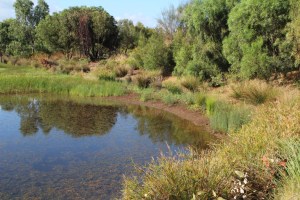
Local pond

On the edge of the pond there are a few medium sized eucalyptus trees that flower this time of year. They have broad canopies adorned with either cream or coral blossoms and are a favourite destination of the local rainbow lorikeet tribe. As I passed the trees I could hear the raucous screech of feeding birds but the tone seemed a little different to the cacophony of sound that frequently greets me.  A quick glance confirmed that most of these parrots were musk lorikeets with just a smattering of rainbows amongst them.
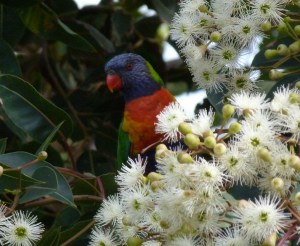
Rainbow Lorikeet amongst white gum blossoms

Musk lorikeeets ( Glossopsitta concinna) are medium sized lorikeets between 20-30cms from head to tail. They use their brush tipped tongues to feed on pollen and nectar but will also eat some seeds, fruits and insects. They often travel in flocks and are usually found in dry woodlands where they nest in hollow branches. They are slightly smaller than rainbows and less common in this area.
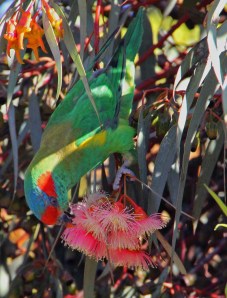
Musk Lorikeet feeding on coral gum blossoms

I decided that the grebes could wait. And, while I have quite a good collection of rainbow pictures I rarely see more than a few Muskies and the chance to photograph them while feeding does not come along too often. They were endearing little animals to watch as they performed an extraordinary range of acrobatic movements. Sometimes they hung upside down to get their beaks into a bunch of blossoms; at other times they used it as a prehensile tool to climb along spindly branches. Despite their preoccupation with feeding they were still a little nervous and as I moved cautiously around the trees they scattered into the denser parts of the foliage making photography somewhat difficult.
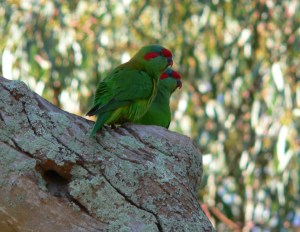
Pair of Musk Lorikeets

I tried sitting quietly in some of the surrounding bushes closer to the pond and using the telephoto on full zoom. An equally unsuccessful manoeuvre, as the birds seemed to rarely feed on the outer blossoms as doing so would probably increase their exposure to local predators like harriers and falcons. Finally I adopted a more professional and scientific approach to the problem; walk slowly, keep shooting and hope for the best.

Musk Lorikeet pair bonding near nest hole

Dozens of frames later, with the light diminishing and more than a few bird droppings adorning my jacket, I left my flock of musk lorikeets to their meal and walked down to the pond for a quick look at the pair of grebes. One was repairing the nest and the other half hidden in the reeds at the edge. Australian Grebe building nest
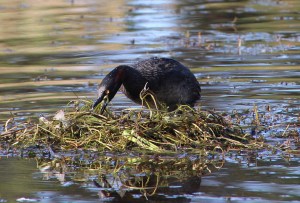
Another post for another day

Cheers

Baz

← Back

Thank you for your response. ✨

Seaside Dragons

30 Dec

After a chilly morning the day has warmed considerably, making it perfect weather for hunting dragons. My quarry is the glorious little Painted Ground-dragon, a species that lives in the remnant coastal dunes fringing several of Adelaide’s beachside suburbs. The dunes behind Tennyson Beach provide a perfect habitat; scrubby heath with coastal grasses and succulent ground covers. The best strategy is to walk slowly along the marked trails stopping frequently to listen for a tell tale rustle in the understory.

Tennyson dunes showing low fencing to preserve environment

Painted Ground-dragons (Ctenophorus pictus) are one of the 65 species of dragon lizards that occur in Australia. They are diurnal with long tails and legs and a typically rough, stippled appearance. Some of their scales form ridges and points that give them a rather undeserverd, fearsome appearance. Painted Dragons grow to around 20 cms in length, live in burrows in sandy soil amongst low vegetation and feed mainly on small invertebrates.

close up of male Painted Dragon showing skin texture and colouring

Close up of male Painted Dragon showing skin texture and colouring

At this time of the year the feisty little reptiles have some serious breeding to attend to and they need a few rays to warm up their blood. The rather promiscuous females are game for any male that looks their way and the guys need some energy to put on their twisting, bobbing and erecting displays.

male Paintd Dragon in display mode

Male Paintd Dragon in display mode

male Painted Dragon sunning himself  amongst understory

Male Painted Dragon sunning himself amongst understory

Sexual necessity and the never ending quest for food gives me an advantage as Painted Dragons will often break cover or bask on a branch or tree root to get more exposure to the sun. The complex barred pattern on their bodies, coupled with the blue grey and orange colouring of the showy males and browns and creams of the females, makes them difficult to spot unless they move. The trick is to walk quietly enough to hear them yet boldly enough to flush them out.

As I pass a tangle of dead branches and spiky coastal grass a female that has been lying on one of the wind scoured limbs runs across the path, freezing as she reaches the edge. I fire off a couple of frames. Then I glance back at the area she emerged from, immediately spotting a now forlorn male perched on a bare branch that overlooked her hiding place. He appears to be performing a set of lacklustre push-ups and tail wriggles in a futile attempt to lure her back.female Painted Dragon flushed onto path

As the afternoon progresses I get a few more shots and watch a large White Faced Heron stalking insidiously through the dunes, also hunting dragons but with a far more sinister intent. Finally, hot and tired from my afternoon’s endeavours I take one of the short, sand blown trails down to the beach and enjoy a leisurely paddle through the cool, clear water.

White Faced Heron stalking lizards

White Faced Heron stalking lizards

But ther is one final surprise to end my dragon hunting day. As I walk towards the edge of the car park, I catch sight of one last lizard. Not a Painted Dragon this time but its larger relative the Bearded Dragon. This one, probably a male is wrapped around the dead trunk of an old acacia tree, surveying his territory.

Bearded Dragon surveying territory

Bearded Dragon surveying territory

Some days the gods of wildlife do smile on us.