Tag Archives: Australian birds

A Bite at Grange

19 Sep

Dear Reader:

A lone silver gull is flying parallel to the shore just above the Norfolk pines that grow along the Grange beach front. Suddenly it veers off course, dipping towards one of the trees and letting out a loud, raucous shriek. This unusual behaviour encourages me to stop and take a closer look through the telephoto lens. And there, perched serenely on the topmost branch is a beautiful nankeen kestrel surveying its stretch of prime coastal real estate.

Nankeen kestrel looking for prey

Nankeen kestrel looking for prey (click all images to enlarge)


Nankeen kestrels are small falcons that are widely distributed across the country. They usually live in rural or outback regions where they hover over fields and open bushland preying on small mammals, reptiles and occasionally taking birds in the air; which explains the gull’s nervous disposition. Seeing one in an urban area is a really quite unusual. For the next half an hour I follow the raptor as it patrols the shoreline and dunes moving from tree tops to fence posts to survey its territory.

The Marines, beachside heritage homes

The Marines, beachside heritage homes


Grange Beach is just 15 minutes from the centre of Adelaide. An old wooden jetty, classic golden sands and heritage buildings make it an ideal place to go for a walk and grab a bite to eat summer or winter! A walking &cycling trail passes through the area winding between the seafront properties and coastal revegetation zones providing a unique blend natural and urban habitats that encourages a wide variety of wildlife.

Spotted dove

Spotted dove

Singing honeyeater in coastal scrub

Singing honeyeater in coastal scrub

The unfortunately named pigface

The unfortunately named pigface


After watching the kestrels I follow the track south. The delicate shrubs and grasses that stabilise the dunes are home to many different bird species from common house sparrows to spotted doves and singing honeyeaters. Although it is a coolish day and the insect life is in short supply a few bees and butterflies are congregating around some early blooming pigface, a common succulent in the dunes.

Grange jetty at low tide showing worm casing encrustaceans

Grange jetty at low tide showing worm casing encrustaceans


For a little variety I walk back along the beach. The tide is out exposing concrete-like encrustations of tube worms cemented to the jetty piles. A track leads from the beach to the old kiosk which is now a fashionable restaurant. My day ends with a glass of white, salt and pepper squid with sautéed scallops in the shell accompanied by a generous serve of crusty bread.

Grange Kiosk

Grange Kiosk


Until our next adventure

Baz          

I Wonder What the Neighbours are Doing?

11 Sep

Dear Reader:

It is a cool, early spring afternoon. I can hear annoyingly cheerful birds singing in the white cedars that line my street but I am bored stupid. Home from work with a cold but certainly not sick enough to stay in bed. What to do? Going for a walk along the beach or up in the hills would be foolish and daytime television is just one step above poking my eyes with a sharp stick. Decision made! I shall stroll up to the main road, pick up a magazine and have a cup of coffee with an inordinately unhealthy pastry at one the cosy little cafés that are dotted along Prospect Road.

IMG_4175

A mudlark finds grubs in the gutter (click all images to enlarge)


I am halfway through the door when I stop and think that it might be worth taking the camera along, though the chance of seeing something unexpected on a quiet suburban street at midday; is not very likely. It turns out that I am quite mistaken and my two hundred metre walk to the main drag is filled with interesting moments.

IMG_4174

Rainbow lorikeet feeding on a late flowering gum


First encounter; a pair of rainbow lorikeets are alternately feeding on a late flowering gum and taking turns to performs some trade-like renovations on a hollow branch in a nearby cedar. One of the parrots uses its powerful, curved beak to scour the edge of the entrance while the other pops in out and removing old bits of nest lining. They seem quite oblivious to my presence and allow me to get quite close.

IMG_4185

Rainbow lorikeets house hunting


I leave the rainbows to their reno-project and move further up the street. A Murray magpie is sorting its way through the leaf litter and other detritus deposited in the gutters by recent rains. Every so often it stops, cocks its head to one side and gulps down a worm or bug. Ironically, there is a classic white backed magpie sitting on the power line above watching its little namesake. Despite their titles, the two species are unrelated and it is only their colouring that encouraged early settlers to name the birds after the black and white European magpies. Although it is a large imposing bird this particular magpie has a serious handicap which is revealed when I take a look at its magnified image on the viewfinder. The powerful beak has been badly damaged making both feeding and defence a ‘tough ask’.

A busted beak makes life on the streets tough

A busted beak makes life on the streets tough


Even the cafe has its wildlife component as a squadron of New Holland honeyeaters perched in a courtyard tree argue over territory with the ever present miner birds and several sparrows and pigeons patrol beneath the tables in search of crumbs. But the standouts are still the rainbows and their nesting antics, which simply confirmed an unwritten rule that every wildlife photographer knows; take your camera, something will almost always surprise you.

IMG_1446

Juvenile miner bird watching out for new Holland honeyeaters


Until our next chat

Baz

Kestrels at the Cape

25 Jul

Dear Reader:

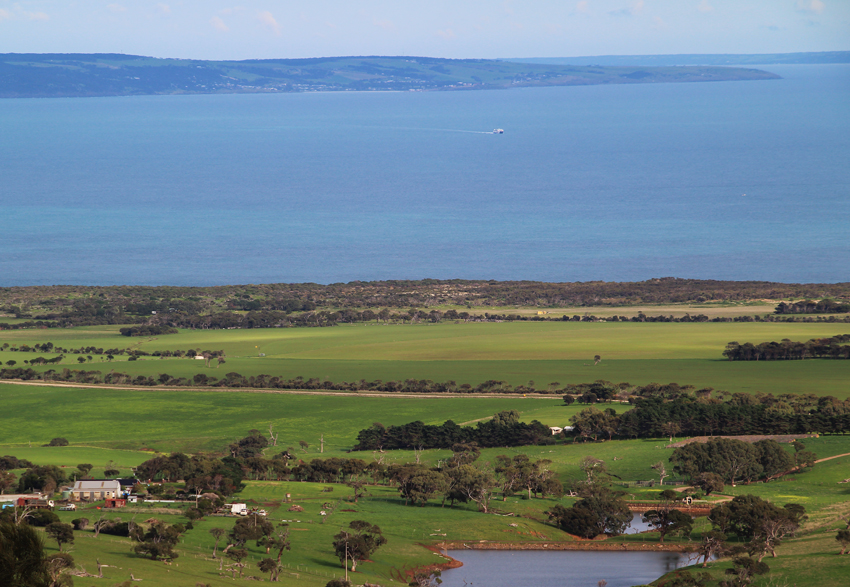
It is late morning on a fine winter’s day and I am leaving the dirt road from Victor Harbor to join the main route back to Adelaide. As I round the curve the descent towards the coast is quite spectacular. From the top of the hill the road drops away sharply providing a panoramic view of open pastures dotted with small dams and patches of native vegetation. A corridor of lazy blue ocean separates the mainland from the island, which appears as a hazy outline on the horizon.

View from the top

View from the top (click to enlarge)

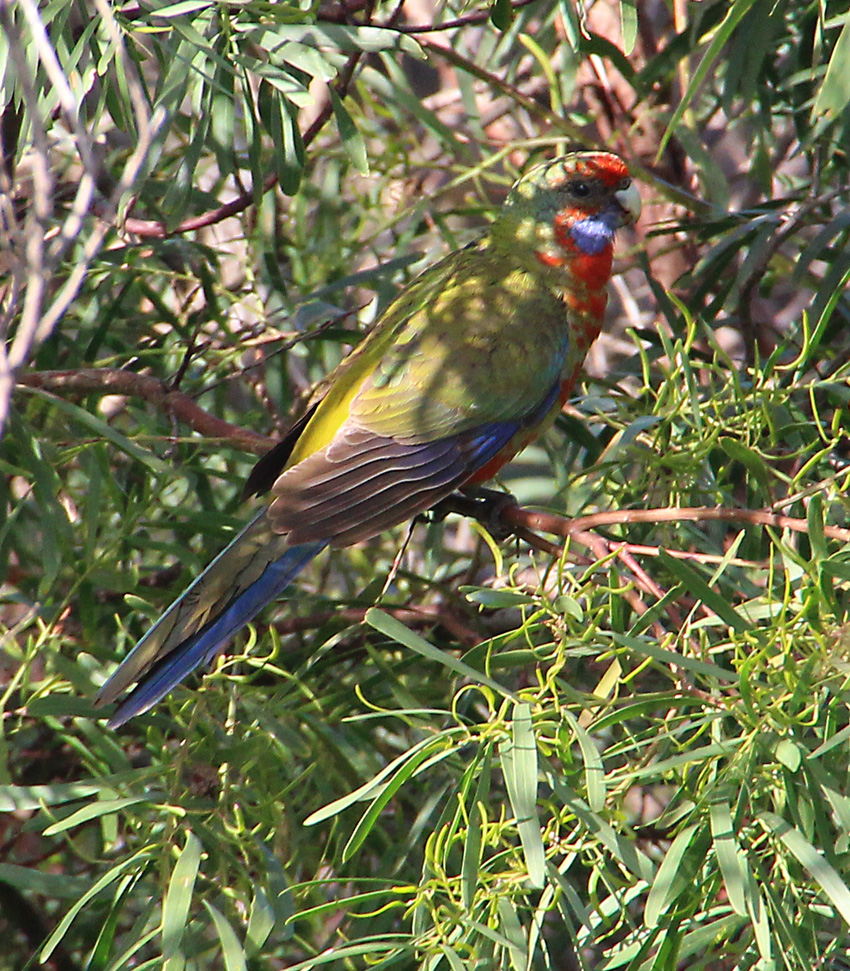
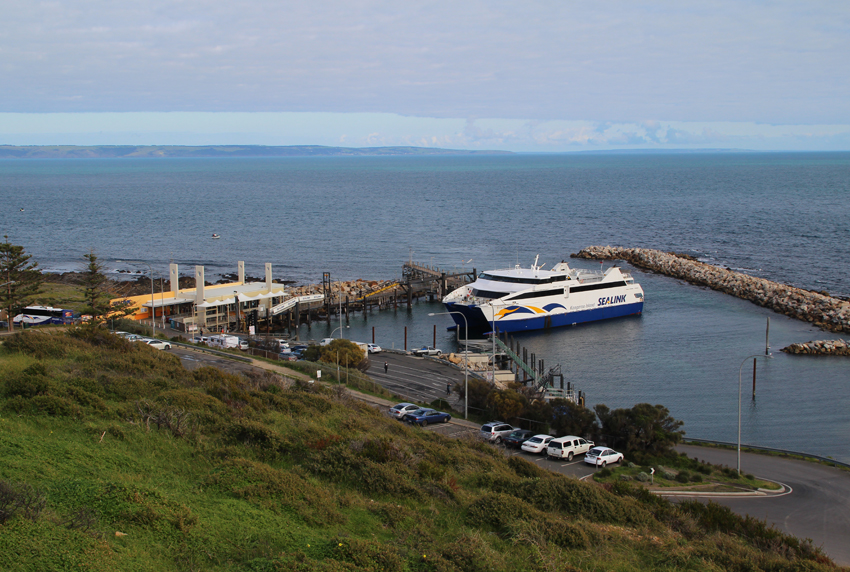
Closer to the coast a dirt track leads to a viewing point alongside a small stand of low trees and bushes. From the elevated position I watch the Sealink ferry crossing Backstairs Passage and stop to take a shot as it docks at the terminal below. While I focus on the ship I can hear the twittering of finches in the nearby scrub and catch a fleeting glimpse of two brightly coloured rosellas gliding into one of the taller bushes.

Rosella feeding in accacia tree

Rosella feeding in acacia tree (click to enlarge)

Sealink ferry docking at Cape Jervis with Kangaroo Island in background

Sealink ferry docking at Cape Jervis with Kangaroo Island in background (click to enlarge)

The ferry from Kangaroo Island docks at Cape Jervis on the southern tip of the Fleurieu Peninsula. It is one of my favourite places in the South Australia; from the little coastal hamlet you can visit local beaches and dive spots, access the Deep Creek Conservation Park, organise a charter fishing expedition or take a day trip to Kangaroo Island.

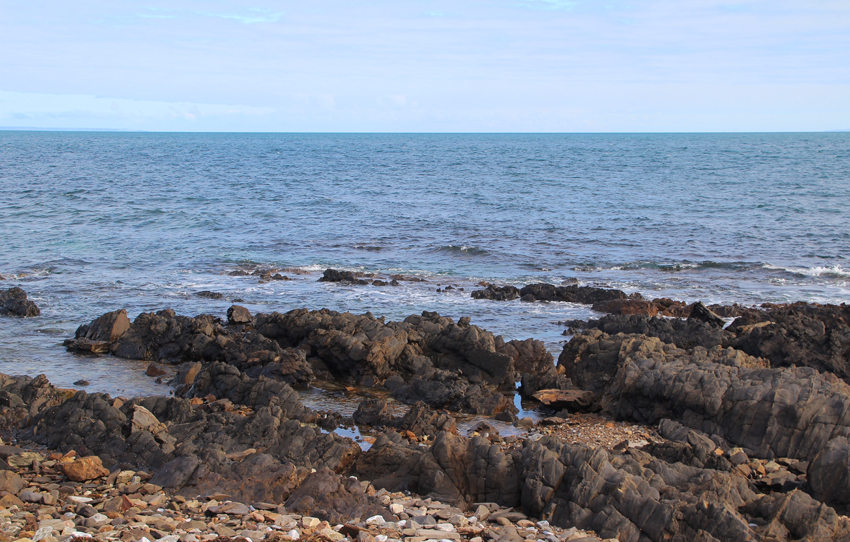
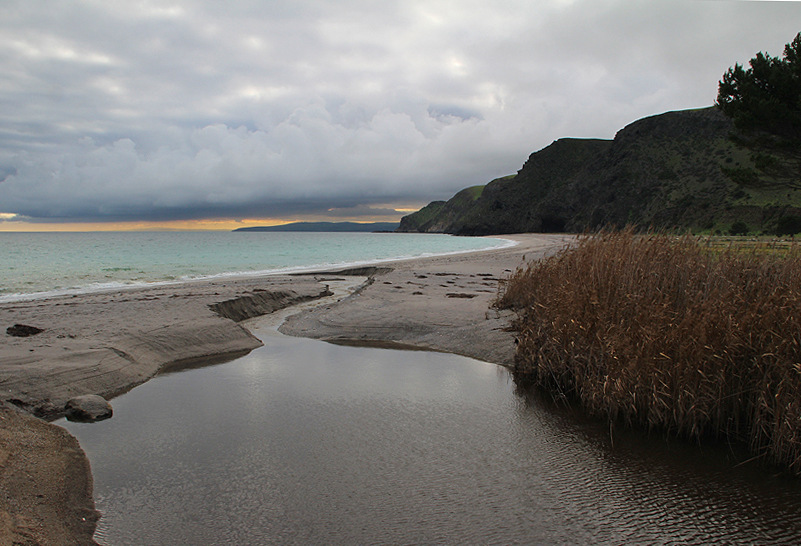
Rocky outcrops extending into the sea

Rocky outcrops extending into the sea (click to enlarge)

From the lookout I follow the road down to the lighthouse and park on a track a hundred metres back from the sea. The shoreline is a geology lesson in itself, with weathered ridges of dark rock ‘criss-crossed’ by veins of quartz, jutting into the ocean and patches of coarse sand and fractured rocks abutting the low earthen cliffs. In the distance I can see a line of giant wind turbines silhouetted on a faraway hilltop and the smell of salt air combined with the sound of waves breaking amongst the rocks fills my senses.

Nankeen kestral hovering above beach

Nankeen kestrel hovering above beach (click to enlarge)

As I move up the foreshore, picking my way between the boulders, I can see two  kestrels hovering over the beach. They seem to be systematically working together; one hovers for  a few minutes over the rocks then moves on while the other works the grassy slopes a little further inland. By pure chance they are slowly coming towards me so I lift the camera skyward and try to remain as still as humanly possible until the birds are almost directly above. I fire off a dozen shots and smile at my good fortune.

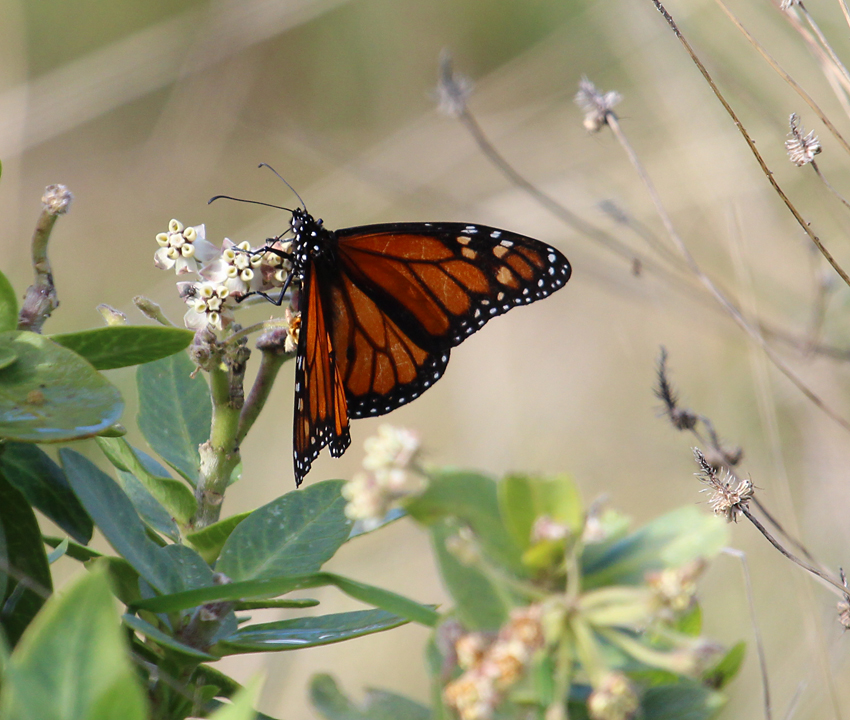
Monarch butterfly

Monarch butterfly (click to enlarge)

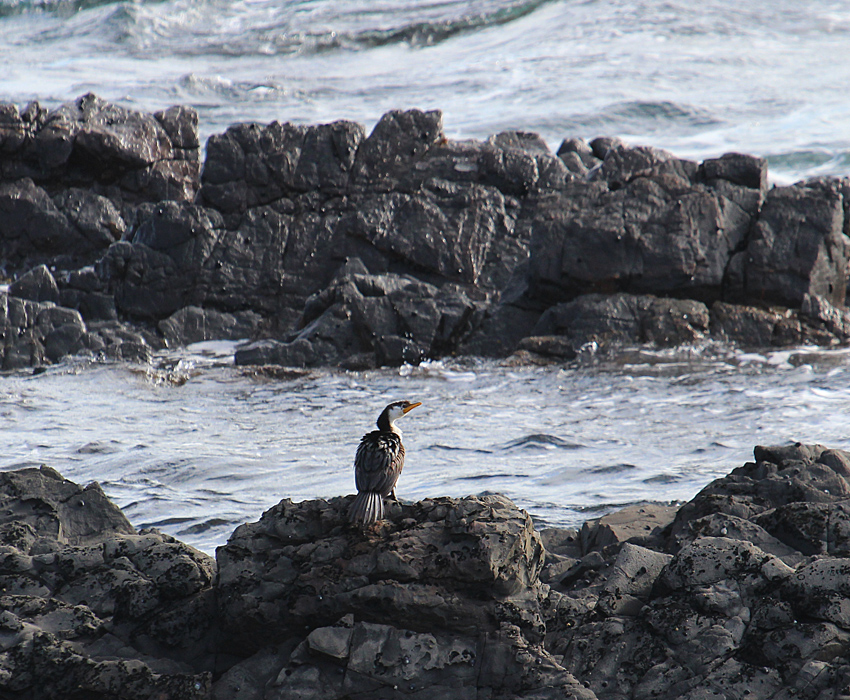
Pied crmorant by rockpool

Pied cormorant by rock pool (click to enlarge)

Raven with nesting material

Raven with nesting material (click to enlarge)

My walk provides a few more interesting moments: a cluster of monarch butterflies in a shrub that looks like milkweed, a lone pied cormorant sunning itself on one of the rocky outcrops that reach into the sea and a raven that is tearing up seaweed on the breakwater for nesting material. However, while I sit in the ferry terminal sipping a coffee, watching passengers returning from KI and reviewing my images I realise that it is the kestrels that have really made my day.

Cheers

Baz

Mt Lofty on a Winter’s Day

12 Jul

Dear Reader:

Last weekend was cool and clear, perfect winter weather for a visit to Adelaide’s highest point, Mt lofty. The bush covered peak is a mere twenty minutes drive from the city along the SE freeway and the viewing deck and restaurant are surrounded by tall eucalypts that are home to a variety of wildlife.

AD A view from the top  (click to enlarge)

A view from the top (click to enlarge)

A selection of walking trails and bike tracks converge on the summit and earlier in the year I had spent some time walking along their lower sections photographing wildlife. However, on this occasion I had decided to see if the distribution of species was different at a slightly higher altitude in the cooler months.

AG Mt Lofty summit - Copy

Mt Lofty summit (click to enlarge)

The summit was quite busy with a smattering of mountain bikers and walkers using the trails and dozens of casual visitors simply enjoying coffee and the view from the observation deck and glass fronted dining areas. As I knelt down by my pack to select a lens I heard the chattering call of some blue wrens that were flitting between some nearby bushes and diving into the undergrowth. I watched their antics for a few minutes before heading off on one of the shorter trails that circle the summit.

AC2 C

Male blue wren surveying his territory(click to enlarge)

AH White backed magpie (click to enlarge)

White backed magpie (click to enlarge)

After walking for several minutes I noticed a sizeable magpie foraging for grubs amongst the grass and rocks. As I paused to take a few shots a group of Japanese tourists stopped and asked about the different birds in this area. We spent an enjoyable few minutes chatting and comparing their native species to ours; it transpired that they were an ornithological party on a study tour.

AE Natve heath - Copy

Native heath (click to enlarge)

AB Rosella feeding in the trees (click to enlarge)

Rosella feeding in the trees (click to enlarge)

A little further along the trail the greens and browns of the understory were enhanced by small patches of bright red flowers belonging to one of the hardy little heaths that flowers in the winter months. But the real splash of colour on this winter’s day was a colourful Adelaide rosella that was feeding on berries high in the branches above me. This was quite unusual as virtually every rosella I have observed feeding has been foraging on the ground for seeds and tubers.

AA Large male koala near the restaurant entrance - Copy

Large male koala near the restaurant exit (click to enlarge)

Mount Lofty, as I have pointed out, is a prime tourism site and in keeping with this status it provided one final surprise. A large male koala, that seemed to be extending a farewell gesture of pure Australiana, was comfortably tucked into the forked branches of a large gum tree alongside to the exit path.

Cheers

Baz

Rapid Bay’s Misty Morning Predators

5 Jul

Dear Reader:

The road drops sharply from a cloud enveloped ridge top to the beach then emerges from the mist alongside a small creek. The sky is clearer close to the ocean and I can see the familiar outline of the steep cliffs and the twin jetties that jut out into the gulf. It is a chilly winter’s morning and my hands are cold as I organise my back pack and cameras ready for a stroll along the seafront.

IMG_3732

The creek at Rapid Bay (click to enlarge)

Two large birds are flying slowly along the beach front; in the early morning light they seem to resemble pacific gulls, a fairly common species along this part of the coast. I track the seabirds with my long lens and fire off a series of shots and quickly review them. Although the light mist obscured the birds’ features to the naked eye the captured images reveal a pleasant surprise. The wing feathers, tail shape and characteristically curved beak indicate a far more interesting and less common bird….the white breasted sea eagle. A little further down the coast I can see the eagles rise up on a thermal alongside the cliffs as they soar in tight spirals before resuming their beach patrol.

IMG_3771 edit1

White breasted sea eagle (click to enlarge)

The beach with its high cliffs, creek and mining jetty define one of the Fleurieu Peninsula’s most interesting and historic locations; Rapid Bay.  It was here that Adelaide’s original surveyor Colonel Light anchored his brig ‘The Rapid’ in the sheltered bay uttering the words “I have hardly seen a place I like better”.  Only 100 kms south of Adelaide, Rapid Bay is a prime location for divers and anglers. It is also  holds a significant place in the lore of several local Aboriginal peoples; a feature of the area that I will explore in more depth at a later date.

IMG_3761

Anglers on the jetty (click to enlarge)

IMG_3755

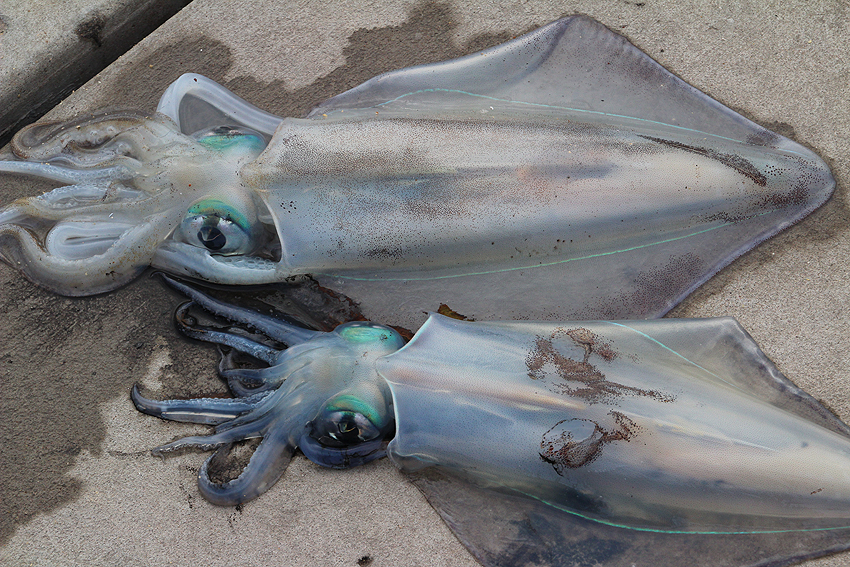
Southern calamari (click to enlarge)

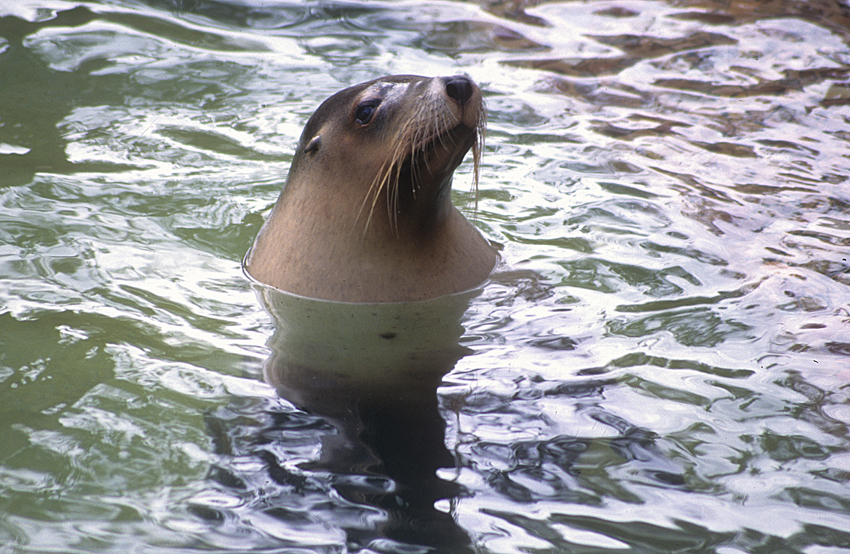
From the beach front I walk along a short dirt road to the jetty. A couple of fishers tell me that a sea lion has been hunting in the shallows between the new and old jetty. After a few minutes a sleek grey shape twists and turns in the water only a dozen metres away and a whiskery face pops up, surveys the surface and is gone as suddenly as it appeared. The anglers tell me that they have tossed a couple of squid to it and that the sealion has been around the jetties for the last couple of days.

sealion 1

Australian sealion (click to enlarge)

I watch the men jigging for squid for a few more minutes before returning to the car which is parked near the creek. As I pack up my gear I can hear the sound of finches in the bushes and reeds but it is difficult to focus on the tiny birds especially in these low light conditions. While I am concentrating on the tiny birds a large raven appears on the nearby embankment with a piece of squid in its beak and proceeds to tear the rubbery flesh apart while keeping a wary eye on me and croaking out a few warning calls to any other would be scavengers that might fancy a calamari entree.

IMG_3741

Little raven (click to enlarge)

Eagles, sealions, squid and even a dolphin that cruises past as I leave the jetty; it has been a morning of predators and scavengers both aquatic and aerial. And now it is my turn to grab a bite to eat. Leonard’s Mill, a renovated flour mill, is one of my favourite dining spots and on the main highway to town a mere 15 kms from the Rapid Bay turn off. Their calamari is on the menu as salt and pepper squid and best enjoyed with a fine white wine from the local vineyards.

Cheers

Baz

The Paralana Trail

29 Jun

Dear Reader 

It’s winter but you’d hardly know it. The afternoon sky is a clear endless blue and though there’s a hint of the approaching night’s cold desert chill, the temperature is still a comfortable 25 degrees. I am in the Arkaroola Wilderness reserve in the Gammon Ranges some 1000 kms north of Adelaide heading towards the Paralana hot springs. After a hearty breakfast in the resort’s dining room we have loaded our gear into Suzuki GV and locked in 4WD for the 30 km trip along one of the most interesting off road adventures in this world heritage region.

Ochre wall

Ochre wall (click to enlarge)

 We have been crawling over the rugged terrain for about 20 minutes and the stony track has opened into a dry creek bed. One section of the embankment is quite extraordinary; a wave shaped deposit of ochre that contrasts sharply with the surrounding bush. This significant deposit was of great importance to the Adnyamathanha people who used it in ceremonies and to trade with other Aboriginal groups.

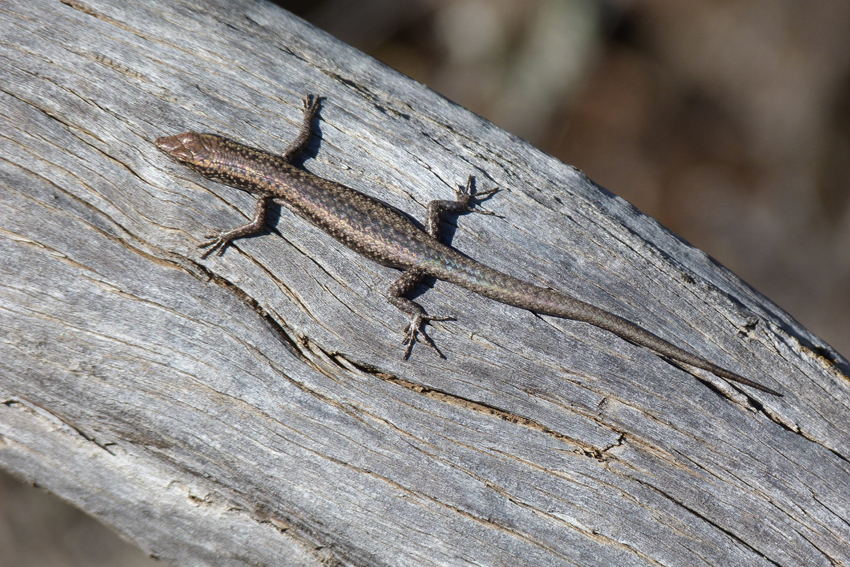
Rock skink

Unknown skink species (click to enlarge)

 While the others break out a little gas stove to brew a ‘cuppa’ I walk along the creek bed camera in hand. The unseasonably warm weather has brought out a few reptiles that would normally be hibernating at this time of the year. They are wary and the only clue to their presence is an occasional rustle in the undergrowth. Finally, one little skink that is basking on a weathered tree trunk decides that remaining motionless is a better option than retreating, offering me a nice clear shot.

(click to enlarge)

Male mulga parrot (click to enlarge)

Femal mulga parrot feeding on blue bush berries

Female mulga parrot (click to enlarge)

 Just as I am about to make my way back to the vehicle a flash of colour amongst the skeletal branches of a long dead acacia tree catches my eye. I peer through the telephoto and focus on the turquoise plumage of a male mulga parrot. If it is the mating season then the female should be nearby and with a little persistence I find her on the ground feeding on some small yellow berries that are the fruit of a low growing saltbush-like plant.

P1010422

Yellow footed rock wallabies on steep cliff (click to enlarge)

 Refreshed, we resume our drive along the trail, slowly climbing into the hills which provide spectacular views across the Gammons. Following a twisting descent down a narrow track we enter the spectacular Baranarra Gorge with its sheer rock walls and boulder strewn pools of clear fresh water.   Our progress has been slower than planned and it is late afternoon when we start to pick our way along the edge of the water hole. Almost immediately I hear the rattle of small rocks skittering down a steep rock face. Almost immediately I hear the rattle of small rocks skittering down a steep rock face. Looking up I catch sight of a pair of yellow footed rock wallabies precariously perched on the sheer cliff face. Once again, I am reminded of the extraordinary adaptations of these beautiful little animals. With their furry back feet perfectly designed for gripping rock surfaces, long counterbalancing tail and subtle camouflage, they are the Aussie equivalent of mountain goats.

P1010408

Chopper based at Arkaroola Village (click to enlarge)

 Unfortunately our stay must be a short one as the light is starting to fade and we must head back to our home base at the village. Tomorrow we have decided to take a helicopter flight over the area to get an overall picture of the terrain before our next off road foray.

Cheers

Baz

Breakout Creek’s Herons

22 Jun


Dear Reader

It is a typically South Australian winter’s afternoon; cool, clear and sunny with a light breeze coming off the ocean.

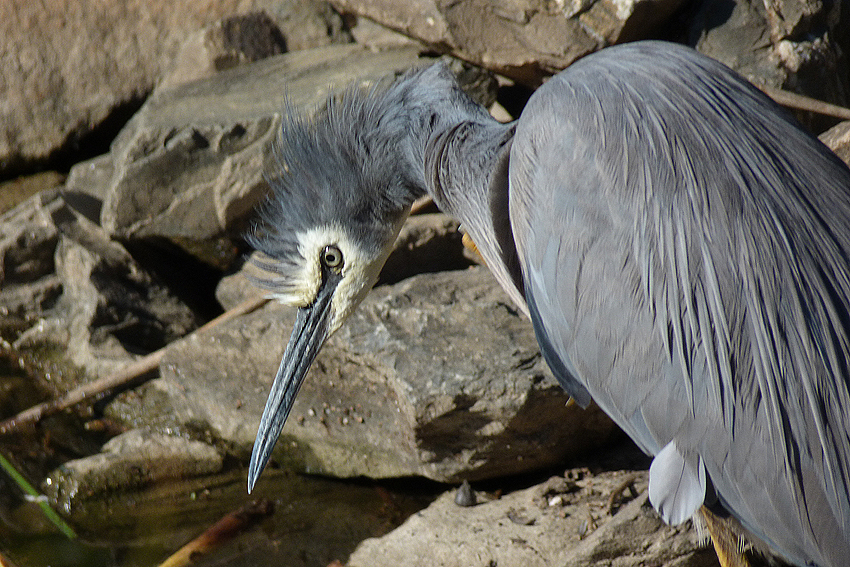
5 heron poised to strike

Grey faced heron poised to strike….click to enlarge image

4 heron and yabbie

Heron and yabbie (freshwater crayfish)….click to enlarge image


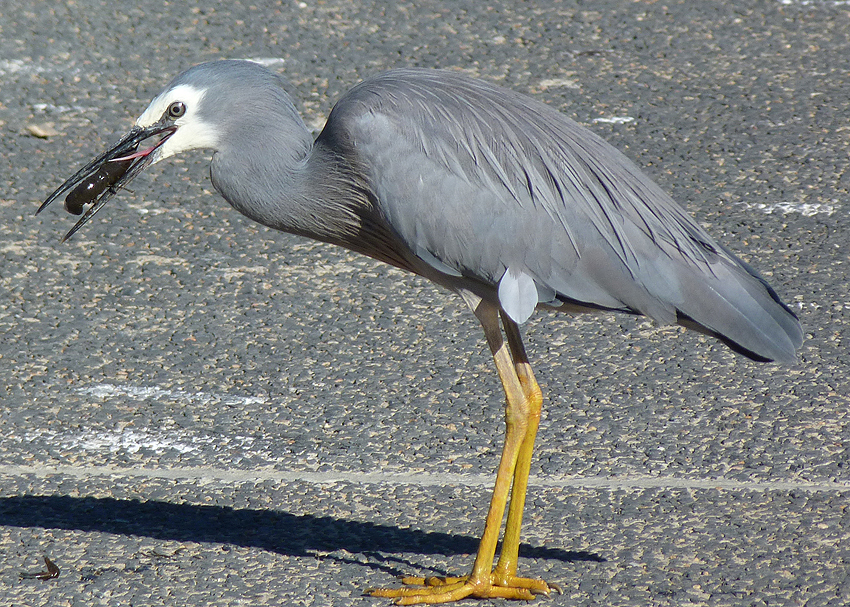
The white faced heron is hunting amongst the shallow reed beds and rocks along the edge of the river bank. It moves slowly, carefully placing each of its long, spindly legs before freezing to stare into the water in search of prey. The long neck coils back slowly and then with disarming speed the dagger beak flashes into the water to snatch an unsuspecting yabbie. The bird rearranges the unlucky crawfish in its beak then strides onto the causeway to enjoy its catch.

3 white faced heron in flight

White faced heron in flight….click to enlarge image


Over the next few minutes I watch the heron as it continues to hunt in the same area. I am trying to capture some images that depict its hunting style but the wader is becoming more nervous and eventually takes to the air.

Breakout Creek looking south

Breakout Creek looking south….click to enlarge image


I am at Breakout Creek, a section of the Torrens where the river broadens and significant environmental work has been done to improve aquatic habitats. Over the years I have seen water rats, lizards, frogs, possums as well as a wide variety of birds in this area. It is a favourite destination when I go for a bike ride along Linear Park and one that I would recommend to any visitor who enjoys the outdoors and a little mild exercise. Free bikes are available at the weir near the golf course and the ride to Breakout Creek and back is an easy one hour pedal.

7 greater egret

Greater egret….click to enlarge image


From the causeway I cycle back towards the city for a couple of hundred metres then dismount where the reeds are thickest. Between a small island and the bank a lone greater egret is hunting, half concealed by the brush. Like the grey face the egret uses its long bill to snatch small prey from the water and while I am watching it snaps up several small fish.

2 Nankeen night heron

Nankeen night heron….click to enlarge image


Close by the reed bed some tall eucalypts overhang the creek and, as luck would have it, there is a far more unusual heron roosting in the topmost branches. The nankeen night heron is a nocturnal hunter and it spends the days resting before hunting for its prey when the sun goes down. This one is becoming a little more active as it is now late afternoon. Night herons are one of my favourite birds and though they are not exactly rare along the river seeing one is a bit of a treat.

6 red ochre grill

Red ochre grill….click to enlarge image


Three herons in one day (egrets are a kind of heron )……nice; but the day is not done and I have planned to meet a friend for dinner at the Red Ochre Grill, a fabulous restaurant adjacent to the weir, golf course and bike hire station where I started my ride. Their menu, which sources local ingredients and is a kind of upmarket take on the bush tucker concept, is certainly something to look forward to.


Until next time

Baz    

Mount Barker’s Wetland Wonders

8 Jun

Dear Reader;

It is a glorious autumn day, perfect for a little bird-watching and a stroll around the water.


The tiny plover has been edging around the reed beds for the last ten minutes, finally coming out of the dense cover around the lake to probe the mud for worms and other avian niceties. The colourful little wader seems more confident and continues to feed just forty metres from where I am concealed in the undergrowth; a little too close to bull ant nest for comfort. Eventually it comes close enough for me to fire off a couple of shots before taking off abruptly, spooked by a pair of maned ducks cruising low over the water.


P1070914

Black-fronted plover (click to enlarge)


I am at the Laratinga wetland on the edge of Mount Barker, the largest town in the Adelaide Hills. The word Laratinga comes from the indigenous name for the Mt Barker Creek and near the entrance of the wetlands there is magical series of portraits that relate episodes within the timeline of the original inhabitants of the area, the Peramangk people. Mount Barker is a busy regional centre with plenty of places to buy fresh local ingredients for making up a picnic lunch to enjoy while you wander around the wetlands observing the diverse collection of plants and animals that live there.

P1070892

Portraits at the wetlands (click to enlarge)


Leaving my hiding place on the edge of the lake, I follow one of the many trails that zigzag through the reserve. Near the edge of another patch of reeds a small flock of ibis are feeding in the shallows. Their distinctive curved beaks and greater size means they might be feeding in the same habitat as the little plover but their prey will be distinctly different. Such a variety of beaks, feet and size is one of the reasons that so many different species of birds can feed together in the same area without destroying the food supply. But the wetland is not reserved for wildlife enthusiasts and a jogger runs a little too close to the flock causing the them take to the air. Despite this being a fairly recent wetland, constructed by the council to filter water naturally, wildlife and people live quite harmoniously and the birds soon return to their chosen spot and resume dining.

P1070923

Ibis in flight (click to enlarge)


Although I have caught a fleeting glimpse of a couple of turtles in the shallow pools and the undergrowth has more than healthy population of insects; it is the bird life that is dominating my walk around the wetlands. The reeds that encircle the water are a veritable cathedral of birdsong. I can hear the twitter of finches and reed warblers in the tangle of greenery and occasionally catch sight of one of the tiny birds flitting amongst them. Finally a superb blue wren makes a more prolonged appearance as it perches on a reed stem giving me just enough time for one last shot before I leave.

P1070928

Superb blue wren (click to enlarge)


Cheers

Baz

Port Willunga’s Natural Charms

24 May

There is a pair of pigeons nesting along the limestone cliffs. They are billing and cooing and puffing up their feathers if rival birds come anywhere near their territory. Unbeknown to the loving pair a far greater menace, in the form of kestrel, is circling high above, scanning the cliff face for a tasty pigeon treat. Luckily for the nesting pair, the hunter overlooks them or perhaps the angle of attack is too steep and the cliffs too perilous.

Lucky pigeons

Lucky pigeons……click to enlarge


I am walking along Port Willunga beach just 40 minutes from Adelaide; a glorious little stretch of white sand that lies below ochre limestone cliffs and bounded by the Aldinga reef to the south and Gull Rock to the north. The reef is a marine sanctuary that showcases a wide variety of the state’s diverse aquatic life. And the beach is a rich repository of the South Australia’s pastoral history where the sea scoured remnants of an old wheat jetty, built in 1853, protrudes from the shallow water. Despite its idyllic setting, Port Willunga also harbours a darker history with no less than five ships being wrecked in the vicinity. The most famous of these was the Star of Greece whose skeleton can still be explored just 500m offshore.

The view from the beach

The view from the beach…..click to enlarge


Leaving the fortuitous pigeons to their parental duties I kick off my shoes and walk through the water amongst the old jetty piles. The wood is bleached white and worn by wind, sand and rain. Tenacious little limpets cling to the timber and a shore crab scuttles past my feet. Looking back across the beach I can see the rough hewn caves that were dug into the cliffs to house fishing dingies and give shelter to the hardy men who made a living from these waters.

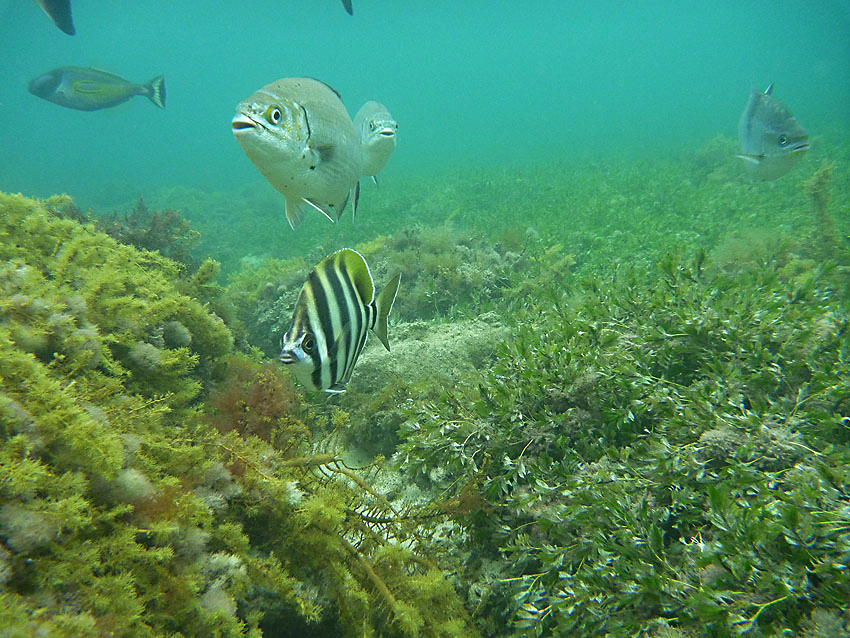
Drummer, leatherjackets, sweep and a moonlighter on the edge of the reef....click to enlarge

Drummer, leatherjackets, sweep and a moonlighter on the edge of the reef….click to enlarge


Warm clear water, a fine day and good light….thinks….twenty minutes later I am snorkeling along the edge of the reef. The water is fairly shallow and the marine life prolific. A school of zebra fish swims close to me and large dusky morwong and magpie perch feed along the undercut shelves that define the reef’s edge. At the end of one rocky outcrop a number of different species are congregating where the reef and the adjacent seagrass meadow intersect. I dive to the bottom and hold onto the rocks to steady myself and fire off a couple of shots. Later when I review the images they seem to reflect both the environment and the moment. An hour in the water and I’m getting a little chilly and its time to go back, this time I walk across the shallow rocky platform exploring the many tidal pools.

A casual lunch outside or fine dining inside....click to enlarge

A casual lunch outside or fine dining inside….click to enlarge


The change rooms at the end of the car park make getting out of the wet suit easy and the short walk up the slope to the restaurant, named after the hapless Star of Greece, gives me a good view north and south along the coast. Often I have caught sight of a pod of dolphins cruising the calm gulf waters but not today; just a few fishers and an optimistic body surfer are enjoying the water. However, after a strenuous swim and a walk along the beach my priorities have changed from natural history to lunch and the boutique restaurant, once a fish and chip shop that I frequented as a lad, beckons. Fresh seafood, quality local produce and wines; a typically South Aussie way to finish my day.


Cheers

Baz

The Art of Nature

17 May

The metallic sculpture sits in the middle of a shady pool. The polished industrial surface in stark contrast to the delicate blue kingfisher that the artist has crafted to pose, lifelike, on its extremity. But it seems that the artist has done the job too well as the supposedly fabricated kingfisher suddenly takes to the air. I have rarely seen sacred kingfishers in the hills and to find one conveniently posed on a sculpture in a pond is simply too good to believe.

2 sacred kingfisher - Copy

Sacred kingfisher….. click to enlarge


I am strolling around ‘The Cedars’ the privately owned property near the tourist hamlet of Hahndorf in the Adelaide hills which is open to the public and host many art displays throughout the year. It was home to South Australia’s most famous artist, Sir Hans Heysen. The German born Heysen moved to SA in 1884 at age 7 where he was inspired by the beautiful and rugged countryside of the Adelaide Hills. He painted rural and landscape scenes for over 70 years in many SA locations before his death in 1968 The home and studio are set in 60 hectares of open woodland and scrub and wandering amongst the bush it is not difficult to see how the area inspired him.

5 heysen studio - Copy

Heysen’s studio….. click to enlarge


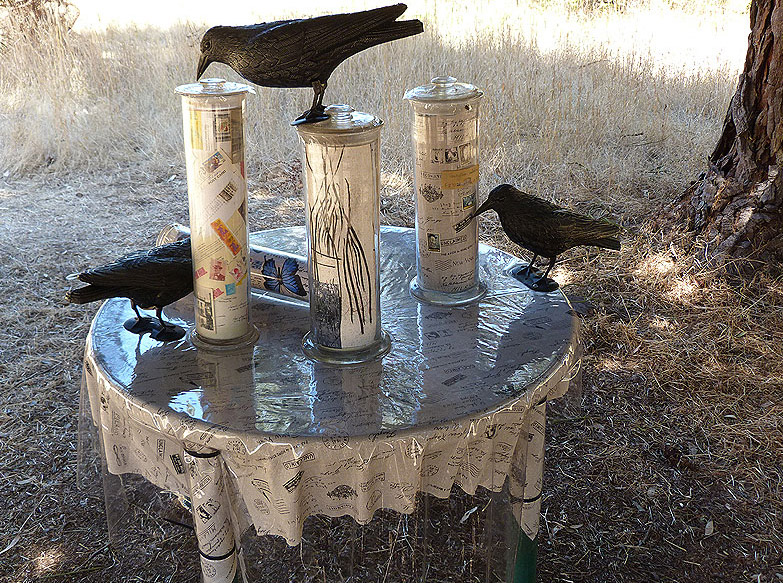
From ‘shady pool’ I climb the gentle slope above Heysen’s studio to explore a stand of Eucalypts. I can hear the warbling of magpies and screech of lorikeets. Half way up the incline I notice another piece of art work. Several crows are balanced on a table peering into glass specimen jars full of postcards. Nearby a pair of genuine, organic crows are perched in some bushes searching for food with their piercing blue eyes. In reality, the birds we commonly refer to as crows are more likely to be Australia ravens as the true crows are usually found further north in drier conditions.

3 crows - Copy

Crow art

IMG_3620 red

Crow/Raven….. click to enlarge


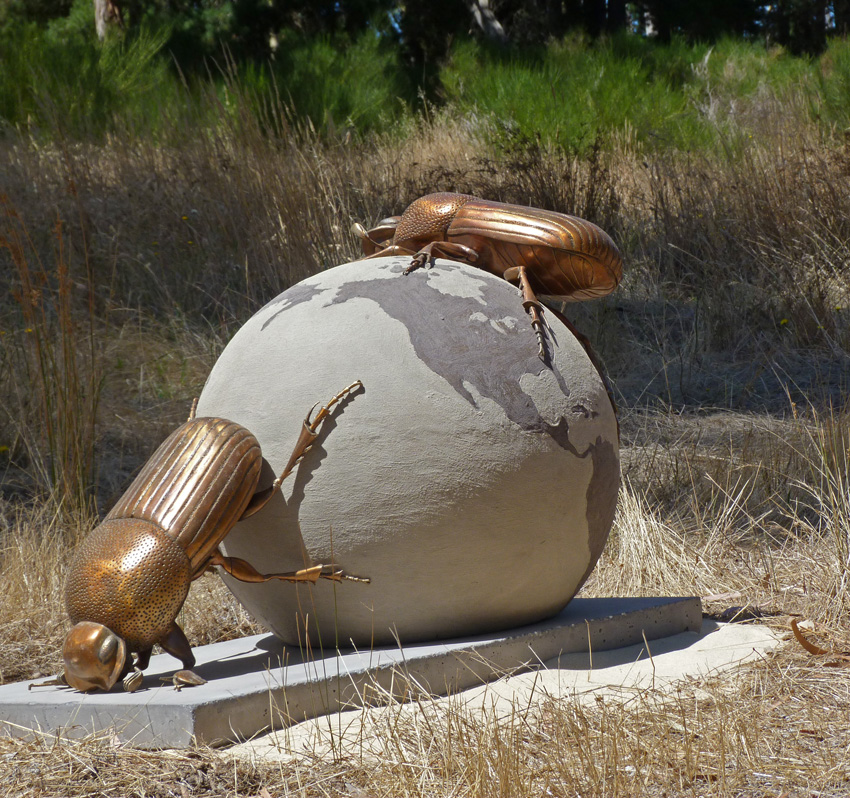
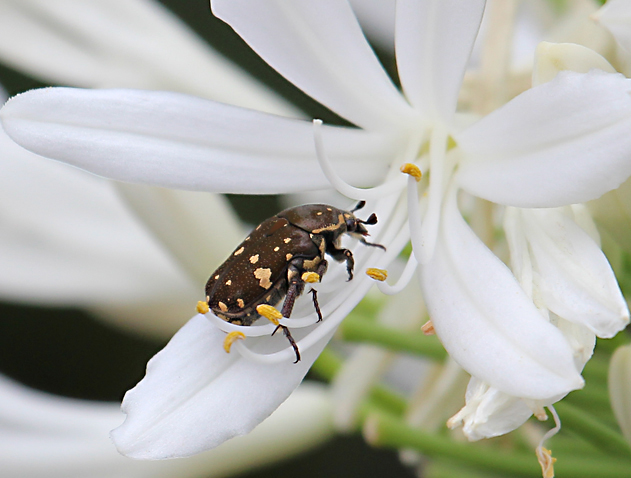
A little further along the trail I discover yet another art work hidden in the scrub: a pair of dung beetles rolling a globe. This piece seems to reflect on the state of the planet as seen by one artist. From this site I take a short walk to the house where Hans Heysen and later his daughter Nora lived and worked. The well kept garden features an eclectic mix of native and exotic flowering plants, the perfect place to find some beetles though not the dung variety which are more typical of Africa not Australia. After a little searching amongst the agapanthus, roses and native species I discover a brown flower beetle crawling across an agapanthus blossom.

P1080531 copy

Dung beetles….. click to enlarge

2 brown flower beetle on white agapanthus (2) red

Brown flower beetle….. click to enlarge


My walk has been both entertaining and informative with each animal species mirrored by a piece of art: a lovely way to spend an autumn afternoon.


Until our next adventure

Baz