Tag Archives: Australian parrots

Adelaide’s Parkland Rosellas

4 May

Dear Reader Adelaide’s CBD is surrounded by parklands. They are a place for workers to enjoy during a lunch break or cyclists and joggers to traverse on the daily commute. They set the tone for the city and also provide a natural backdrop to the everyday business of the state’s vibrant capital. They were conceived by the city’s founder and first governor Colonel Light and are still treasured and protected by those who live in the city and inner suburbs.

AA bike linear park

Bike riding through the parklands

The ecology of the parklands like the commerce of the city has its own rules and hierarchy. magpies and miner birds aggressively mark out and defend their territories, brushtail possums enjoy the nightlife and screeching rainbow lorikeets seem to know everyone’s business.

AB Noisy Miner feeding on a banksia bloom

Noisy miner feeding on a banksia bloom

One of my favourite animals in this urban ecosystem is the elegant and colourful eastern rosella. They are found throughout the Adelaide and Mount Lofty region and seem to have a preference for open woodland where they can find suitable nesting holes, preferably in old growth trees. There has been a pair raising their young in a white cedar in front of my home this year and when I go for an evening walk I can hear the young ones deep in the tree calling to the adults.

AC Male and Female Adelaide Rosellas feeding

Male and female eastern rosellas feeding

Adelaide rosellas are around 35 cms in length with females being slightly smaller with a faintly orange cast to their plumage and less defined markings. They create a nest up to a metre deep within a tree hollow. Both parents feed the young. Rosellas are mainly seed eaters and feed mainly on the ground.

AD Adelaide Rosella on parkland fencepost feeding on wild grain heads

Eastern rosella on parkland fencepost feeding on wild grain heads

For me, one of the attractions of rosellas is their is its truly unique South Australian connection.  Indeed one particular type, the Adelaide rosella,  only occurs within a few dozen kilometres of the city. It is actually a hybrid of the yellow rosella which inhabits the Murray River valley and the crimson rosella which is more prevalent in the south east of the state.

AE Social interaction between Adelaide Rosellas above nesting hole

Social interaction between eastern rosellas above nesting hole

If you walk through the parklands during the spring and summer months it is not difficult to observe these colourful rosellas exhibiting a full range of behaviours from feeding to nesting and mating.

AF Adelaide Rosella perched on nesting hole entrance

Eastern rosella perched on nesting hole entrance

Cheers Baz

← Back

Thank you for your response. ✨

Solandra Wetland’s Musk Lorikeets

4 Jan

Dear Reader

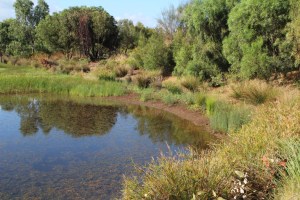
Last week, on a warm summer afternoon, I decided to walk down to the pond at the bottom of the street to photograph a pair of nesting Australian grebes. The pond is part of a chain of wetlands that feeds off the nearby creek and filters stormwater for use on local parks and gardens around Tea Tree Gully. It provides a welcome oasis for many species during the dry summer months and supports a small semi-permanent population of water birds.

Local pond

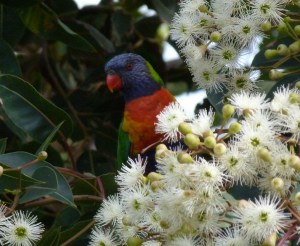
On the edge of the pond there are a few medium sized eucalyptus trees that flower this time of year. They have broad canopies adorned with either cream or coral blossoms and are a favourite destination of the local rainbow lorikeet tribe. As I passed the trees I could hear the raucous screech of feeding birds but the tone seemed a little different to the cacophony of sound that frequently greets me.  A quick glance confirmed that most of these parrots were musk lorikeets with just a smattering of rainbows amongst them.

Rainbow Lorikeet amongst white gum blossoms

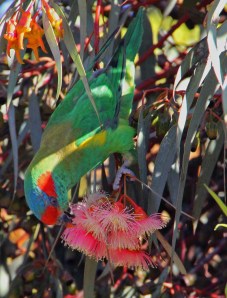
Musk lorikeeets ( Glossopsitta concinna) are medium sized lorikeets between 20-30cms from head to tail. They use their brush tipped tongues to feed on pollen and nectar but will also eat some seeds, fruits and insects. They often travel in flocks and are usually found in dry woodlands where they nest in hollow branches. They are slightly smaller than rainbows and less common in this area.

Musk Lorikeet feeding on coral gum blossoms

I decided that the grebes could wait. And, while I have quite a good collection of rainbow pictures I rarely see more than a few Muskies and the chance to photograph them while feeding does not come along too often. They were endearing little animals to watch as they performed an extraordinary range of acrobatic movements. Sometimes they hung upside down to get their beaks into a bunch of blossoms; at other times they used it as a prehensile tool to climb along spindly branches. Despite their preoccupation with feeding they were still a little nervous and as I moved cautiously around the trees they scattered into the denser parts of the foliage making photography somewhat difficult.

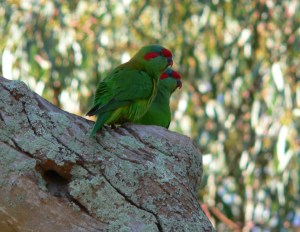
Pair of Musk Lorikeets

I tried sitting quietly in some of the surrounding bushes closer to the pond and using the telephoto on full zoom. An equally unsuccessful manoeuvre, as the birds seemed to rarely feed on the outer blossoms as doing so would probably increase their exposure to local predators like harriers and falcons. Finally I adopted a more professional and scientific approach to the problem; walk slowly, keep shooting and hope for the best.

Musk Lorikeet pair bonding near nest hole

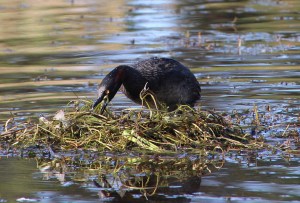
Dozens of frames later, with the light diminishing and more than a few bird droppings adorning my jacket, I left my flock of musk lorikeets to their meal and walked down to the pond for a quick look at the pair of grebes. One was repairing the nest and the other half hidden in the reeds at the edge. Australian Grebe building nest

Another post for another day

Cheers

Baz

← Back

Thank you for your response. ✨