
Adelaide Rosella
Dear Reader:
Over the years I have made several major errors as a wildlife photographer. Perhaps the most telling has been the tendency to see a shot at the beginning of a field trip and not take it as I believe there will be a better one later. Not this time! As I climb out of the SUV I notice a pair of Adelaide Rosellas flying into a gum tree about a hundred metres away. I steady my camera against the vehicle and fire off a couple of frames. And yes; they were the only Rosellas I came close to photographing for the rest of the day.

Trailhead

Typical section of the trail showing some fire damage
I am walking the loop trail in the Hale Conservation Park a few kilometres out of Williamstown on Warren Road which leads to Gumeracha. It is a lovely, compact park with a small parking area and a well-defined track with information panels at the head of the trail.

Flame Heath with Goodenia flower growing through

Cryptandra species
The path climbs gently with generous views of the surrounding rural landscape. There is evidence of fire damage in some areas and significant regrowth; especially the Blue Gums. Although it is winter there are still numerous flowering plants along the trail including Flame Heath and Prickly Cryptandra bushes with Goodenia flowers growing through them.

Clever hands
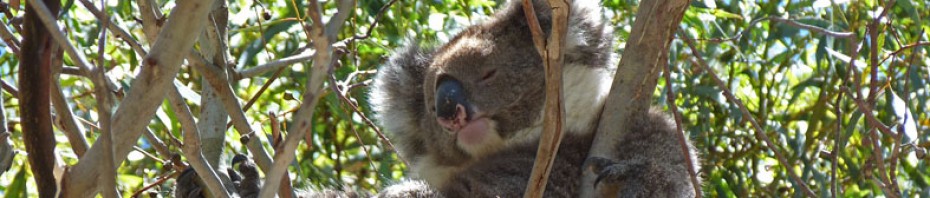
I continually scan both trees and bushes for birdlife, possums and Koalas. On a level section, which gives me an excellent view of trees growing below me on the hillside, I spot a large Koala in the forked branches of a eucalypt. Its grip on the tree provides an excellent example of the prehensile nature of the marsupial’s ‘opposable thumb grip’-a feature more common in primates.

Scarlet Robin and New Holland Honeyeater (ID images only)
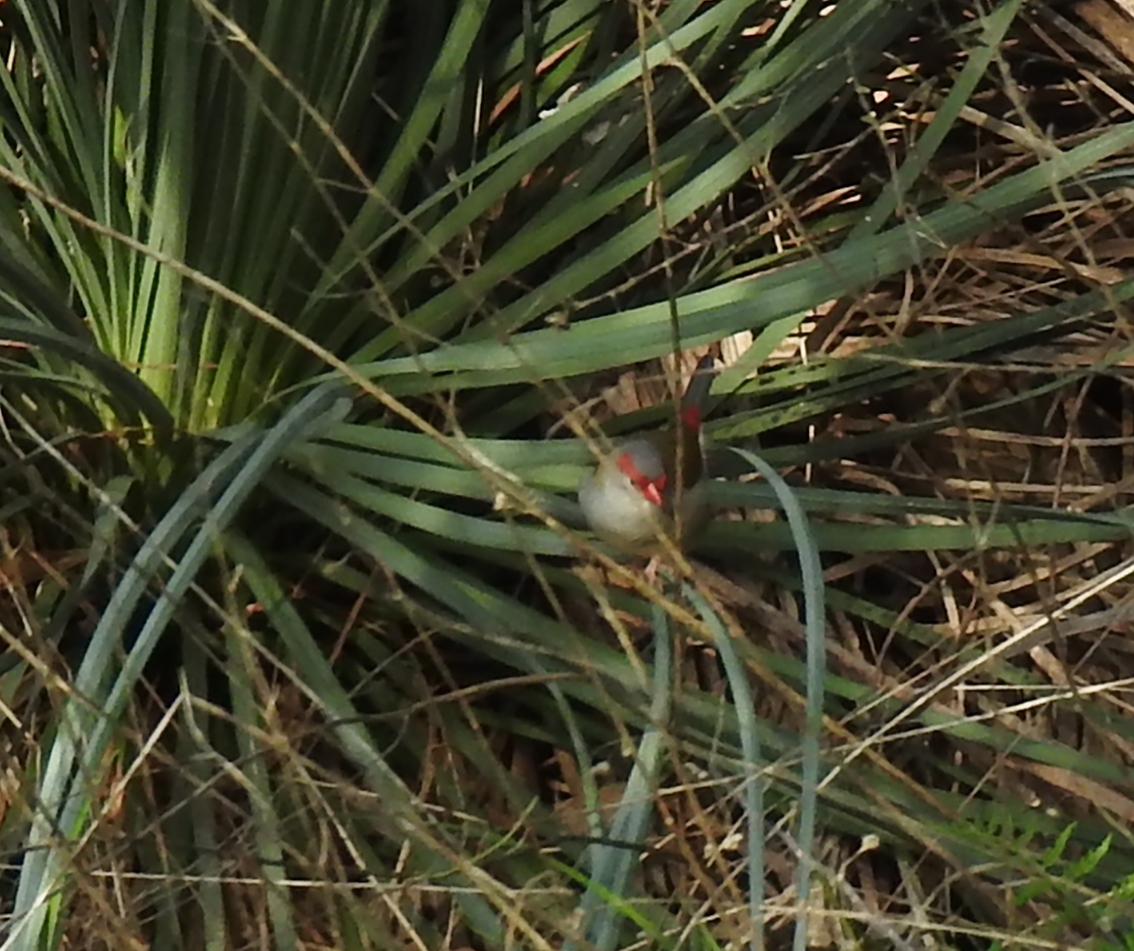
Red-browed Finch (ID image only)
With rain clouds gathering, I decide to backtrack rather than continue along the loop trail. Near the parking area there is a noticeable population of smaller birds which are hard to photograph as they flit between branches and leaves. I decide to take a sit and wait approach and capture some images for identification purposes. My results are far from ideal but they do give a true sense of the difficulty inherent in acquiring good clear shots in a natural environment where animals are wary. Nevertheless, I have included my attempts in this post.

Spotted Ctenotus
When I explore a new area I try to find and photograph animals from as many groups or classifications as possible. In the cooler months, cold blooded animals such as invertebrates and reptiles are the most difficult to locate. It is always worth turning over a rocks and dead tree branches or peering under bark to find animals that might take shelter there, (always replace the item or make sure the animal can move back to a safe place). Today, I find a Spotted Ctenotus; a small, stripy, long-tailed skink, hiding under a rock on a north facing incline.
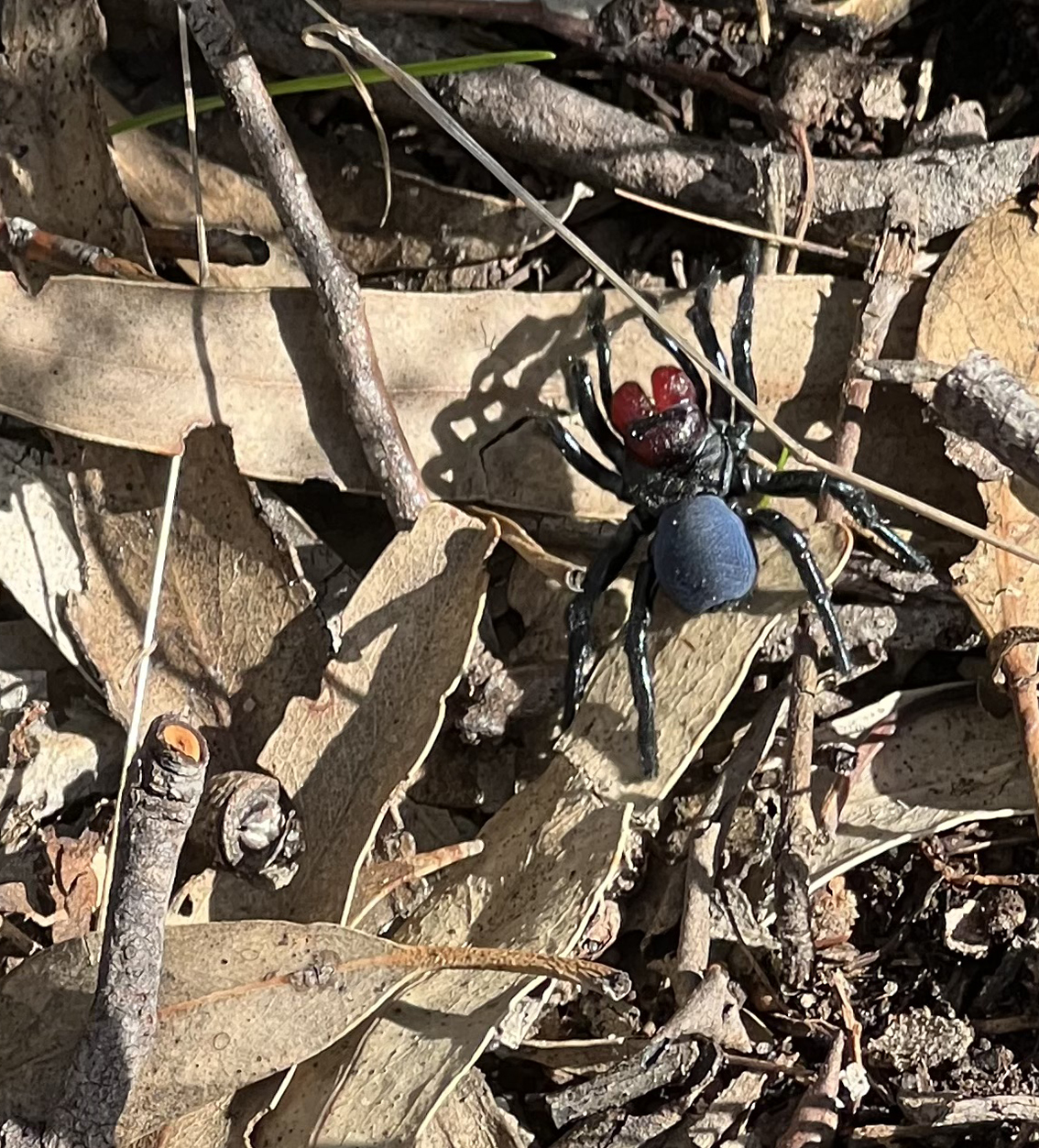
Mouse Spider (Credit Andrew Fitzner)
One of the best things about exploring our parks is encountering like-minded people and today’s walk is no exception. I meet a couple who passed me on the trail earlier and we chat about what we have seen. They show me a picture of a Mouse Spider spotted on the trail and photographed with an I Phone.

My walk completed, including a promise to myself to return in the spring, I drive back to Williamstown and the local bakery to treat myself to a chai latte and one of the best custard tarts I have eaten in ages.
Cheers
Baz
Additional notes
This is a moderately steep walk with a small parking bay. It is not dog friendly.
Please pass on this blog title and or contact information (URL) to any person or organisation with an interest in taking walks and enjoying wildlife in SA.
Click on these links and see more South Australian stories and pictures in my Weekend Notes articles as well as locating similar blogs on Feedspot’s top 20 Australian wildlife blogs




 Naturally South Australia