Tag Archives: South Australia

An Autumn Walk and Drive Around Stirling

21 Mar

Dear Reader:

There are ravens in the tree near the restaurant. We call them crows in SA but the birds that live around Adelaide are usually little or Australian ravens. True crows are found much further north in outback regions. The birds are feeding on some autumn berries in a deciduous tree by the roadside. Every so often, one of the more adventurous gang members swoops down and reconnoitrers the outdoor tables for any tasty leftovers.

1 1 red

Raven disguised as crow


I am sitting in Rubys Organic cafe in the hills town of Stirling, a twenty minute drive from the city along the south-eastern freeway. This charming town of around 3000 people has a distinctly English feel about it. As well as native trees the town has numerous European species and the cooler climate makes it ideal for plants such as azaleas and camellias.

1 2 red

Healthy, interesting and tasty


After a healthy and delicious (gf) lunch of salmon croquettes and a pumpkin and bean salad, I drive out to the golf course on the outskirts of the town. At the end of the aptly named Golflinks road I park the car and walk into the Mt George Conservation Park. Tall stringybarks dominate this section of the walking trail which is part of Adelaide renowned Heysen Trail. Some of the trunks are blackened from earlier fires though most are still alive and bearing new growth. There is a proliferation of native groundcovers including heaths, grevillias and even some tiny orchids and lilies sheltered in the understory.

1 3 red

One of the many small plants growing in the understory, probably a heath


Walking through the forest is enjoyable but most of the bird life is high in the trees and hard to photograph so I return to the car, drive back and head along Old Carey Gully Road to the Mt George turn off. At the little picnic area, pleasantly situated by a small dam, I rejoin the track which is now part of the Pioneers Womens Trail. It runs over a small bridge where I pause to look into the creek bed in search of water skinks or perhaps a water rat (rakali). To my surprise I catch a fleeting glimpse of a small rat-like creature hopping across a pool on a fallen log. It is a southern brown bandicoot, a marsupial, not a rat at all. It pauses for a brief moment on its makeshift bridge and I take a shot. Photographically, the results are somewhat mediocre but in terms of satisfaction as a naturalist, it is a special moment.

1 4 red

Bridge on trail crossing Cox Creek


1 4 2 red

Unbelievable to get a photo of a bandicoot especially in daylight hours


But the bandicoot is not my last marsupial. To really ‘make my day’ I spot two koalas, probably a mother and joey, perched on a slender eucalypt overhanging the creek bed.

1 5 red

Mum and youngster


I started with lunch in Stirling and I decide to finish with a visit to Aptos Cruz; one of my favourite hills art galleries.

1 7 red

Aptos Cruise gallery from the top floor


However, on the short drive back to the town nature provides one last surprise when a deer bounds out across the road then pauses amongst the singed trunks of the gums on the edge of the roadside

1 6 red

Oh dear, wrong continent!!!

Cheers

Baz

Wildlife and Wineries

15 Mar

Wildlife and Wineries

Dear Reader:

I can hear the first few notes of a kookaburra calling near some picnic tables across the other side of the green. The birds are usually quite shy and I don’t hold out much hope of sighting them with all the families enjoying their lunch on the grass. However, to my surprise there are two birds sitting on a low branch quite close to a group enjoying a BBQ and glass of wine. I have seen kookaburras steal a sausage in the past and these birds must be residents accustomed to life in the grounds of one of South Australia’s most notable wineries.

1 1

Laughing kookaburras


Seppeltsfield winery in the Barossa Valley is a pleasant 50 minute drive from the city. Easily recognised by the avenue of huge palms at its entrance, the rambling complex encompasses: green spaces, bushland, old buildings, a family mausoleum, fine restaurant, cellar door facilities and even an art gallery; and that’s without even mentioning the sprawling vineyards. Established in 1851 the land was initially used for growing tobacco then wheat and finally grapes in the mid 1860s. Today, it is one of the nation’s most famous and revered wine wineries.

1 2

Jam Factory gallery


I decide that a bushland trek in the area is not by best wildlife option. Today, I will simply wander around the grounds enjoying the animals that take advantage of the plantings, food and shelter that this popular rural setting can provide. My strategy pays off when a wattle bird hops down onto one of the slate tables just a few yards away. Like the kookaburras, wattle birds are fairly common but shy and often difficult to photograph. Having one so close is a rare opportunity.

1 3

Wattle bird


1 4

Picturesque grounds

From the picnic area I take a walk around the courtyards near the restaurant enjoying the tasteful landscaping and searching for insects amongst the plantings. There is a good selection of butterflies this time of year and several different kinds of tiny spiders are hunting amongst the flowers.

1 5

Flower spider n blossoms


After a late afternoon meal ‘Local Garfish, Skordalia, Snowpeas and Vegetable Escabeche’ at ‘FINO’ and a sample sip of the wonderful vintage port that Seppeltsfield is renowned for, I call it a day. As I walk back out to the car park a young magpie fixes its gaze on me cocking its head to one side as if to bid me farewell

1 6

Fond farewell from magpie gatekeeper


Cheers

Baz    

Athelstone … a river walk…field notes and images

15 Oct

Athelstone … a river walk…field notes and images


Dear Reader: I hope that you enjoy the field notes and images from my day exploring the lower reaches of the Torrens Gorge near Athelstone. I will be using this style from now on as it allows me to share more observations and thoughts with you.


Spring 12/10/2015

A cool morning with a little cloud cover and patches of blue sky

Drove from city to Gorge Road intersection then to Athelstone, approx 20 minutes

Stopped in at bakery to get steak pie, apple tart and fruit juice

Photographed historic community centre, lovely roses on display

Spoke to history officer

Quite a few colonial buildings in the area worth visiting

Started walk from the mining road 2.8 Kms from Athelstone Council chambers, just past stone and fibre house on RHS of main road, parked near the causeway (ford)

Followed old, narrow bitumen road along left bank of Torrens heading up the gorge (upstream) towards historic aquaduct

B18 jpeg

Council chambers

B17 image

Stone and fibre home by turn off


Trail to aquaduct only 800 meters

Not going to walk off impending lunch this way

Walked slowly, stop, look and wait

Can hear small birds twittering in scrub to the left

Several little wrens fossicking in leaf litter

They appear to be different species as one has a blue tail

All are females as fairy wren males of the most common species have patches of bright blue plumage

B8

Female superb fairy wren

B9

Male superb fairy wren


Koala in dense foliage of a non native tree, unusual

There are several gums nearby, perhaps this tree is shadier

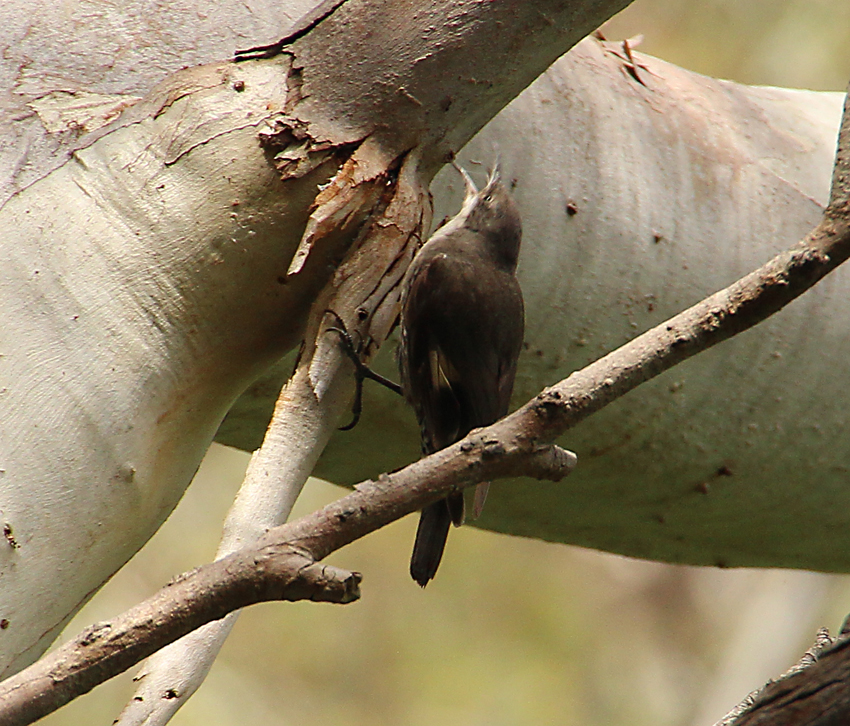
Tree creeper (possibly white throated) feeding probing for insects on a eucalyptus tree, seems to be favouring old and dead branches

Note the huge feet for gripping and providing stability

Hard to get a clear shot

Switch to shutter priority to stop action 1/1600 should do

B13

Koala

White throated treecreeper

White throated treecreeper


Reach the aquaduct

Note the signage about its history

State listed heritage item in 1980

Operated continuously for 138 years carrying water from Hope Valley Reservoir

There is a deep pool below

Scan the edge of the water and several logs for fresh water turtles…nothing

A water skink is basking on one of the flat rocks

As I approach and take a couple of shots it disappears into the undergrowth

I have often photographed these little reptiles and never seen one in the water swimming

B10

Aquaduct

IMG_8953

Eastern water skink


Start return walk to car

Expansive views of the gorge rising on the SE side

Several cyclist ride past on the main road above the river

They use the steep road for training

Concentrate on the other side of the path on return walk

Yellow tail black cockatoos fly above

See and hear a lot of Rosellas in taller trees

Manage to get a shot of a crimson feeding on berries in tree top

Stop to look at interesting gum trunk with red sap oozing from it

Like the colours and texture

B20 red

Bark patterns and gum resin

Back at car

Drive to park about 1 kilometre out of Athelstone to walking trails in parkland area, still has Torrens flowing through

Lunch on a bench watching some magpies haggling over territory

A Good morning’s work

Cheers

Baz

Walkerville’s Bickle Reserve…..Fairies in the Garden

4 Sep

Fairies in the Garden

Dear Reader:

As I have categorically stated in several of my posts, “I am no botanist”. I love gardening and appreciate the wonderful diversity of South Australia’s flora but remembering all the different classifications, names and botanical intricacies is just a little too much like hard work. Instead, I rely on a couple of field guides to common plants in the Adelaide area, phone a friend or simply make reference to those yellow bushes or tall straight eucalypts. Hopefully, this gap in my naturalistic armoury will be narrowed as I write more nature posts, though the signs are not promising. So: it is with some trepidation that I lead into the following piece …….

P1130228

Pink fairy (Caladenia species)

IMG_8066

The Torrens near Bickle Park

 ….It is a cool winter’s day, slightly overcast and I am on my knees examining a glorious little patch of native orchids. Most are pink fairies but there is one tiny delicate bloom, the size of a little finger nail, called a gnat or mosquito orchid. Nearby several of the flat prostrate leaves indicate where other orchids will appear in the near future.

P1130247

Gnat orchid (Cyrtostylis species)

All of these species are endemic to the area and though a few might have grown naturally, most are the result of a dedicated group of volunteers who are revegetating this area which is part of the Vale Park Wildflower Walk. The section I am exploring is alongside the Torrens River just east of the autobahn bridge near the Bickle Reserve. Several of the Vale Park group are holding an open morning and explaining the importance and biology of the plants they have established.

P1130234

Chatting about orchids

IMG_8071

Native Wisteria (Hardenbergia)

IMG_8099

Purple swamp hen

As I listen to information about the relationship of certain fungi in the soil to the propagation of orchids and marvel at the spidery native clematis and hardenbergia that are climbing up some eucalypts (big tall ones) I notice a pair of purple swamp hens foraging in the long grass by the river. Leaving the group I pursue the birds and make my way along the bank where there are also dusky moorhens in the reeds and crested pigeons feeding near the bikeway.

IMG_8059 edit

Dusky moorehen

Rejoining the group I chat about the importance of maintaining our wild heritage for future generations and learn about Aboriginal use of some types of native plants including orchids. Predictably in this group I encounter another wildlife photographer and the conversation fluctuates between nature and the lenses we have used for different purposes.

IMG_8088

An occasional visitor

In the course of our conversations one of the replanting team asks me if I have any images from the area and I remember that on a bike ride along this part of the linear park trail I had photographed a koala high in the largest eucalypt overshadowing the orchid beds. But, in keeping with my botanical prowess I forget to ask what kind of species it is (probably a tall, straight one).

Until the next journey into SA’s natural wonders

Cheers

Baz

PS

Check out Geotravelling a new site that I have attached that celebrates the natural, cultural and urban diversity of our planet through my travel photographs.

Adelaide’s Frome Road Bikeway

16 Aug

Adelaide’s Frome Road Bikeway 

Dear reader:

One of my favourite bike rides starts in north Adelaide at the junction of Barton and LeFevre Terraces. From the roundabout, a dedicated bike lane follows Le Fevre Terrace which is flanked by open parklands on one side and lovely colonial homes on the other. For the marginally more adventurous, there are several paths through the park that run almost parallel to the road. Noisy miners, honeyeaters, magpies and lorikeets are common here and in the evening you might see brush-tailed possums in the trees.

miner bird5

Noisy miners are a species of honeyeater

1

Nice little house with a good view of the parklands


The bike lane curves down towards the city through more parklands and playing fields. Huge Moreton Bay Fig Trees dominate the parklands providing a vantage point for both rose breasted and sulphur crested cockatoos that often fly down to the grass in search of food.

2a

Galahs having a bite to eat


Just over the Frome Road Bridge, Adelaide Zoo’s classic entrance marks the end of the parklands. Tucked between the zoo and the Botanic Gardens there is a stand of huge pine trees. Look up and it’s hard not to notice a large colony of fruit bats (flying foxes) that call these trees home.

2b

Entrance to the zoo

2c

Fruit bats in the trees


After the zoo there is a well marked bike lane that runs up Frome Road past the medical school and hospital. The lush lawns around these buildings are a favourite haunt of Sacred Ibises that probe the soft ground with their long curved beaks in search of worms and grubs.

12

View of the Torrens from the Frome Road Bridge


3

Sacred ibises feeding


As Frome Road crosses North Terrace you enter a purely urban environment with a wide bikeway that cuts all the way across the city towards the southern parklands. This charming region of the city has many unique little houses and flats decorated with native plantings providing a rich urban ecosystem that supports common bird species such as sparrows, blackbirds and magpies.

10

Magpies carolling in an urban environment

11

Stopping for a coffee along the way


The bikeway finally emerges at the Himeji Japanese Gardens. These gardens are dedicated to Adelaide’s sister city on the Japanese island of Honshu. In keeping with the rest of Adelaide’s green belt parklands the signage also relates to the aboriginal heritage of the area. Rosellas and lorikeets are common inhabitants in the ancient eucalypts that characterise this southern edge of the city.

5

Japanese garden

6

White cheeked eastern roesella


From the Japanese Gardens there are bike paths that meander through all of the southern parks but their wildlife and charms will be the subject of a further post in the warmer months to come.


Cheers

Baz

Tea Tree Gully’s Camellia Nursery

5 Jul

Dear Reader:

It is a cool crisp morning, and to be perfectly honest, I am not in the mood for a long drive. Instead, I have decided to visit a local nursery just a few kilometres away, where the North East Road starts its climb into the Adelaide Hills.

1a Newman's nursery

Newman’s nursery front entrance


As I park the car next to the entrance I am immediately struck by the contrast in lighting conditions. The path following the little creek that leads from ‘Newman’s Camellia’ nursery to the ‘Tea Tree Gully Hotel’ is in deep shade whereas the hills on the opposite side of the road are bathed in sunlight. An afternoon walk might have offered better lighting for photography but the wildlife always seems more active in the morning.

1a Start of the walk

The path begins


Climbing out of the car I glance up at the hillside above the little creek and to my surprise and delight I notice the hunched outline of a koala wedged between the branches of a huge gum tree; not what I was expecting this close to a suburban area.

1a koala in tree

Koala in tree


The trail starts just a few metres from the nursery entrance and meanders alongside the small watercourse for a mere 500 metres before broadening to a neatly manicured lawn enclosed by trees and shrubs. A varied collection of plants flank the path; including arum lilies, several lovely camellias, indigenous wattles and melaleucas as well as the ever-present, towering eucalypts.

1a Rogue camelia

A rogue camellia alongside the path


Small birds are continually flitting through the bushes though I am only able to catch fleeting glimpses of them. Some are definitely female blue wrens and I suspect that the tiniest ones are thornbills. Eventually, a small brownish bird settles in a low, flowering shrub some 50 metres away. I fire off a series of shots which, on review, reveal a glorious eastern spinebill.

1a Eastern spinebill  foraging in shrubs

Eastern spinebill foraging in flame heath bush


At the end of the trail half a dozen magpies are foraging for grubs in the well tended lawns. Several enormous gums tower over the grass and a pied currawong is perched on one of the topmost branches with a seed pod hanging from its beak. Another bird joins it, they seem nervous, jumping between branches before flying off, possibly to a nesting site.

1a Currawong with food approaching nest

Currawong approaching nest with food

The walk back is equally eventful with both rosellas and lorikeets feeding on berries in the scrub along the edge of the trail but capturing a sharp image in the shadows and overcast conditions is somewhat challenging.

1a Tapas on the terrace

Tapas


Newman’s nursery has a charming little restaurant with both inside and alfresco dining areas which afford a fine view of the hillside on the other side of the road. While I enjoy the delights of a tapas snack I notice several tiny finches feeding on the liquid amber trees that decorate the front of the nursery. From my outside table the birds are just within camera range and using the long lens I am able to identify them as European goldfinches.


1a European goldfinch in liquid amber tree

European goldfinch in liquid amber tree


Until next time

Baz

Tea Tree Gully-An Afternoon in San’s Garden

12 Jun

Dear Reader:

Sometimes, it is not about four wheel drives, walks in the bush or diving on a reef. Sometimes, South Australia’s wildlife wonders are the common animals and plants that live  right under our noses in the backyard. Last weekend I grabbed a pie and a doughnut from the local shop, pulled out the recliner and watched the antics of the local critters in my friend’s garden. I hope you enjoy the pictures and a few minor, explanatory observations.

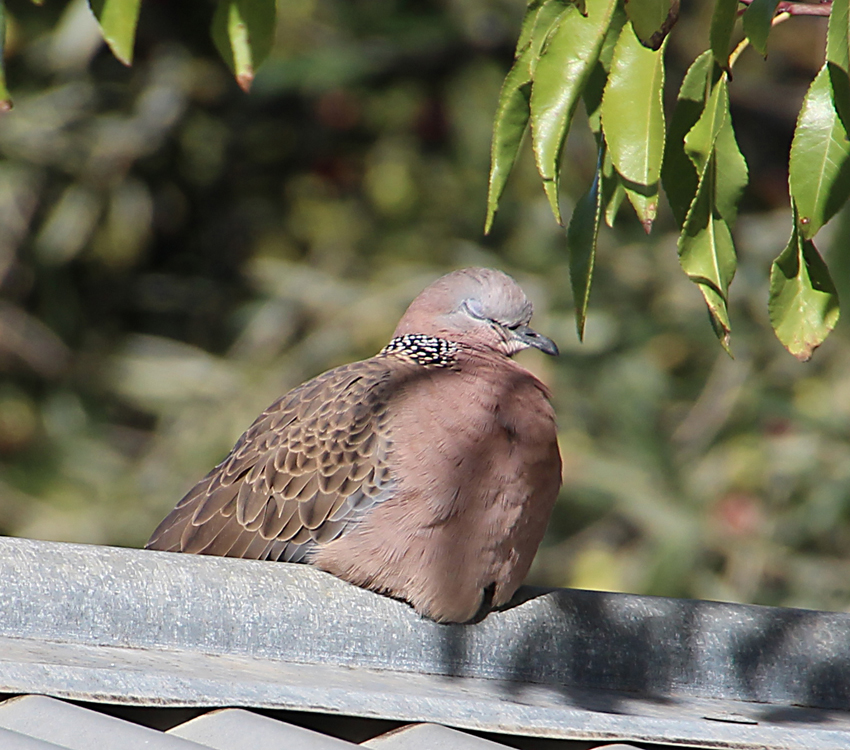
Spotted dove snoozing on the garage roof

Spotted dove snoozing on the garage roof

To initiate proceedings, a spotted dove landed on the garage roof, much to the consternation of a local cat, who sat and stared at it for a few minutes, decided it was too much work then nonchalantly strolled off to find easier prey.

New holland honeyeater feeding on orange honeysuckle

New holland honeyeater feeding on orange honeysuckle

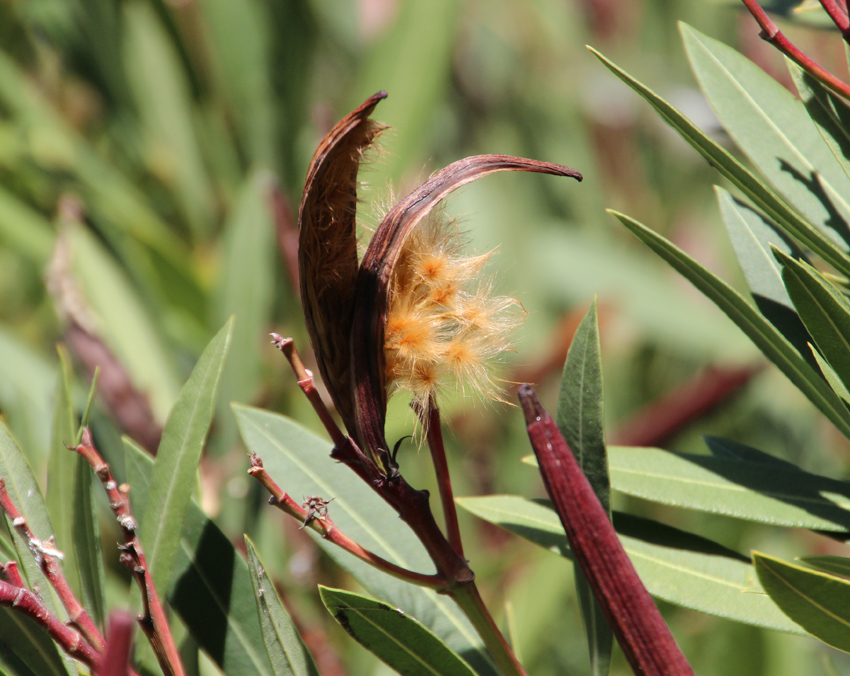
Oleander seeds pods

Oleander seeds pods

New holland honeyeater catching insect in mid flight

New holland honeyeater catching insect in mid flight

While the dove dozed the high energy brigade arrived in the form of a squadron of new holland honeyeaters who proceeded to feed on various blossoms, hawk for insects and in one bizarre instance; pull apart the seed pods of an oleander. Fair enough if it was nesting season but a little hard to fathom at the beginning of winter!!

Hover fly grabbing a suck to eat

Hover fly grabbing a suck to eat

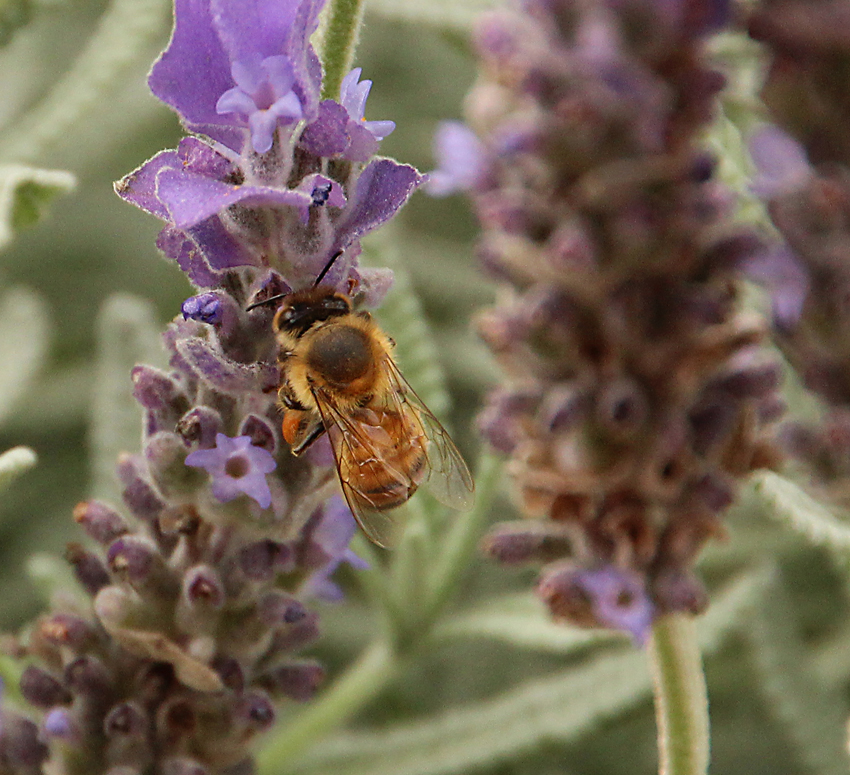
Bee on lavender

Bee on lavender

The winter months are not too conducive to insect life but a few ‘die hards’ do persist and the lavender and daisies played host to quite a number of bees and hover flies respectively.

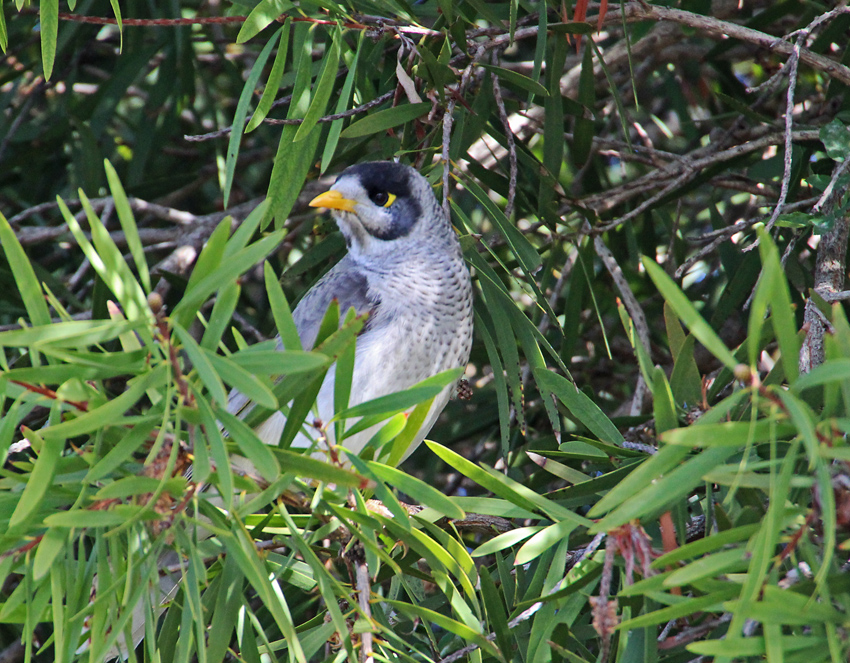
Noisy miner surveys the garden with a bandit glare

Noisy miner surveys the garden with a bandit glare

Whatever the season my little bandit friends are always around with their masked faces and grey plumage. A small flock of noisy miners did the afternoon rounds, harassing the other birds and making their presence felt; arguing as much with each other as the other species.

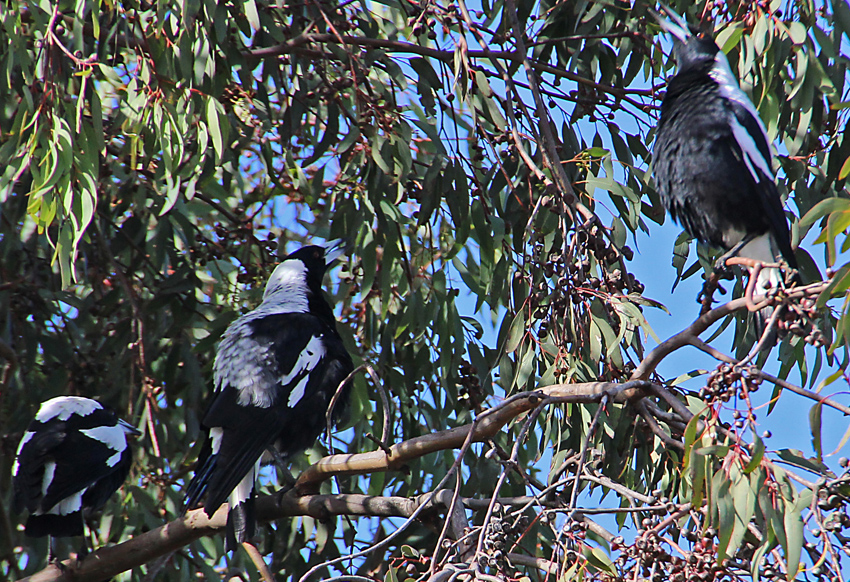
Singing the team song in the old gum tree

Singing the team song in the old gum tree

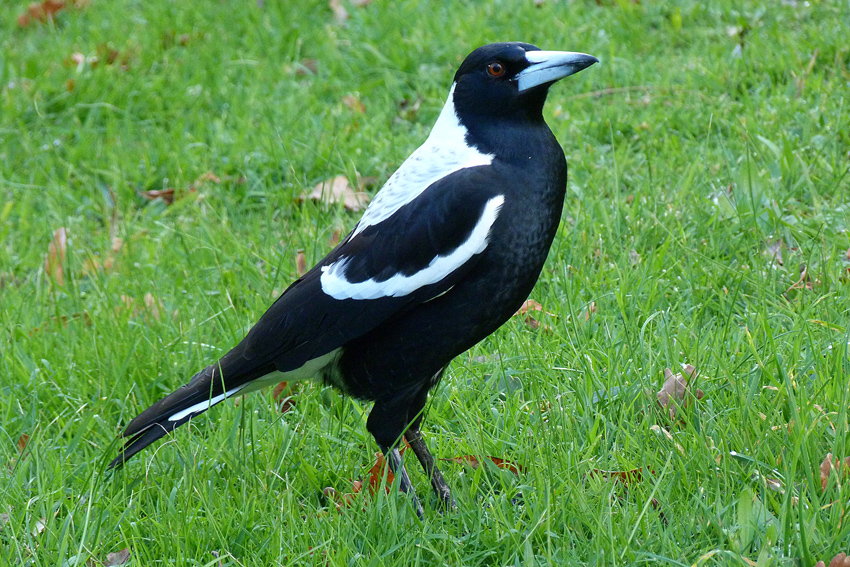
Strutting his stuff on the back lawn

Strutting his stuff on the back lawn

Just as I was settling for a little snooze when the warbling (carolling) call of white backed magpies brought me to my feet. I walked around to the front garden to see a trio of the large black and white birds high in the crown of a roadside eucalypt loudly proclaiming their territory. Then, the largest and obviously most confident bird flew down into the garden only a few metres away to search for grubs.

Quinnus muchsuddliusforaging in the fairy garden

Quinnus cuddlius foraging in the fairy garden

Back to recliner, pictures taken, lunch finished; book or snooze again beckoning…when the most active of all the garden’s wildlife toddled in and a restful, lazy afternoon dissipated like an early morning mist evaporating when the sunshine arrives.

Enjoy your own gardens

Baz

Brougham Park on a Winter’s Afternoon

7 Jun

Dear Reader:

It is late in the afternoon and a bit on the chilly side. Grey skies and showers have alternated all day with patches of blue and occasional bursts of sunshine through the clouds. My car is parked in O’Connell Street where I am meeting friends in an hour for a bite to eat then a movie at the art deco Piccadilly Theatre. Typically, and despite the weather, I have arrived a tad early with camera in hand, hoping that I might encounter a little urban wildlife.

O'Connell street has a woderful collectionof cafes and restaurants

O’Connell street has a woderful collectionof cafes and restaurants


At the end of O’Connell St the road curves down into the city through a little patch of parkland. Asphalt paths cross this little green oasis which is dotted with tall eucalypts, pines and several large Moreton Bay Figs. I can hear parrots calling in the tree tops and eventually I spot a rainbow lorikeet shuffling along a branch high in the crown of one of them. With a flourish of feathers, a second bird appears and the parrots start to preen and gently peck at each other. They seem to be a mating pair settling in for the night. Nearby a lone eastern rosella appears to be looking on with a touch of sad envy…anthropomorphic, I know.

Just dropped in to say Hi

Just dropped in to say Hi

A lone eastern rosella sillhouetted against the late afternoon sky

A lone eastern rosella sillhouetted against the late afternoon sky


I sit and watch the birds for a few minutes while scanning the rest of the tree with my telephoto lens when I notice the furry coat of a possum wedged in a hollow. I toss a couple of pebbles against the branch. The brown patch moves and a tail appears for a second as the owner moves further into the tree; definitely a possum, probably a brush tail as they are far more common than their ring tail cousins.

Daytime view of a brushtail possum

Daytime view of a brushtail possum

Parkland possums forage at night

Parkland possums forage at night


On the eastern side of the park the imposing facade of the Brougham Place Uniting Church is framed by the massive leaves of an old fig tree. There are birds flitting though the foliage but in the afternoon shadows it is impossible to identify, let alone photograph them.

Brougham Place Uniting Church across park

Brougham Place Uniting Church across park


Before heading back up to my parked car I walk further down Brougham Place alongside a red brick wall that cordons off one of the area’s classic old mansions. A tangle of olive tree branches straddle the top of the wall and deep in their shadows a pair of crested pigeons are finding a sheltered place to roost.

Classic homes and businesses surround the park

Classic homes and businesses surround the park

Crested pigeons in olive tree

Crested pigeons in olive tree

Even on a cloudy winter’s afternoon, Adelaide has yet again delivered a memorable wildlife experience; a fascinating and ever-changing urban ecosystem available to anyone who takes a few moments out of their busy day to stop and look.


Thanks for reading my work

Cheers

Baz

North Adelaide……the lion circuit

8 May

Dear Reader:

It is a mild sunny morning and I am enjoying one of my favourite bike rides. Starting at The Lion Hotel I ride away from the city along Melbourne Street to the Park Terrace intersection. The street is an eclectic mixture of cafes and niche retailers selling anything from clothes to antiques and Persian rugs.

2

Classic old building converted into shops and galleries


Crossing Park terrace I wind my way through narrow streets and past some lovely old homes to intersect the path that runs alongside the Torrens River before it hits the city proper. The river has cut a narrow gorge through the ochre coloured rocks and tall eucalypts dominate the trail. A pair of rainbow lorikeets is fussing around a nesting hole and one bird takes flight as I dismount to take a closer look.

P1030399

Rainbow lorikeets nesting


A wooden boardwalk descends towards the river and the weir that controls the water flow. Common pigeons can often be seen foraging along the steep hillside early in the mornings. I think that the clay might supplement their diet and aid digestion.

5

Boardwalk trail along the river


6

Common pigeon feeding on cliff-side


Where the walkway levels out a small bridge splits the trail with one path leading back into the city and the other north east to the foothills. I head for the city. The track is flatter here and I pass numerous joggers and other cyclists all enjoying the fine weather.

7

Foot and cycle crossing near St Peters


4

Large dragonfly resting in a bottle brush near the river bank


Just past the little foot bridge the path sweeps under the much larger Hackney Road Bridge that carries the majority of traffic into the eastern side of the city. Here, the river widens, slows and becomes the Torrens Lake. As if to herald the change, a graceful snowy egret stands sentinel-like amongst the reeds watching for prey. Further along the waterway, a great cormorant perches close by with similar intent. These larger predatory water birds seem to indicate a greater abundance of prey in the lake.

8

Signage explains Aboriginal connections and other historical facts


9

Great Cormorant perching on the lake behind the zoo


egret edit

Egret hunting in reeds


Although the path follows the lake right along the northern edge of the city, I only ride a couple of hundred metres further to the Frome Road Bridge. Pausing briefly to take in the view of the lake, city and zoo from the top of the bridge, I turn right and head past the playing fields riding parallel to Mackinnon Parade through an avenue of massive, stately eucalypts. Cyclists, joggers and football players of all codes share this green space with cockatoos and other parrots that squawk in the trees and feed in the grass.

10

Cockatoo foraging on the oval near McKinnon Parade


Left near the end of the tree line and I’m back where I started and ready for coffee or breakfast at The Lion.

1

Back at The Lion


A brilliant way to spend the morning!!

Try it some time!!!

Cheers

Baz

Old Noarlunga….A River Walk

17 Apr

Dear Reader;

As I pull the SUV into the parking area I can hear the sound of cockatoos and corellas foraging in the recreation area just a cross the road. At the beginning of the walking trail several monarch butterflies are hovering around a stand of late flowering eucalypts. They are all part of a sudden surge of activity following recent morning showers; a welcome distraction after a long hot summer and a dry start to autumn.

P1080891

Corellas feeding


IMG_6156

Monarch butterflies


There are several marked trails that I can take from the park but today I am simply following the bitumen path along the river front to get some idea of the terrain and wildlife. This side of the river is bordered by the little township of Old Noarlunga and the area is quite significant in terms of South Australian history. For thousands of years it was a meeting place for the Kaurna people who lived along the river banks in natural caves or dome shaped dwellings. Later, during the early years of European settlement the area was a rest stop for bullock trains and some of the timbers and bricks in the park are remnants from the old Horseshoe Inn that burnt down in 1987.

IMG_0350

One of the larger pools


On the far side of the river, the summer brown hills rise steeply and there is mixture of native scrub and cleared grazing land. A wood and cable bridge links the two banks and a small group of students appear to be carrying out some kind of environmental survey on the opposite bank.

IMG_0360

Footbridge across the river


The river is at its lowest during this time of the year; a series of large pools linked by pebble strewn shallows where the water flows slowly. At the far end of one pool a white faced heron is hunting stealthily amongst the rocks. Every so often the bird jabs its long beak into the water to grab, what appears to be, some kind of large insect larvae.

IMG_0356

Grey faced heron hunting


After a while I decide to rest on a large tree stump above one of the larger pools and simply watch the water. Near the reed beds I can make out the shapes of some sizeable bream cruising between the bank and several submerged logs in the middle of the river. At the end of the pool there are large black cormorants perched on branches that overhang the water. Surprise!!! They are also watching the fish.

IMG_6147

School of bream in shallow water


A few hundred meters further up the track there is a side road that leads to The Old Noarlunga Hotel. In the warm weather a drink and lunch are a welcome break before I head back on the other side of the river. As I start to pack away the camera, a flash of grey catches my eye. A large bird flies along the river bank and lands in the trees quite close to where I am standing. Pulling the camera back out, I walk slowly towards the target keeping a large tree in line for cover. It turns out that the bird is an Australian bittern, a heron-like species that is not often seen in the daylight hours.

IMG_0374

Old Noarlunga Hotel


bittern

Australian bittern


Half an hour later, refuelled and rehydrated I shoulder arms and head back down to the river to explore the other bank. But that area will be the subject of a future post, perhaps in the springtime, when the character of the river will have changed again.


Cheers

Baz