Dear Reader:
The predatory bird circles high in the morning sky then swoops down low to within a hundred metres of me. A Wedge-tailed Eagle, Australia’s largest bird of prey.

Wedge-tailed Eagle hunting
I am heading for the Kaiserstuhl Conservation Park, a twenty minute drive from Nuriootpa in the Barossa Valley and around 90 kms from Adelaide. Kaiser Stuhl was a popular winery, now incorporated into Penfolds, that flourished in the region for over half a century. The name comes from a prominent hill in the Barossa. Indigenous people referred to the area as Patpoori which means little grass tree, a species common to the area.

Beginning of the Wallowa Trail
As I approach the park from Tanunda Creek Road the boundary between native scrub and vineyards is quite obvious; a metaphor for the unique blend of beautiful countryside and rural endeavour that typifies the Barossa Valley.

Scrub and vines on the periphery of the park
I leave the car opposite the entrance to the park and clean my boots in the scrubbers provided which lessens the chance of transferring Phytophthora (root rot) infection. Two Tracks, Stringybark and Wallowa are clearly marked and I choose the latter. Within a few metres I spot a group of Superb Fairy Wrens in the undergrowth; their fluffy plumage suggests that some are juveniles.

A juvenile Superb Fairy Wren is well camouflaged in the leaf litter

Leaf Curling Spider inside leaf and attached to web
To my surprise and delight there are numerous identification plates near the base of some bushes and trees. As I am not a particularly competent botanist, being able to easily name some of the plants I encounter when constructing my posts is a real bonus. I wish more parks would follow this example. I pass some banksias which have been fire blackened, a process which opens up their seed pods helping to rejuvenate fire affected bushland. Further along the trail I notice a Leaf Curling Spider which has built its web, and suspended home, in a Grass Tree.

Eucalypt and Grass Tree (Xanthoria) scrub
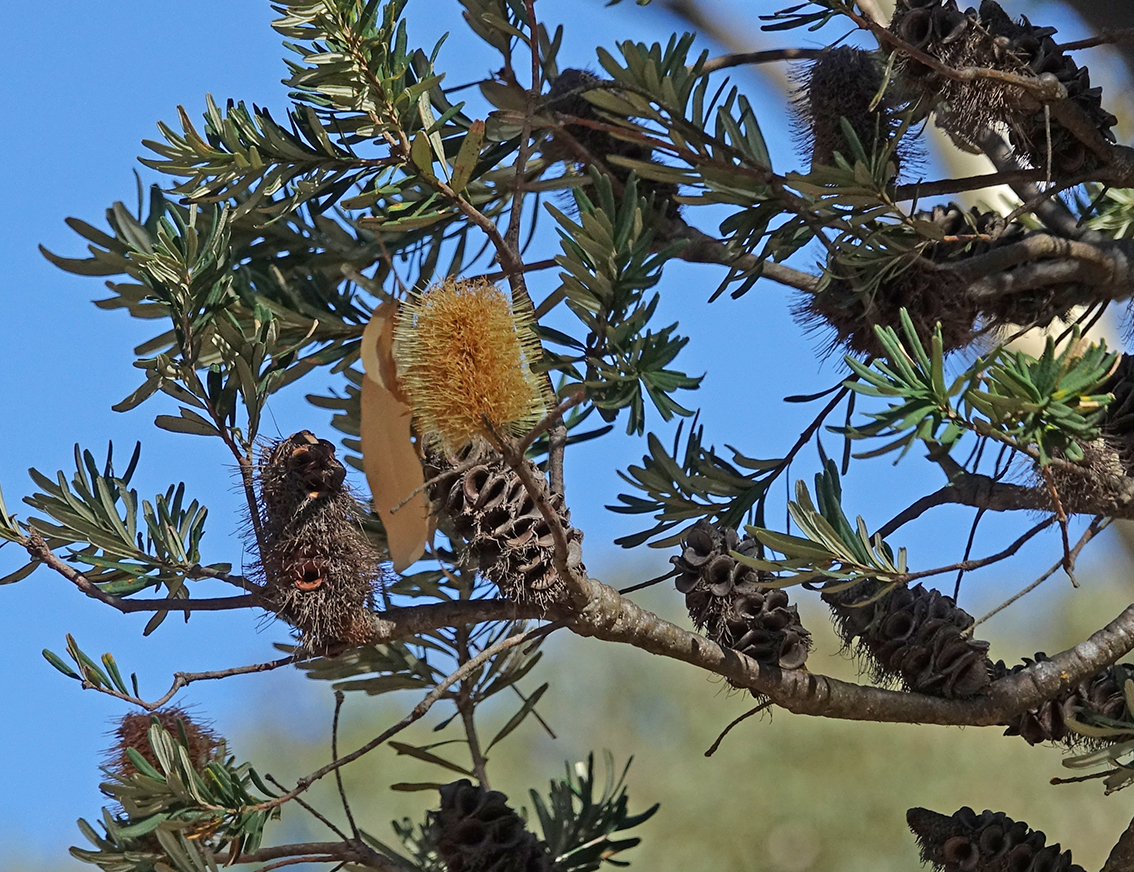
Banksia species showing flower and open seed pods
There are smaller birds in the canopy and I use the full extension of my Sony RX10 3 to identify them. However, getting a clear photograph proves impossible. Later examination and a lot of Photoshopping reveals them as: Silvereyes, a pardalote species, Crescent Honeyeaters, New Holland Honeyeaters and a Scarlet Robin.
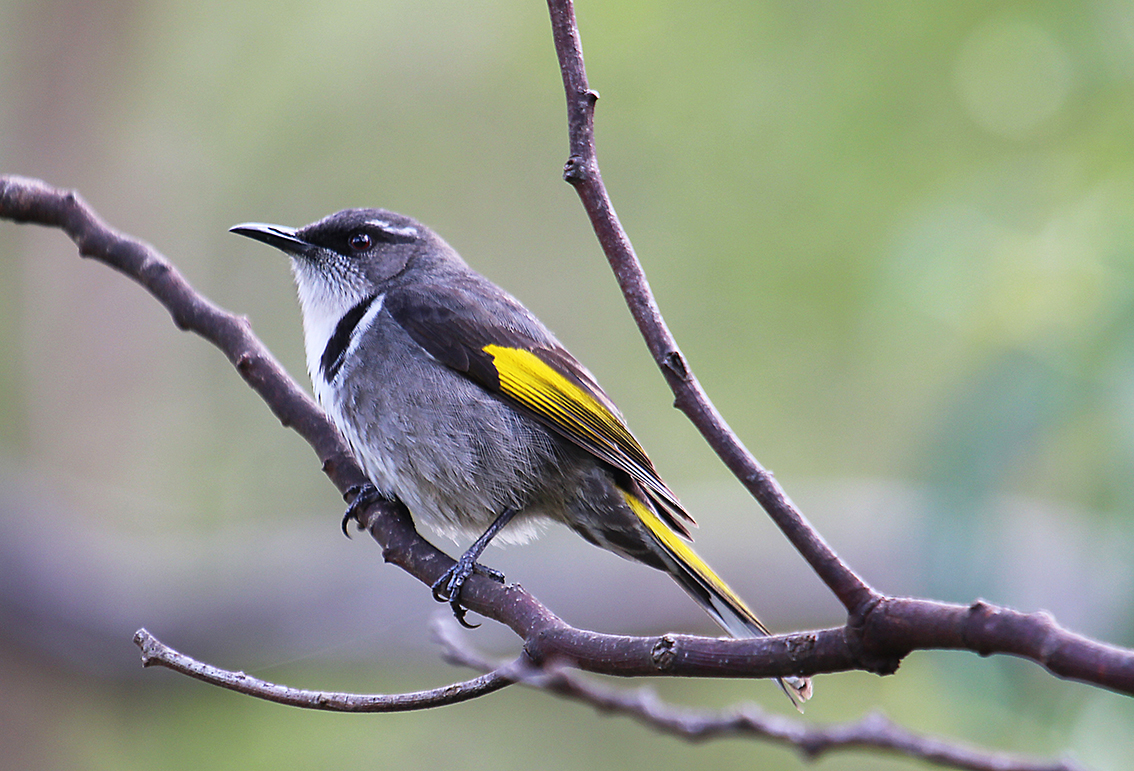
Crescent Honeyeater (Image from my stock photos)
Time is marching on and I have an appointment in Nuriootpa to learn more about the Khaiserstuhl name and its history; which I will reveal in a later post. As I retrace my way to the entrance I hear the distinctive rustle of a larger animal in the scrub to my left. I freeze and ease the camera around slowly. A pair of Western Grey Kangaroos are standing motionless about fifty metres away. An adult and half grown joey. A lovely way to finish my walk.

Adult Western Grey Kangaroo

Western Grey Kangaroo joey
Cheers
Baz
Additional notes
This is an easy walk and pleasant drive which is quite suitable for families and seniors. There are trail markers as well as panels with maps and other information.
Please pass on this blog title and or contact information (URL) to any person or organisation with an interest in taking walks and enjoying wildlife in SA.
Click on these links and see more South Australian stories and pictures in my Weekend Notes articles as well as locating similar blogs on Feedspot’s top 20 Australian wildlife blogs




 Naturally South Australia