Archive | Marsupials RSS feed for this section

Walkerville’s Bickle Reserve…..Fairies in the Garden

4 Sep

Fairies in the Garden

Dear Reader:

As I have categorically stated in several of my posts, “I am no botanist”. I love gardening and appreciate the wonderful diversity of South Australia’s flora but remembering all the different classifications, names and botanical intricacies is just a little too much like hard work. Instead, I rely on a couple of field guides to common plants in the Adelaide area, phone a friend or simply make reference to those yellow bushes or tall straight eucalypts. Hopefully, this gap in my naturalistic armoury will be narrowed as I write more nature posts, though the signs are not promising. So: it is with some trepidation that I lead into the following piece …….

P1130228

Pink fairy (Caladenia species)

IMG_8066

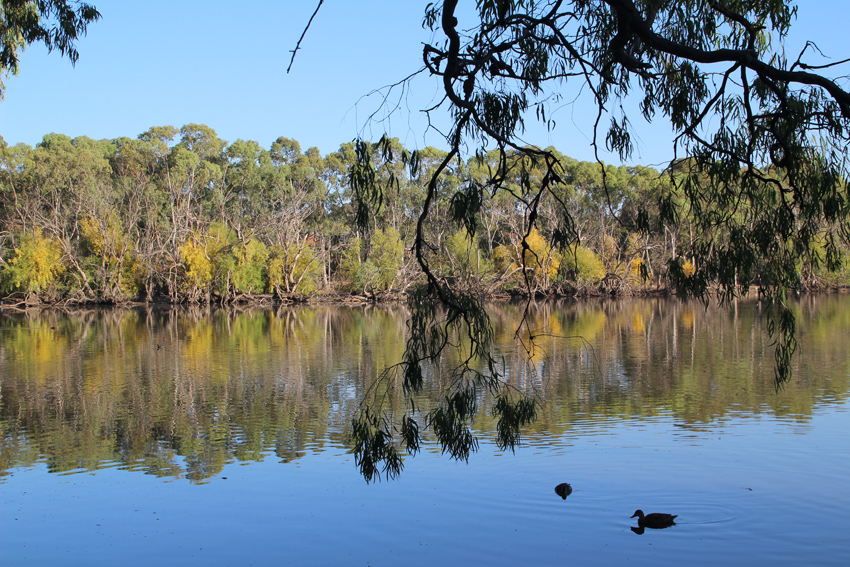
The Torrens near Bickle Park

 ….It is a cool winter’s day, slightly overcast and I am on my knees examining a glorious little patch of native orchids. Most are pink fairies but there is one tiny delicate bloom, the size of a little finger nail, called a gnat or mosquito orchid. Nearby several of the flat prostrate leaves indicate where other orchids will appear in the near future.

P1130247

Gnat orchid (Cyrtostylis species)

All of these species are endemic to the area and though a few might have grown naturally, most are the result of a dedicated group of volunteers who are revegetating this area which is part of the Vale Park Wildflower Walk. The section I am exploring is alongside the Torrens River just east of the autobahn bridge near the Bickle Reserve. Several of the Vale Park group are holding an open morning and explaining the importance and biology of the plants they have established.

P1130234

Chatting about orchids

IMG_8071

Native Wisteria (Hardenbergia)

IMG_8099

Purple swamp hen

As I listen to information about the relationship of certain fungi in the soil to the propagation of orchids and marvel at the spidery native clematis and hardenbergia that are climbing up some eucalypts (big tall ones) I notice a pair of purple swamp hens foraging in the long grass by the river. Leaving the group I pursue the birds and make my way along the bank where there are also dusky moorhens in the reeds and crested pigeons feeding near the bikeway.

IMG_8059 edit

Dusky moorehen

Rejoining the group I chat about the importance of maintaining our wild heritage for future generations and learn about Aboriginal use of some types of native plants including orchids. Predictably in this group I encounter another wildlife photographer and the conversation fluctuates between nature and the lenses we have used for different purposes.

IMG_8088

An occasional visitor

In the course of our conversations one of the replanting team asks me if I have any images from the area and I remember that on a bike ride along this part of the linear park trail I had photographed a koala high in the largest eucalypt overshadowing the orchid beds. But, in keeping with my botanical prowess I forget to ask what kind of species it is (probably a tall, straight one).

Until the next journey into SA’s natural wonders

Cheers

Baz

PS

Check out Geotravelling a new site that I have attached that celebrates the natural, cultural and urban diversity of our planet through my travel photographs.

Chinaman’s Creek on a cloudy day

3 Aug

Chinaman’s Creek on a cloudy day

Dear Reader:

It is a cool, overcast afternoon; not ideal for wildlife watching or photography. Nevertheless, I have organised a weekend trip north to Port Augusta to investigate the Arid Zone Botanic Gardens during the winter months. As an added bonus, I hope to explore a shallow mangrove creek some 20kms south of the town that a friend has suggested as an interesting wildlife stop off en route.

1 wedge tail 2

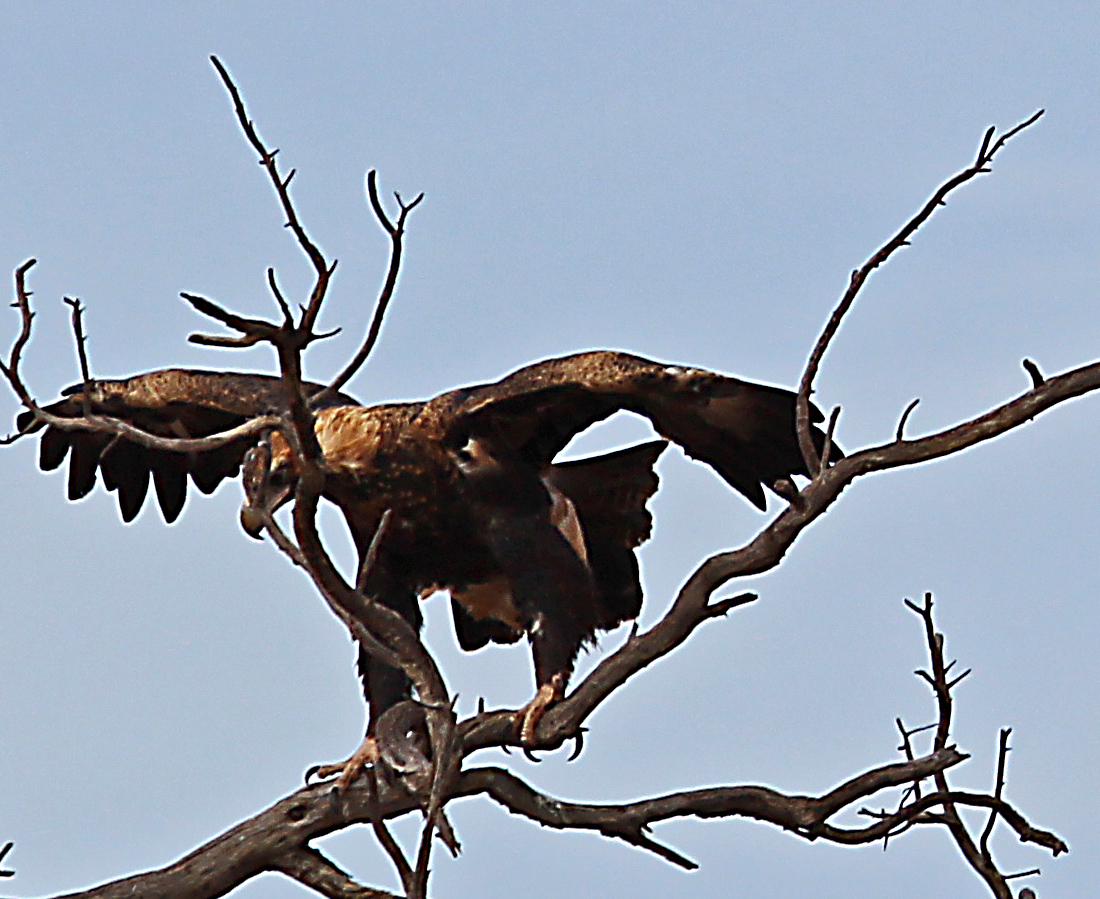
Wedge – tailed eagles are Australia’s largest raptors with a wingspan over 2 metres

1 wedge tail 1. Australia's largest raptor with a wingspan over 2 meters

Wedge-tailed eagle about to fly

1 wedgy takes flight

In flight


As I approach the Chinaman’s creek junction I notice a pair of wedge-tailed eagles in the skeletal branches of a mallee tree. The birds seem quite relaxed as they survey the low scrub that stretches towards the coast. I let the car roll to a stop and gingerly climb out careful not to let the door bang shut. There is good cover between the birds and myself and I fire off a couple of shots before one bird senses the movement and takes to the air.

2 Galahs iin bush near wheat fields

Galahs in bush near wheat fields

2 Cockatoo near the park's entrance

Cockatoo near the park’s entrance


The stretch of unsealed road that stretches towards the coast is flanked on both sides by scrubby farmland that supports sheep and some wheat fields. Small groups of rose breasted cockatoos are perching in the branches alongside the road. They occasionally take flight into the fields to dig out tubers and possibly ravage a few of the crops; lovely birds to watch but not always popular with farmers.
4 Dirt trackinto the coservation park about 5 kms from the highway

Dirt track into the conservation park about 5 Kms from the highway

4 Visitors to the park

Visitors to the park


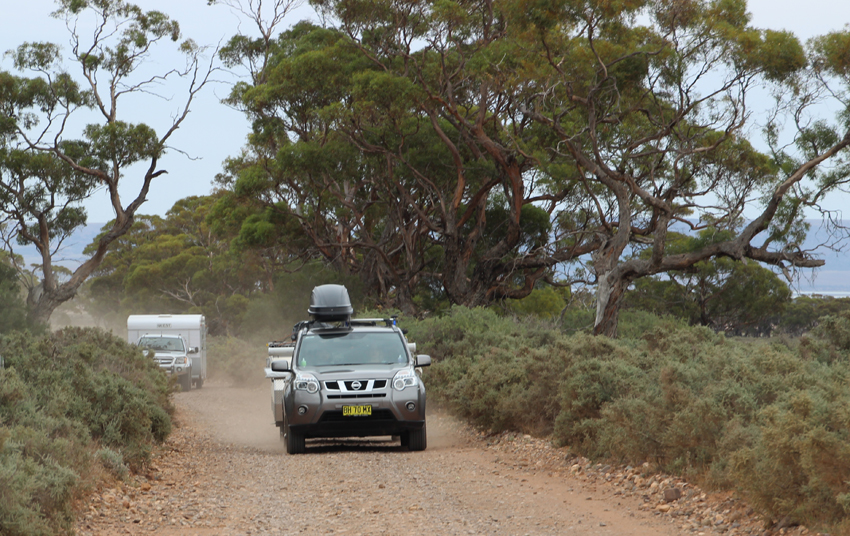
Where the cleared land gives way to forest and denser scrub, a fence and sign announces the Winninowie conservation Park which incorporates Chinaman’s Creek. Despite the remoteness of the area we meet a couple of 4X4s complete with camping trailers and stop to chat with the drivers for a few moments. They have been camping by the creek for a few days and had some success fishing the mangrove flats on the receding tide for whiting and mullet.

6 Chinaman's creek jetty at low tide

Chinaman’s creek jetty at low tide

9 Momentary glimpse of a sacred kingfisher

Momentary glimpse of a sacred kingfisher


A few minutes later we pull into the camping area. There is a scattering of permanent shacks and a small jetty that is completely exposed at low tide. I change from shoes to gum boots, from experience I know that this mud sticks like glue, and start to walk along the edge of the little creek. I can hear singing honeyeaters in the mangroves and catch flashes of colour from other unidentifiable species that flit amongst the thick foliage. But the birds are some distance away and the overcast conditions make photography all but impossible.

6 Chinaman's creek jetty at low tide

Chinaman’s creek jetty at low tide


I notice thousands of small burrows honeycombing the edge of the intertidal zone. Each is home to a small shore or mangrove crab. In the creek I can see roving schools of silver baitfish eagerly eyed by a pair of herons that are stalking the fringe of the mangroves.

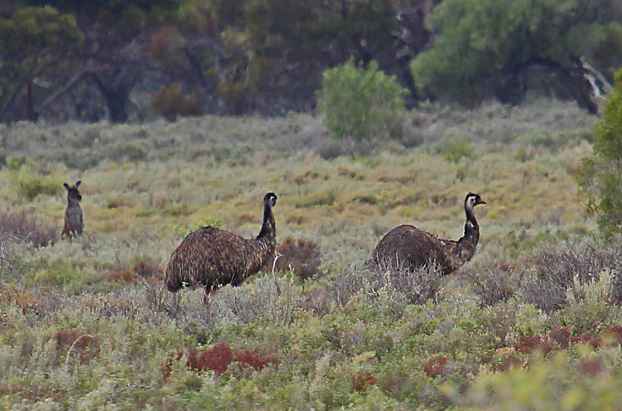
4 As a pair of emus head towards the trees a grey kangaroo pops its head up

As a pair of emus head towards the trees a grey kangaroo pops its head up


Our time at the creek is limited. The clouds are thickening and a few fat raindrops have bounced off my camera lens. As we leave the park has a few more wildlife surprises that make me grit my teeth over the poor lighting conditions. A gorgeous sacred kingfisher perches on a long-dead coastal acacia bush and a group of grazing emus wanders across the saltbush dominated plain. Later, when examining this image in detail I discover that there is another participant in the scene; a grey kangaroo that was feeding close to them.

5 The creek at low tide with mangrove forest and Flinders Ranges in the background

The creek at low tide with mangrove forest and Flinders Ranges in the background


It has been an interesting first look at this coastal environment with its varied habitats and I look forward to further visits in the warmer, lighter months ahead.


Until next time

Cheers

Baz

Tea Tree Gully’s Camellia Nursery

5 Jul

Dear Reader:

It is a cool crisp morning, and to be perfectly honest, I am not in the mood for a long drive. Instead, I have decided to visit a local nursery just a few kilometres away, where the North East Road starts its climb into the Adelaide Hills.

1a Newman's nursery

Newman’s nursery front entrance


As I park the car next to the entrance I am immediately struck by the contrast in lighting conditions. The path following the little creek that leads from ‘Newman’s Camellia’ nursery to the ‘Tea Tree Gully Hotel’ is in deep shade whereas the hills on the opposite side of the road are bathed in sunlight. An afternoon walk might have offered better lighting for photography but the wildlife always seems more active in the morning.

1a Start of the walk

The path begins


Climbing out of the car I glance up at the hillside above the little creek and to my surprise and delight I notice the hunched outline of a koala wedged between the branches of a huge gum tree; not what I was expecting this close to a suburban area.

1a koala in tree

Koala in tree


The trail starts just a few metres from the nursery entrance and meanders alongside the small watercourse for a mere 500 metres before broadening to a neatly manicured lawn enclosed by trees and shrubs. A varied collection of plants flank the path; including arum lilies, several lovely camellias, indigenous wattles and melaleucas as well as the ever-present, towering eucalypts.

1a Rogue camelia

A rogue camellia alongside the path


Small birds are continually flitting through the bushes though I am only able to catch fleeting glimpses of them. Some are definitely female blue wrens and I suspect that the tiniest ones are thornbills. Eventually, a small brownish bird settles in a low, flowering shrub some 50 metres away. I fire off a series of shots which, on review, reveal a glorious eastern spinebill.

1a Eastern spinebill  foraging in shrubs

Eastern spinebill foraging in flame heath bush


At the end of the trail half a dozen magpies are foraging for grubs in the well tended lawns. Several enormous gums tower over the grass and a pied currawong is perched on one of the topmost branches with a seed pod hanging from its beak. Another bird joins it, they seem nervous, jumping between branches before flying off, possibly to a nesting site.

1a Currawong with food approaching nest

Currawong approaching nest with food

The walk back is equally eventful with both rosellas and lorikeets feeding on berries in the scrub along the edge of the trail but capturing a sharp image in the shadows and overcast conditions is somewhat challenging.

1a Tapas on the terrace

Tapas


Newman’s nursery has a charming little restaurant with both inside and alfresco dining areas which afford a fine view of the hillside on the other side of the road. While I enjoy the delights of a tapas snack I notice several tiny finches feeding on the liquid amber trees that decorate the front of the nursery. From my outside table the birds are just within camera range and using the long lens I am able to identify them as European goldfinches.


1a European goldfinch in liquid amber tree

European goldfinch in liquid amber tree


Until next time

Baz

A Morning at the Zoo with Quinn

27 Feb

Dear reader: 

It is a warm Adelaide morning and the shady paths of the zoo are a labyrinth of intrigue for a nearly three year old. Around every turn there is a new enclosure full of sights, sounds and animals that she had only previously experienced in picture books.

7

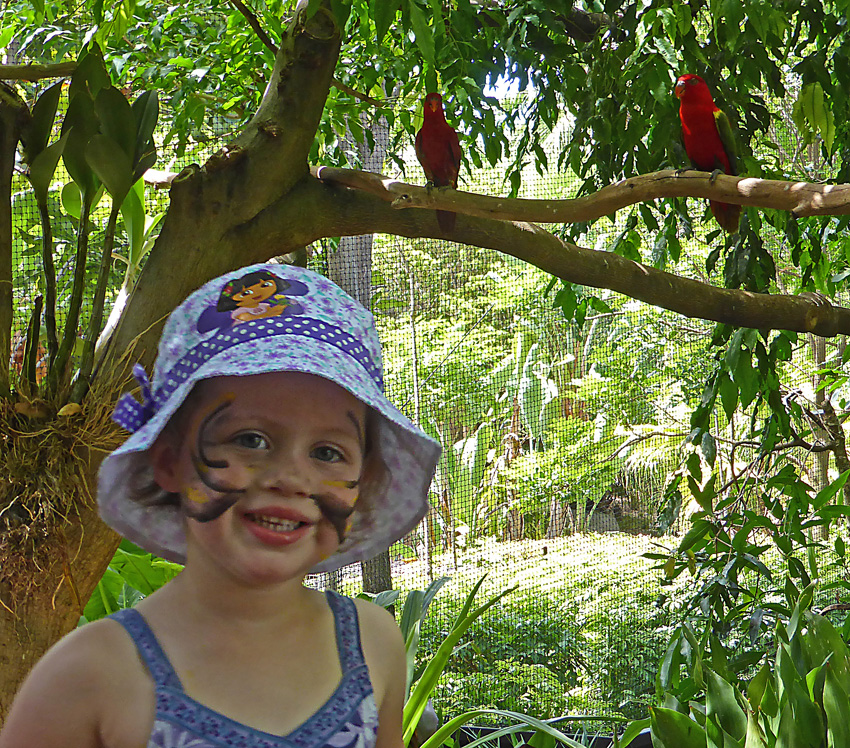
A pair of king parrots provide a suitable backdrop for a tiger striped Quinn


3

The zoo is situated by the river just over the Frome Road Bridge


A misty spray of water shrouds the koala and Tasmanian devil enclosures in anticipation of the midday heat. It proves irresistible to our little granddaughter and sends her squealing down the path shouting, “bear, bear, bear!” I stand and watch the ‘really not bears’ as they stoically munch on eucalyptus leaves and fire off a couple of frames. Sometimes the images that can be taken in a zoo are invaluable additions for later projects.

1

A koala chews on eucalyptus leaves that would be inedible even toxic to any other species of marsupial


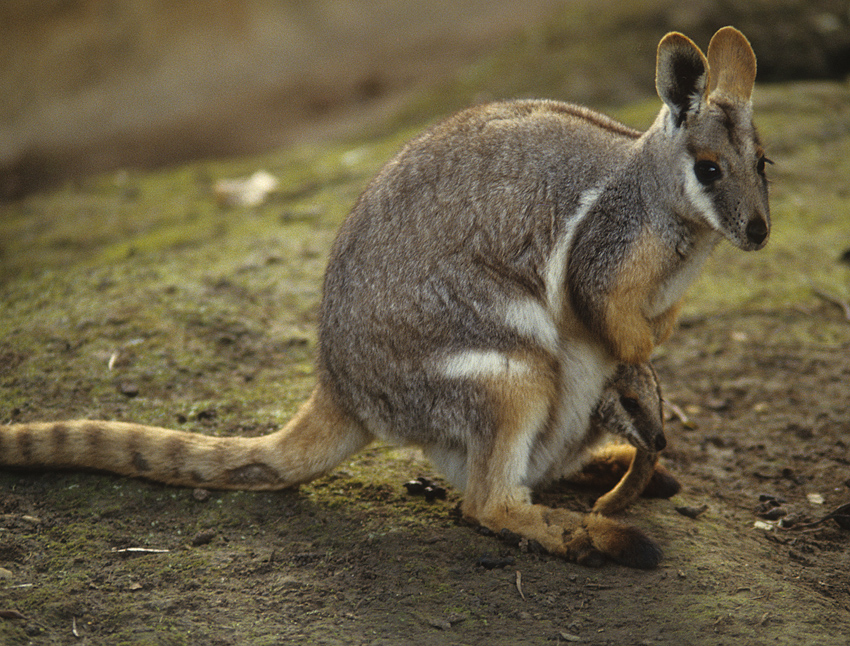
Half a vegemite sandwich and an ice cream later a little hand tugs mine and a voice whispers, “ Pop, kangaroo”. She is almost right, as a pair of yellow footed rock wallabies emerge from behind a tree in an open enclosure a few metres away. One of the little marsupials has a joey in its pouch; a difficult image for any photographer to catch in the wild.

6

A young yellow footed rock wallaby peering out from the safety of its mother’s pouch


The nocturnal house proves to be a real challenge. Try telling a toddler to be quiet as she goes through a dark tunnel lined with glass exhibits featuring bats and other night time wildlife. Near the entrance there are some aquariums which she finds quite fascinating (translate as…actually stops moving for a few seconds) giving me the opportunity to photograph some purple spotted gudgeons, one of our threatened native fish species. Yet another example of the pictorial opportunities that only captive animals can provide the amateur photographer.

2 purple spotted gudgeon

Purple spotted gudgeon are found in South Australia’s freshwater streams and lakes


Ironically, our final wildlife moment is not one that the Royal Zoological Society can claim credit for. Just as we are leaving and wandering past the hippos, Nan’s favourite exotic animal, we hear a family excitedly chattering about a spider. And there, strung in front of the hippo pool is last night’s tattered web of a sizeable orb weaver with the resident arachnid devouring a hapless dragonfly. Quinn says “yuck”, Nan scoops her up and I click away merrily wishing that I had brought the DSLR instead of popping the point and shoot in my pocket to ensure hands free, child minding capabilities.

4

A large orb weaver makes short work of an unfortunate dragonfly


By now the temperature is getting into the mid thirties and it is time to leave. She does not want to go. “More animals Pop.” A good sign for the future.


Cheers

Baz (and Quinn)

Wynne Vale Dam Walk

17 Feb

The sulphur crested cockatoos are perched up high in the river gums that surround the dam. Their loud and raucous calls fill the air and drown out the sounds of the other birds that live and feed around the water’s edge. Every few minutes some of the large, white parrots fly down into the acacia bushes that grow along the pathway in search of food. They tear off some of the brown, elongated pods and fly back into the higher branches where they manipulate them with their feet and beaks to extract the seeds.

Acacia pods with seeds exposed

Acacia pods with seeds exposed


Sulphur crested cockatoo eating acacia seeds

Sulphur crested cockatoo eating acacia seeds


Wynne Vale Dam is just a fifteen minute bike ride north of Tea Tree Plaza along the Dry Creek trail which can be easily accessed from the bridge over Ladywood Road near the Modbury Hotel. It is a great way to break up the shopping chores or get some exercise after lunching at one of the nearby hotels and restaurants. The small lake is part of a stormwater reclamation and creek improvement project and is surrounded by a track with viewing platforms, interpretive signs and a sizeable earthen dam on the southern edge.

Wynne Vale Dam from the viewing platform

Wynne Vale Dam from the viewing platform


After watching the birds feeding for a few minutes I climb back on my bike and cycle round to the other side of the dam. Leaving the pathway I shift the mountain bike into low gear and pedal along an exposed stretch of the embankment bumping over a tangle of roots that radiate from a stand of partly submerged trees. Their skeletal trunks and branches are the perfect vantage points for a white faced heron to scope out its prey and a freshwater turtle to bask in a patch of early morning sunshine. White faced herons are quite common along the banks but the turtle is a more unusual sighting.

White faced heron survey its kill zone

White faced heron surveys its kill zone


Short necked turtle on a tree branch

Short necked turtle on a partially submerged tree branch


Just as I start to move off to my next location I catch site of a medium sized bird roosting high in one of the old willows that overhang the water. It is a nankeen night heron. Easily recognised by their cinnamon plumage and shorter powerful, beaks these herons tend to stay hidden during the day feeding in the morning, evening and sometimes at night; a behaviour that is referred to as crepuscular.

In the winter months the water level rises considerably covering the embankment

In the winter months the water level rises considerably covering the embankment


Nanakeen night herons feed on aquatic invertebrates and small fish

Nankeen night herons feed on aquatic invertebrates and small fish


After photographing the heron I cycle around the lake once more to make sure that I haven’t missed anything too obvious then head back down the western side of the creek. Where the dam ends and the creek re-emerges there is a line of exceptionally tall river gums. And there, right in my line of vision, are two koalas climbing up into the branches. Koalas, nankeen night herons and a turtle on one short ride. Not a bad morning’s work.

A pair of koalas climbing. Probably an adult fmale and mature joey.

A pair of koalas climbing. Probably an adult female and mature joey.


Thanks for reading this post.

I hope you enjoyed it.

Tell a friend who might be interested.

Cheers

Baz

Aldinga Scrub

21 Dec

The tawny frogmouth is absolutely motionless. At first glance, I can’t see the bird even though my guide has pointed out its position. Eventually I locate it amongst the foliage exploiting its extraordinary camouflage and the tactic of remaining statue-still to remain ‘hidden in plain sight’. I am using a long lens which allows me to zoom in close enough to capture the delicate whisker-like structures around its beak; perfect for sensing insects at night. “Sometimes there are two together,” she informs me. “And we’ve had a nest with young.” I make a mental note to ask her to give me a call when that happens; photographing a frogmouth and its chicks would be something special.

A tawny frogmouth exhibits its amazing camouflage

A tawny frogmouth exhibits its amazing camouflage (Click to enlarge all images on page)

I am on the edge of the Aldinga scrub; a patch of remnant bushland that hints of what this coastal plain would have looked like before the early settlers arrived with their ploughs and sheep. Aldinga and its coastal neighbour Silver Sands are just an hour’s drive from the centre of Adelaide and a favourite haunt of mine for an entirely different reason. No more than a kilometre away is one of my favourite snorkelling destinations. A reef to dive on, long white beaches for swimming and surfing and a patch of scrub to explore; make this an ideal destination for a day trip from the city.

A half full water hole attracts a wide variety of animals

A half full water hole attracts a wide variety of animals

I continue to walk along the road that borders the scrub. The houses on the urban side of the track blend in well with the bushland ambience. Obviously the residents have chosen this location because of its natural setting and the gardens are filled with a variety of native plants that attract insects and birds. In a huge gum that towers over the track I can hear the raucous screech of a wattle bird high in the canopy. The largest of all the honeyeaters, wattle birds often feed on leaf bugs and nectar from eucalyptus flowers. This one is hopping between the branches calling loudly while foraging amongst the leaves.

A wattle bird wipes its curved beak clean on a branch.

A wattle bird wipes its curved beak clean on a branch

A post and wire fence separates the road from the scrub and a host of tiny birds are twittering and flitting between the trees just inside the reserve. I find a likely spot and sit quietly, balancing the camera and lens carefully on my knees. Eventually, one of the tiny birds perches on a bare branch a dozen metres away. I track the fluffy bundle of feathers and take a quick series of shots as it hops and turns before taking flight. Perhaps one frame will freeze its incessant motion and allow me to identify the species. On reviewing the image my best guess is a species of thornbill.

Thornbil species

Thornbill species

I am more than pleased with my stroll along the edge of the scrub. The frogmouth, wattle birds and tiny finch-like birds were more than I expected. But as I turn to walk back to the car I hear the familiar thump of a kangaroo’s powerful back legs hitting the hard packed earth of the track. An adult grey kangaroo and its joey bound across the road and pause by the fence-line. I watch them as they survey the obstacle for a few seconds then the joey squeezes between the strands of wire while the adult clears it with a single bound. They stop and look around before disappearing into the thick scrub.

A joey balances on its tail and lifts its back legs before squeezing through the fence

A joey balances on its tail and lifts its back legs before squeezing through the fence

The afternoon light is fading and I have one last stop to make before driving home and it has little to do with wildlife. Opposite the Aldinga pub there is a charming café called the Old Vine. It has a colonial cottage feel about it and the meals are interesting, tasty and sourced from local produce but the main draw card is a citrus tart that is as good as any I have eaten anywhere in the world…and I have sampled quite a few.


Come visit

Merry Xmas

Baz

The Old Talisker Mine

15 Nov

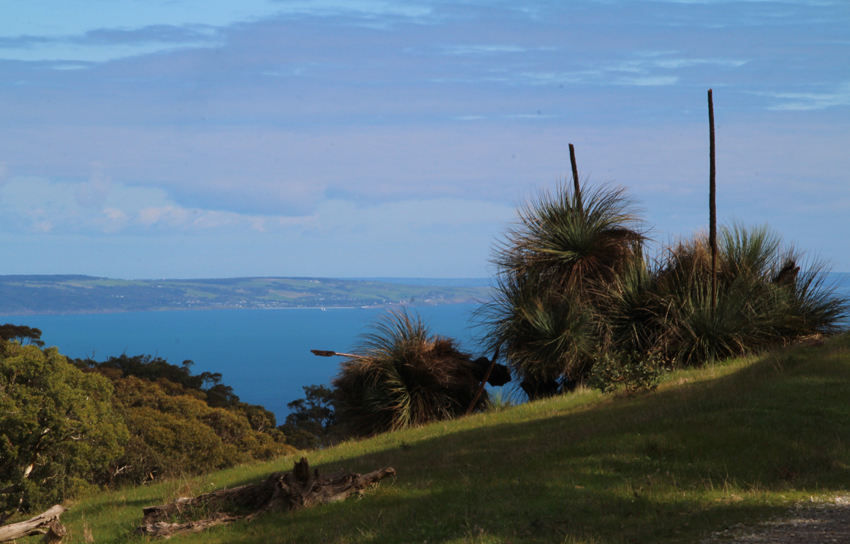
The view from the top of the hill is spectacular. Soft winter pasture still covers the ground in sharp contrast to the spiky Xantheria or grass plants that characterize the harsh coastal scrub and the blue of Baxter’s Passage and hazy profile of Kangaroo Island beckon on the horizon.


Backstair's passage and Kangaroo Island

Backstair’s passage and Kangaroo Island (double click to enlarge all images on this page)


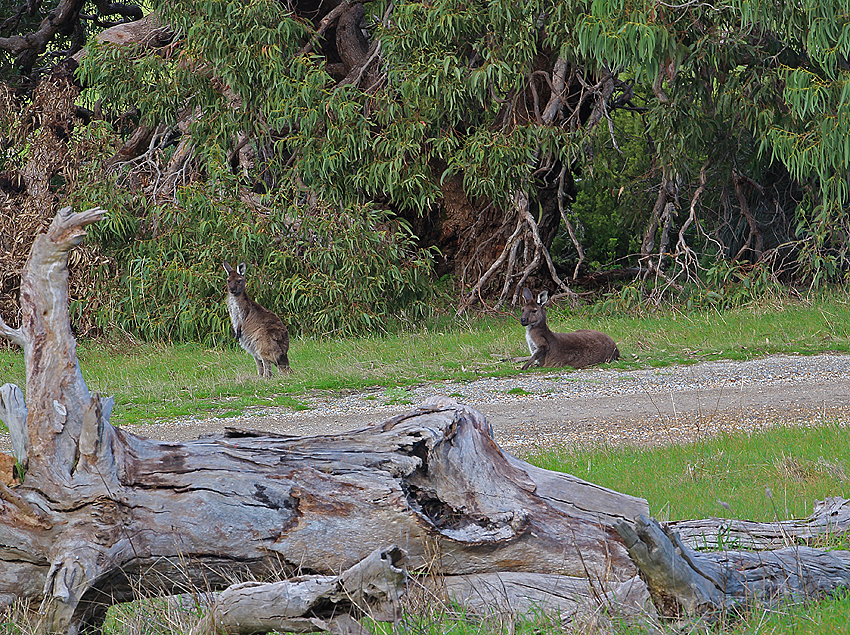
As I get out of the 4WD to capture this image I notice a pair of western grey kangaroos on the edge of the scrub no more than 20 meters from the vehicle. They are wary, ears twitching and sniffing the air. One is considerably larger than the other. They are probably a mother with a joey at heel and her pouch looks a little enlarged suggesting that she may have another little one tucked away. There could even be two in the pouch; one permanently attached to the nipple while the other simply enjoys the ride. In good times kangaroos can multiply quickly.

Western greys by the track

Western greys by the track


I am in the Talisker National Park about an hour and a half journey from the city and 10 kms from Cape Jervis at the toe of the Fleurieu Peninsula. The park centres around a series of bush trails that surround an abandoned silver and lead mine dating from the 1860s. Old machinery, buildings and shafts add an historic dimension to an area rich in scenery and wildlife.

Crushing house and old boiler

Crushing house and old boiler


From my cliff top lookout I backtrack along the dirt roads to the entrance of the old Talisker mine site. The walking trail to the mine is not too steep but the scrub on both sides is dense and full of life. In both the treetops and bushes I can hear the calls of wrens and honeyeaters. Eventually one of the delicate little birds pauses on a branch to announce its territory.

Crescent honeyeater

Crescent honeyeater


The track ends in a small clearing where the rusted remains of crushers, boilers and old buildings mark the main site. They are all that is left of a mine that once was the workplace of dozens of miners and supported a community of 300 souls at nearby Silverton; now also long gone.

Pied currawong

Grey currawong


The buildings are surrounded by a forest of eucalypts and I can hear the more distinctive movements of a larger animal in the branches on the far side of the crushing plant. I focus my long lens on the area and start to search for the perpetrator, expecting another roo or even a possum disturbed from its daytime sno0ze. But it is a large crow-like bird that I spot amongst the leaves and branches, a pied currawong, a relative of the white backed magpies that are so common on the plains where I live. Currawongs are a group that I have rarely photographed successfully as they tend to be a little more wary than their magpie cousins.

Bush track surrounded by eucalypt forest near the park entrance

Leaving the park along a bush track


It has been quite a long day walking, driving and stalking wildlife and the ruins are a great place to sit and unpack a well anticipated lunch picked up at the local Yankalilla bakery; nothing flash, just a steak and mushroom pie and an indulgent apricot tart to round off the meal. Good South Aussie ‘tucker’ to fuel up for the walk up the hill and drive home.


Cheers

Baz                  

The Paralana Trail

29 Jun

Dear Reader 

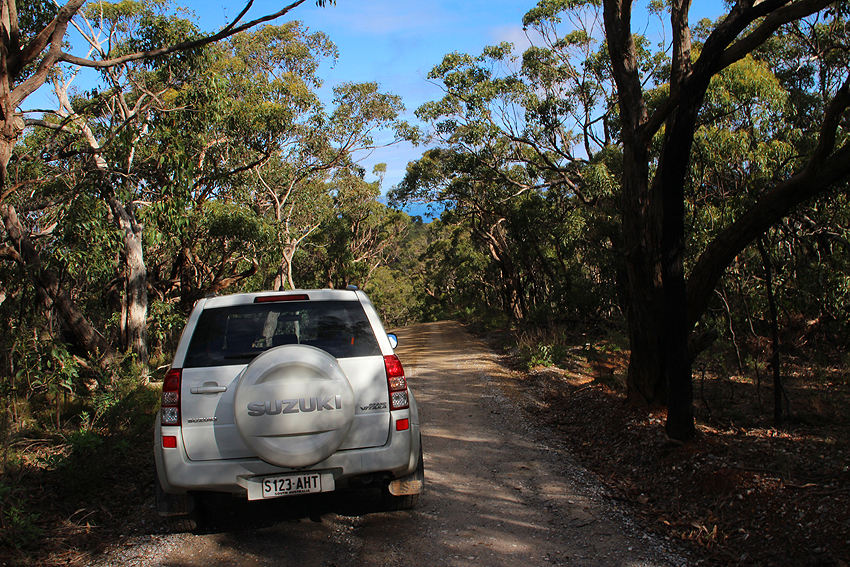
It’s winter but you’d hardly know it. The afternoon sky is a clear endless blue and though there’s a hint of the approaching night’s cold desert chill, the temperature is still a comfortable 25 degrees. I am in the Arkaroola Wilderness reserve in the Gammon Ranges some 1000 kms north of Adelaide heading towards the Paralana hot springs. After a hearty breakfast in the resort’s dining room we have loaded our gear into Suzuki GV and locked in 4WD for the 30 km trip along one of the most interesting off road adventures in this world heritage region.

Ochre wall

Ochre wall (click to enlarge)

 We have been crawling over the rugged terrain for about 20 minutes and the stony track has opened into a dry creek bed. One section of the embankment is quite extraordinary; a wave shaped deposit of ochre that contrasts sharply with the surrounding bush. This significant deposit was of great importance to the Adnyamathanha people who used it in ceremonies and to trade with other Aboriginal groups.

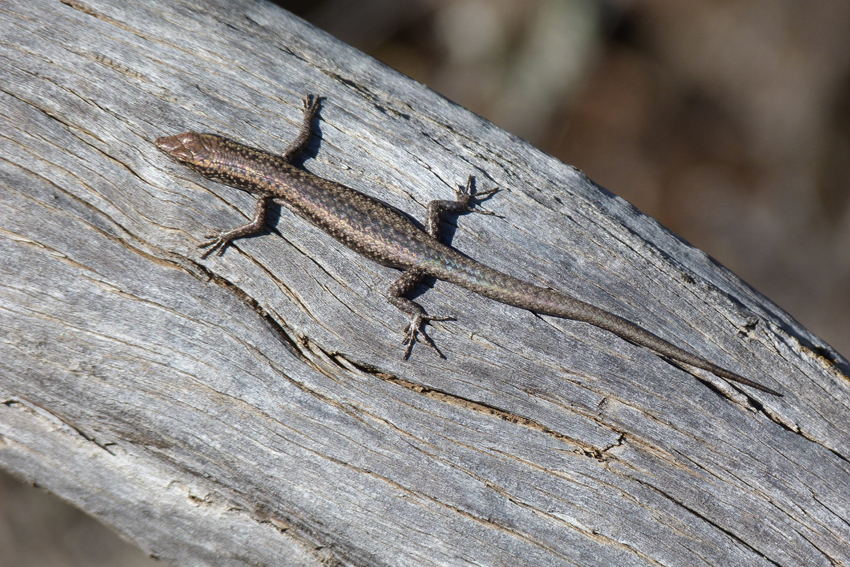
Rock skink

Unknown skink species (click to enlarge)

 While the others break out a little gas stove to brew a ‘cuppa’ I walk along the creek bed camera in hand. The unseasonably warm weather has brought out a few reptiles that would normally be hibernating at this time of the year. They are wary and the only clue to their presence is an occasional rustle in the undergrowth. Finally, one little skink that is basking on a weathered tree trunk decides that remaining motionless is a better option than retreating, offering me a nice clear shot.

(click to enlarge)

Male mulga parrot (click to enlarge)

Femal mulga parrot feeding on blue bush berries

Female mulga parrot (click to enlarge)

 Just as I am about to make my way back to the vehicle a flash of colour amongst the skeletal branches of a long dead acacia tree catches my eye. I peer through the telephoto and focus on the turquoise plumage of a male mulga parrot. If it is the mating season then the female should be nearby and with a little persistence I find her on the ground feeding on some small yellow berries that are the fruit of a low growing saltbush-like plant.

P1010422

Yellow footed rock wallabies on steep cliff (click to enlarge)

 Refreshed, we resume our drive along the trail, slowly climbing into the hills which provide spectacular views across the Gammons. Following a twisting descent down a narrow track we enter the spectacular Baranarra Gorge with its sheer rock walls and boulder strewn pools of clear fresh water.   Our progress has been slower than planned and it is late afternoon when we start to pick our way along the edge of the water hole. Almost immediately I hear the rattle of small rocks skittering down a steep rock face. Almost immediately I hear the rattle of small rocks skittering down a steep rock face. Looking up I catch sight of a pair of yellow footed rock wallabies precariously perched on the sheer cliff face. Once again, I am reminded of the extraordinary adaptations of these beautiful little animals. With their furry back feet perfectly designed for gripping rock surfaces, long counterbalancing tail and subtle camouflage, they are the Aussie equivalent of mountain goats.

P1010408

Chopper based at Arkaroola Village (click to enlarge)

 Unfortunately our stay must be a short one as the light is starting to fade and we must head back to our home base at the village. Tomorrow we have decided to take a helicopter flight over the area to get an overall picture of the terrain before our next off road foray.

Cheers

Baz

A Hill’s Face Hike

16 Feb

Dear Reader:

The koala is well camouflaged and firmly wedged between two branches in a stunted eucalyptus tree which is growing on the edge of a steep slope. Getting a decent shot involves scrabbling through some spiky acacia bushes and perching myself precariously on the edge of a rocky outcrop. But a quick glance at the playback screen suggests that the effort has been worthwhile and a few more scratches on my legs are ‘par for the course’ in this terrain.

3 Koala near the trail head

Koala near the trail head


I am half way up Anstey Hill on the north eastern edge of the Adelaide Hills. This ‘hills face’ recreation park is part of the in the Greater Mount lofty Parklands and one of several reserves that permit hiking, walking dogs on leads while banning camping, mountain bikes and the lighting of any fires. Anstey Hill is only 8 Kms from the CBD, easily accessed from several major roads and close to quite a few reputable hotels and restaurants. In short, an ideal destination for a morning or afternoon walk followed by a meal and a glass of wine.

1 Local pub and restaurant

Local pub and restaurant


Satisfied with koala image I start take a winding trail towards the top of the hill emerging on its northern flank where the view across the cliff face towards the city and coast is quite spectacular. A winding trail skirts the ridge and there are still some late blooming wattles and melaleucas clinging to the rocky outcrops and a small group of new holland honeyeaters are feeding on the blossoms and hawking for insects.

2 View from the ridge

View from the ridge


Further along the trail a small stand of eucalypts pushes up through the lower layer of scrub and many of them are losing their outer layers of bark….an ideal opportunity to look for huntsman spiders which often search for prey in this micro environment. And luck is on my side after a little foraging a piece of bark with a sizeable huntsman comes away from the tree. These large spiders often come into suburban homes where they stay high on the walls and eat a whole collection of unwanted pests from mosquitoes and flies to earwigs and roaches.

4 Huntsman spider

Huntsman spider


I turn south at the top of the hill and head through a little section of bush that has recently been burnt. To my surprise a large, dark robber fly is perched on one of the blackened branches magnificently camouflaged as it waits for smaller insects to ambush.

5 Blackbugs on burnt trees

Robber fly on burnt trees


My final wildlife encounter is with a pied currawong. Related to crows and magpies these large omnivorous birds are not common on the Adelaide plains and prefer the higher elevations of the Mt Lofty Ranges. I have never seen them around this area before and have few photographs consequently; this capturing this image was quite a treat.

6 Pied Currawong

Pied Currawong


Now it’s lunch at the pub


Cheers

Baz


JET

Second Valley ….drive and dive

17 Aug

Dear Reader:

This week’s post is courtesy of a chilly winter dive and a pleasant day’s drive to one of my favourite childhood haunts, Second Valley.

D Second Valley bay on a winter's day

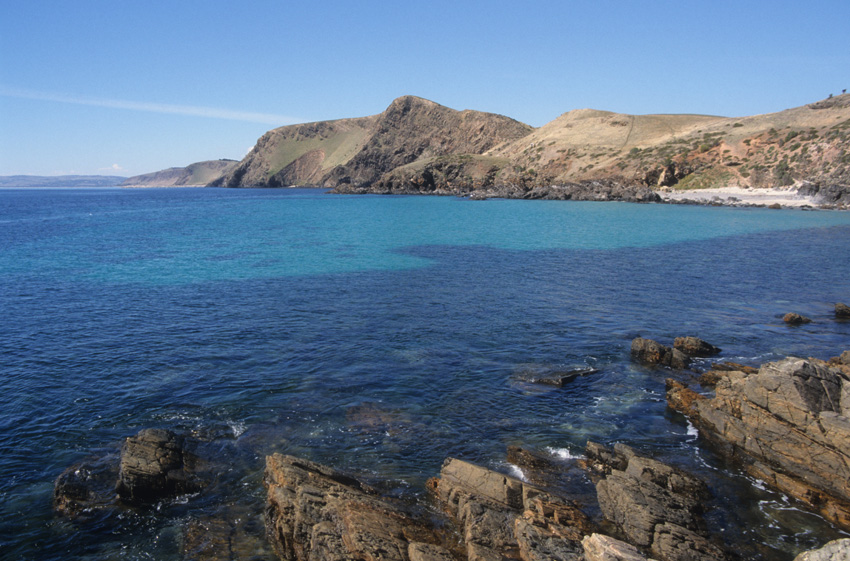
Second Valley bay and beach on a calm winter’s day


In 1836 Colonel Light, the founder of Adelaide, was searching for a good location for South Australia’s new capital city. He sailed his ship, the Rapid, into a sheltered bay with a fresh water stream that flowed in from a fertile valley. Light named the bay after the vessel. The second little cove that he discovered was just a few miles north towards the present location of Adelaide and was simply known as Second Valley.

E farmer and dog taking dairy herd across the road near Rapid Bay

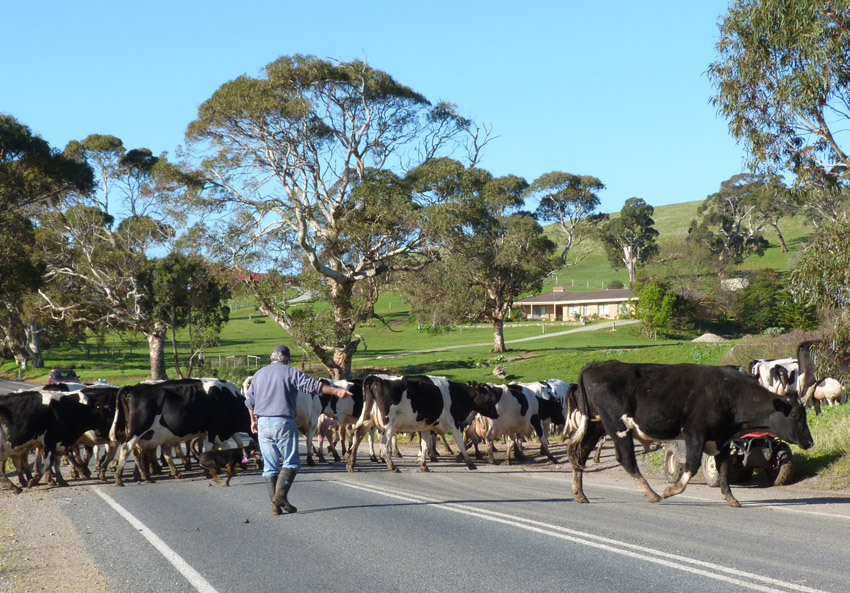
Farmer and cattle dog taking dairy herd across the road near Rapid Bay

Second Valley is a one and a half hour drive from the city centre along the Fleurieu  Peninsula’s south coast road. The dairy farms that lie amongst the rolling hills, large expanses of open woodland, and vineyards make it a recreational drive worth undertaking for its own sake. But for the wildlife enthusiast both drive and destination are even more enthralling. The farms and bushland support a healthy population of western grey kangaroos that are often visible from the road. Rosellas, various cockatoos, lorikeets and a host of other bird species are also common throughout the year.

BB Western grey kangaroos near the roadside near Second Valley

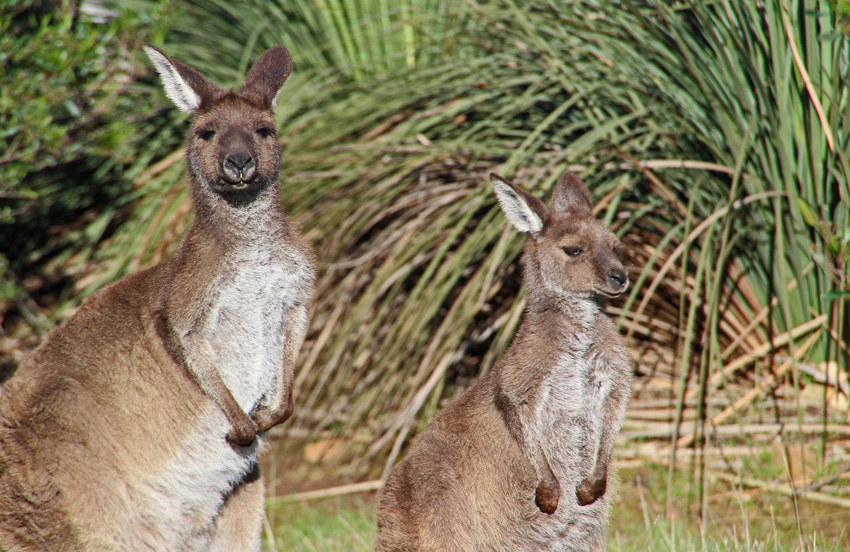
Western grey kangaroos by the roadside near Second Valley

However Second Valley’s real charm lies beneath its pristine waters. The sheltered little bay is enclosed by limestone hills and coastal cliffs . It boasts an exquisite little beach and miniature rocky headland which is bisected by an old wooden jetty. Small boats can be launched from the beach but the marine environment is just as easily accessed from the beach, jetty and rocks for shore based divers. It is, in my experience, one of the best scuba and snorkelling locations that I have encountered anywhere in the world. A place where a novice snorkeler can swim amongst shallow rocky reefs in water they can stand up in or a more adventurous diver can swim a short distance and be next to a cliff face that drops away into 10 metres of water.

A squid at nightshowing irridescence

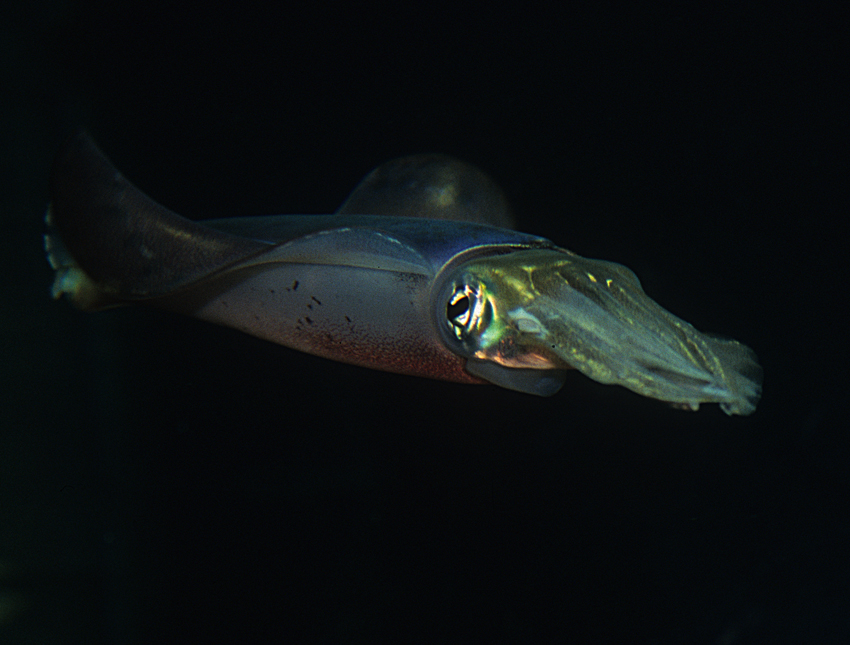
Squid viewed on night dive

Below the water there is a diverse range of habitats to explore ranging from limestone caves and ledges, to rocky reefs, seagrass meadows and open expanses of white rippled sand. There is always a wide selection of marine life to enjoy. Over the years I have encountered everything from huge eagle rays to schools of iridescent squid on a night dive and once I came across an elephant shark lazily gliding across the segrass as it came into the shallow bay to breed.

B large cuttlefish amongst brown algae

Large cuttlefish amongst brown algae

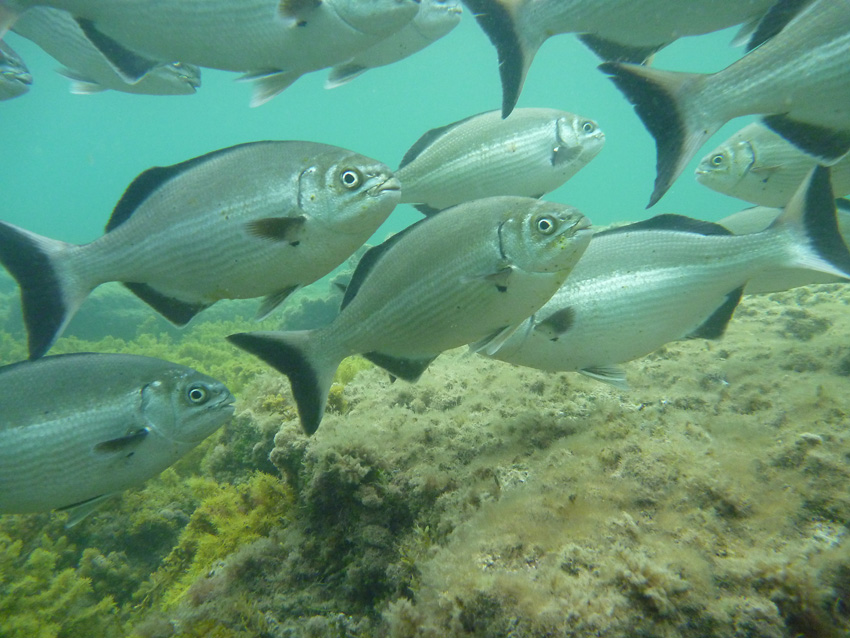
Although the balmy days of summer are the ideal weather for a dip in the ocean the winter months often produce long fine breaks when the sea is calm and visibility excellent. On this particular occasion I was lucky enough to encounter a couple of large cuttlefish under a ledge and a school of silver drummer milled around me on the edge of the rocky outcrop. On any typical dive, either snorkelling or with scuba, I would expect to sight at least 30 different species of fish and a multitude of invertebrates. This dive was no exception.

BB Silver drummer schooling  at the end of the rocky peninsular

Silver drummer schooling at the end of the rocky peninsula

As always I hope you enjoyed the pictures and anecdotes and that they encourage you to come and enjoy our unique scenery and wildlife.

Cheers

Baz