Tag Archives: South Australian birds

Burnside’s Hidden Creek

6 May

Dear Reader: 

The wattle bird seems to be totally absorbed and indifferent to my presence as it feeds on the tiny white lerps that dot the leaves of a creek-side eucalyptus tree. Usually these large members of the honeyeater group are quite nervous and hard to approach. This one, however, is determined to provide me with a ringside display of its acrobatic ability as it hangs upside down and hops from branch to flimsy branch in pursuit of its lunch. The tiny white lerps look like an arborial version of measles. In fact they are the early stage of a parasitic bug called a psyllid, an introduced insect pest that sucks the ‘juice’ from the trees.

A wattle bird pecks tiny insects from the leaves of a blue gum near the river bank

A wattle bird pecks tiny insects from the leaves of a blue gum near the river bank.


I am walking along the banks of second creek in the Michael Perry Botanical Reserve. This charming little park is easily accessed from a small lane called Andrew’s Walk at the southern end of Hallet Road, in the hills face suburb of Burnside. The shady banks, trickling stream and little ponds have a European flavour to them affording a cool retreat in the drier summer months. Before setting off on my short walk to investigate the creek’s wildlife I made a couple of crucial stops to provision my pack for a bite to eat on the river bank. At the nearby Stoneyfell Winery I found a fine bottle of white while ‘Taylor Blend’, a fashionable little eastern suburbs coffee shop on Hallett Road, provided a wide selection of gourmet paninis and local beesting cake. When one has to sit by a river bank for an hour or so to wait for the wildlife it might as well be done in style.

The brook cascades over a small ford made from slate and sandstone rocks

The brook cascades over a small ford made from slate and sandstone rocks


Leaving the wattle birds to finish their meal I work my way along the creek, pausing frequently to try and catch sight of the small birds that I can hear chirping and rustling deep in the cover of the reed beds. Without warning a grey faced heron explodes from the tangle of branches a couple of metres in front of me. The birds wheels in flight and settles on a branch high in a nearby pine tree where it can keep a sharp eye on its human intruder. As I point the camera at the perching water bird I catch site of a pair of Kookaburras in a huge eucalypt further up the opposite embankment. Two predatory birds; now it’s time to take a look for the prey animals that sustain them.
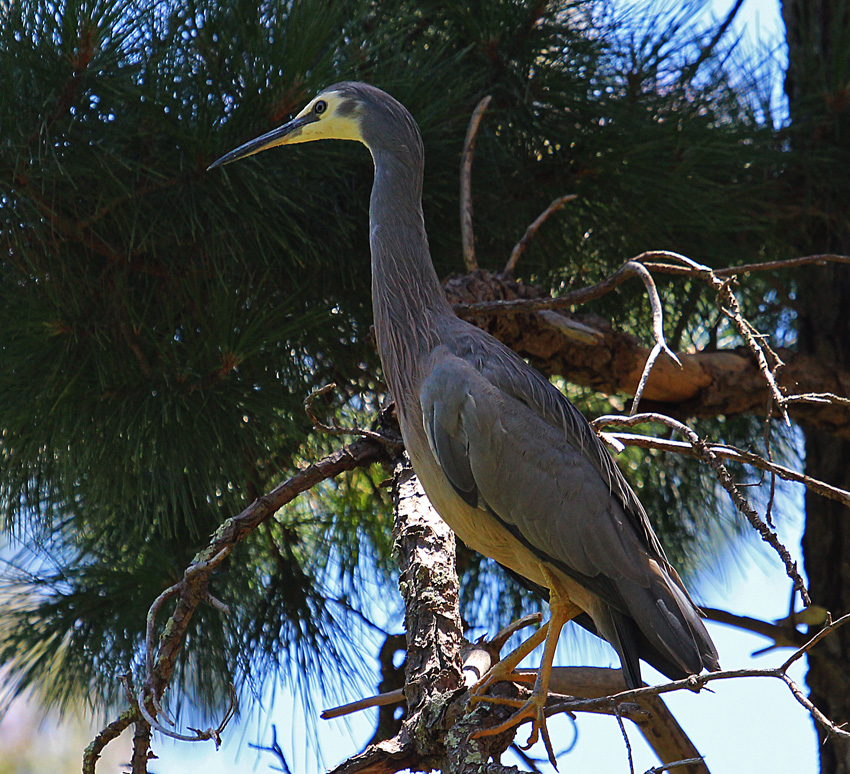
A white faced heron watches the creek from its vantage point in a pine tree

A white faced heron watches the creek from its vantage point in a pine tree


The first interesting small animal that I notice is a water skink which is sunning itself on a log. Being mid autumn I am surprised to see a reptile as most would now be ‘dug in’ for the winter months ahead. As I sit quietly and prepare to watch the lizard, a green eyed dragonfly lands on a boulder in the middle of the creek. And, where the water has formed a small clear pool I can see tiny fish or tadpoles swimming close the reeds and water striders skating across the surface: like my lunch, a gourmet larder for a range of feathered predators.

A water skink basking on a log amongst the reeds

A water skink basking on a log amongst the reeds

A dragonfly pauses for a moment on a warm rock in the creek

A dragonfly pauses for a moment on a warm rock in the creek


A fence marks the end of the reserve and I cross the creek to return on the northern bank. The tiny reed birds still elude me but in a shady stretch of water a single black duck is swimming against the current as it dabbles for food. A common enough species in southern Australia but the light is particularly good and on reviewing the shot it seems to encapsulate the mood of this lovely little waterway.

Black duck are common along the waterway

Black duck are common along the waterway


Until the next time

Baz

Photo Reflections 2

16 Nov

Dear Reader:

South Australia is an extraordinary place to live and work especially if you are a wildlife writer and photographer. Our fauna is both diverse and fascinating and en route to any destination there are always interesting country towns, world class wineries or vast rural properties to explore. This blog is a reflection of those attributes and is a collation of images and notes that remind me of the reasons I live and work here.

A Camping near Arkaroola

Camping near Arkaroola


Arkaroola is a world heritage wilderness area approximately 700 kilometres north of Adelaide. Its geology, Aboriginal heritage and wildlife make it a premier destination for off roaders, photographers and those who simply like a taste of real outback life.

B Nankeen night heron

Nankeen night heron

The wetlands around the Adelaide region have a core of commonly sighted species that include a variety of waterfowl, pelicans, ibises, swamp hens and swallows; to mention but a few. The nankeen night heron is one of the less frequently encountered birds which made photographing this one, as it hid in a willow overhanging a lake near my home, a special moment.

C Vines near McClaren Vale

Vines near McLaren Vale


The coast road that runs south from Adelaide along the Fleurieu Peninsula is a drive I have made countless times on the way to a dive site. On this occasion I was drawn to the dormant vines that stood in stark contrast to the overcast sky and yellow oxalis flowers.

D Biscuit star

Biscuit star


Sometimes the simplest creatures, the ones encountered countless times, catch your attention. Perhaps it is the light or just the way the animal is positioned. This common biscuit star caught my eye as it crept along the edge of a rock face covered in algae and a melange of encrusting organisms.

E Hoverfly on blossoms

Hoverfly on blossoms


Hoverflies are one of the most common invertebrates in our gardens. These agile little insects hover, flit and settle on a variety of flowering plants. They seem to be in constant motion. On an afternoon stroll through the Botanic Gardens an accommodating hoverfly settled on a nearby blossom giving me just a split second to get down low and capture this image which emphasises its startling compound eyes.

F Echidna foraging

Echidna foraging


Echidnas roam the length and breadth of Australia but they are not commonly seen. This one was trundling through the bush in the Adelaide Hills close to a termite mound that it had been ripping apart. It was the sound of the little spiky battle tank that gave away its location. Stealth does not appear to be part of their defensive repertoire. You don’t need to be furtive when you are armed with a plethora of sharp spines.


I hope you enjoyed this little reflection

Baz

Golf Course Birdies

9 Mar

Dear Reader

Adelaide has a diverse collection of golf courses. They wind along the coast, straddle the hills face and even overlook the heart of the city. Their well-watered fairways, native bushes and towering trees provide an attractive habitat for a wide variety of wildlife ranging from kangaroos and possums to waterfowl and colourful parrots.

Well watered fairways and a diverse collection of shrubs and trees provide an enticing array of niches for different bird species

Well watered fairways and a diverse collection of shrubs and trees provide an enticing array of environments for wildlife

This week’s story comes from one of the two inner city courses that stretch between the Torrens Lake and the fine old villas and tree-lined streets of North Adelaide. They are back to back public courses that are used by walkers, golfers and, of course, the occasional wildlife photographer.

An Adelaide rosella nonchalently feeds on seeds as a golfer strolls past

An Adelaide rosella nonchalantly feeds on seeds as a golfer strolls past

My morning walk started around eight and my quarry was the various groups of cockatoos that I had noticed feeding on the fairways earlier in the week. Although the birds are up and about just after dawn the light is not really conducive to capturing quality images in the early hours. As I strolled past the clubhouse towards one of the greens near the end of the course I heard the unmistakeable chatter of galahs (rose-breasted cockatoos). A quick glance around the area and I discovered half a dozen birds in a nearby patch of rough using their powerful, curved beaks to dig out tubers and crack open fallen seeds.

Galah searching for seeds amongst leaf litter below pine trees 2

Galah searching for seeds amongst leaf litter below pine trees

After a few minutes I left the cockies to their morning meal and moved across the course to a stand of tall, pale Eucalypts. As I scanned the canopy for movement several of the feeding birds flew onto a branch and started to groom each other. This was an unusual behaviour that I had not previously observed in galahs though I am sure these gregarious parrots interact socially in many ways. Perhaps they were a nesting pair and an older offspring. The grooming continued for a few minutes then escalated into a good natured session of sparring with beaks and wings that looked remarkably like a wrestling match.

Galahs socialising after flying into a Eucalyptus tree

Galahs socialising after flying into a Eucalyptus tree

My final cockatoo encounter was with a small group of little corellas near the car parking area. They were using their powerful beaks and claws to break up pine cones and extract the seeds. The birds seemed oblivious to me as they worked away at their hard won meal and I was able to sit and watch them for some time.

Little Corella demolishing a pine cone

Little corella demolishing a pine cone

Cheers

Baz

← Back

Thank you for your response. ✨