Tag Archives: South Australian wildlife

Salisbury’s Urban Wetlands

3 Jan


Dear Reader:

The saltbush and thorny wattle bushes that surround the bark chip path are thick and impenetrable. All around me I can hear the hum of insects and the twittering of unknown birds. Eventually I catch sight of a small bird perched in some bushes about twenty metres in front of me. The light is poor despite the sunny day and the shot is far from ideal. I wait for a few minutes. Finally the little bird breaks cover and sits on an exposed branch. It is still moving so the image will not be perfect but I fire off a few frames in the hope that one will help me to identify it.

1 Female fairy wren in scrub

Female fairy wren in scrub

5 Typical wetland  habitat

Typical wetland habitat


A little further along the trail I cross a footbridge and a wide expanse of shallow water confronts me. A collection of wading birds are feeding on an exposed mud-bank. They see me and start to behave nervously. I capture a single image just moments before the birds scatter; some disappear into the reeds while others take flight and head deeper into the wetland.

2 Various species of water birds on an embankment

Various species of water birds on an embankment


I am in the Greenfields Wetlands near Mawson Lakes where I work as a teacher. This complex of lakes, reed beds and low scrub is part of a chain of wetlands that filter stormwater for re-use in the Salisbury area a few kilometres north of Adelaide. This particular area has been carefully rejuvenated over several decades turning wasteland into a natural wetland zone where the wildlife is wary. Even common ducks disperse as I approach rather than simply paddling away as they might in the urban part of the creek that passes through my school. The wildlife is not only cautious but more diverse and one gets a real sense of being in the field, despite the traffic and housing only a hundred metres away.

2 Watershed restaurant

Watershed restaurant


My next wildlife encounter tests both observation skills and patience. I detect a slight movement on a mudflat near some reeds. I look a little closer and can see nothing. I wait, searching through the telephoto. Eventually, what appeared to be a brownish patch of decaying plant matter moves ever so slightly. It is a little black-fronted dotterel that has been foraging along the edge of the creek. A few more minutes pass more before the bird feels confident enough to resume its previous feeding pattern and I have to move carefully and slowly to capture an image. This is the kind of photography that I love. Perhaps it rekindles some lost predatory instinct…who knows?

4 Dotterel feeding on muddy embankment

Black-fronted dotterel feeding on muddy embankment


My final wetland moment is really quite unexpected. As I leave the trail and head up to the little restaurant that sits alongside the wetland there is a flurry of wings and water behind the reeds to my right. A flock of Australian pelicans lifts into the air. My camera is in standby mode and by the time it has re-started the birds are climbing rapidly. I hastily track them in flight and fire off a series of shots. Later when I review the images I am delighted to find that one picture shows three birds with their wings in different flight position.

6 Pelicans showing different wing positions in flight

Pelicans showing different wing positions in flight


As the light starts to fade I return to the Watershed Cafe, hand in my trail key and enjoy coffee and dessert on the deck overlooking the main lagoon. A tough way to end my day.


Cheers

Baz


JET

On the Edge of the Blue Line

25 Dec

On the Edge of the Blue Line

The sand is golden with a uniform, rippled pattern to it; like the sole of an old fashioned sneaker. Every few metres small clumps of grassy weed appear until finally the sand merges into an endless green meadow of seagrass. Seagrasses are not algae but true plants with leaves, roots and in most species, flowers. They form a crucial ecosystem in the shallow waters of Gulf St Vincent. As I hover above the dense mass of leaves, a school of tiny silver fish lifts out of their embrace, swims a few metres then blends back into the shelter of the meadow.

1

Blue line as seen from the sand hills near Henley Beach


I am snorkelling off Henley which is better known as a fashionable beachside cafe strip rather than a dive destination. I decided to arrive a little early and enjoy a cup of coffee while I waited for the sun to get high enough for underwater photography. The water is clear and the ocean warm and inviting at this time of year and it is just a short swim from the local jetty to the blue line where the sand and seagrasses merge. The lush tangle of gently waving blades that surround me are home to one of the planet’s richest marine environments. It is a place where whiting, mullet, blue crabs, giant rays and squid (to mention just a few inhabitants) find food and shelter for themselves and their young.

2 Seagrass meadows

Seagrass meadow


I swim a little further into the seagrass until I locate a patch of sand with some darker detritus around its edge, indicating that something might have dug into the substrate. I stir the sand with the tip of my dive knife…nothing…I swim a few metres further and repeat the process. On the third attempt I get a result. A dinner plate sized blue swimmer crab bursts out of the sand with pincers extended and full of aggression. These crabs are prolific along the upper gulf in the summer months providing a valuable commercial fishery and great sport for recreational fishers and divers.

5 Blue swimmer crab

Blue swimmer crab


Experience has taught me that the boundary between seagrass and sand is an ideal place to observe different animals. Because I am wearing extra weights I am able to rest effortlessly on the bottom in this zone and wait for something to happen. Over the next few dives my strategy pays off as a small group of juvenile King George whiting settle close to me as they search for worms and molluscs between weed and sand.

4 Juvenile King George whiting

Juvenile King George whiting


A little further offshore small sand patches occur regularly in the seagrass meadow. Often there are a few rocks colonised by brown or green algae and even variations in seagrass species in these areas and these slight variations in terrain frequently produce the greatest diversity of marine life. My first sand patch does just that. Lying close to the bottom, I let my eyes adjust to the light and moving shadows produced by the tidal flow and rippling surface. Just a few centimetres from my lens a seahorse clings to a blade of eelgrass using its tail and tiny fins to move in time with the swaying miniature forest of the underwater meadow.

3 Big bellied seahorse

Big bellied seahorse


I have been in the water for over an hour and I am getting a little chilly and besides a cappuccino and breakfast roll beckon back at the Henley Square where many a tourist sips coffee unaware of the glorious marine world just a short swim away.


Cheers

Baz


Willunga’s Blue Bees

13 Dec


Dear Reader:

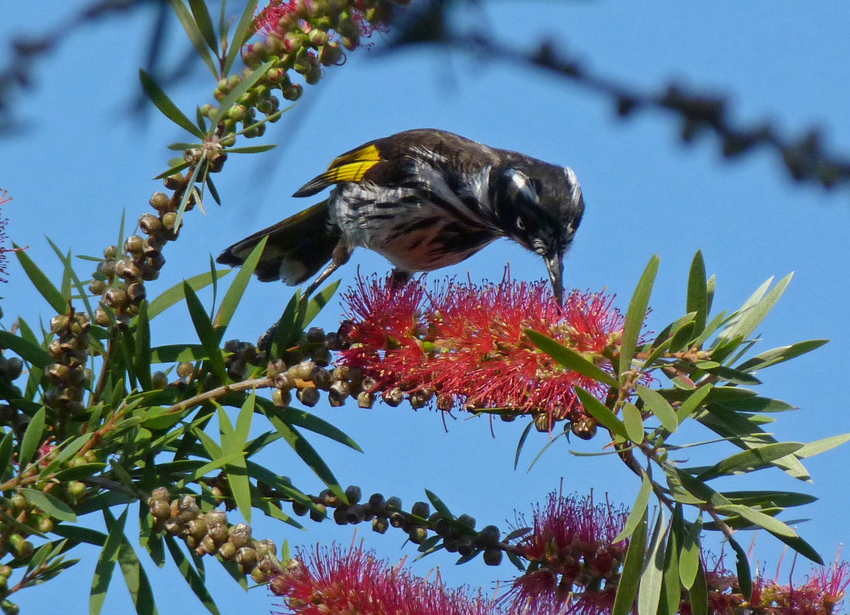
A few weeks ago I spent a weekend in the charming little country town of Willunga just south of Adelaide, in the McLaren Vale wine region. I was updating some illustrations in one of my wildlife books and needed some photographs of honeyeaters feeding on different coloured flowers. We stayed in a heritage B&B on the edge of the town with a lovely garden featuring stands of agapanthus, native hibiscus and several large bottle brush trees. Throughout the day a variety of birds, including both new Holland and white plumed honeyeaters, used their elongated beaks to probe the blossoms and hawk for insects.

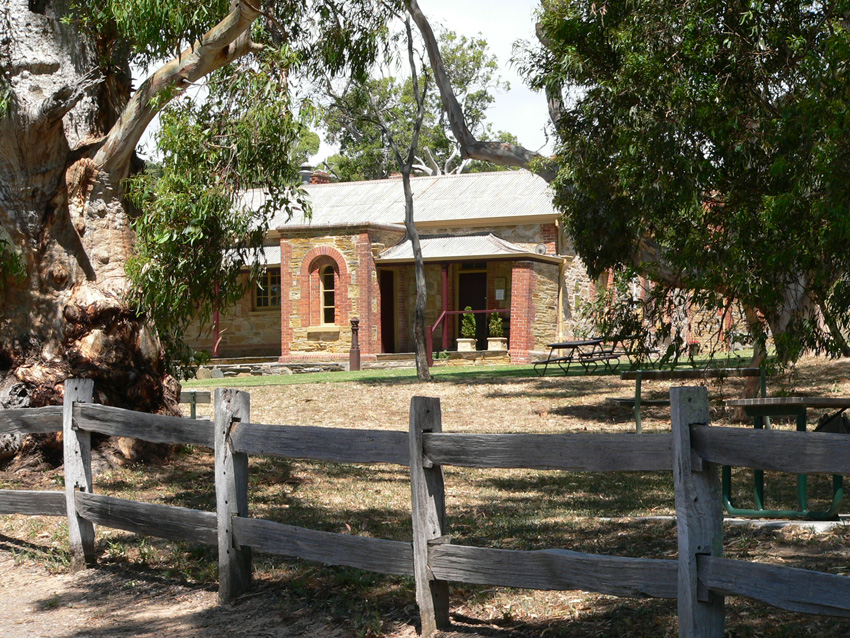
1 Willunga has many fine old colonial buildings

Willunga has many fine old colonial buildings


As well as honeyeaters the plants attracted more than their fair share of bees. Between sips of wine and a nibble of cheese (doing it tough that day) I watched them flit from one blossom to another gathering nectar and collecting a dusting of pollen on their legs. Then, out of the corner of my eye, I caught sight of one bee flying more erratically than the others, it seemed to hover for a second then repeatedly zoom off in different directions; like a miniscule attack helicopter. Every so often it would land but only for a short time before resuming its unpredictable flight pattern.

2 New Holland honeyeater probing bottle brush flowers for nectar

New Holland honeyeater probing bottle brush flowers for nectar


I moved my chair a little closer to the native hibiscus, where the little insect seemed to be spending most of its time, set the camera to macro zoom and started to track it through the lens. The bee was certainly smaller than the honeybees that were also doing the rounds of the blossoms and it appeared to have a bluish tinge. I fired off a couple of frames and took a closer look on the review screen. It was certainly not a honeybee. Over the next hour and a half several of the little blue bees appeared at different times and I managed to get a series of images that I could use to identify them. I suspected they were native bees which I had heard of but knew very little about.

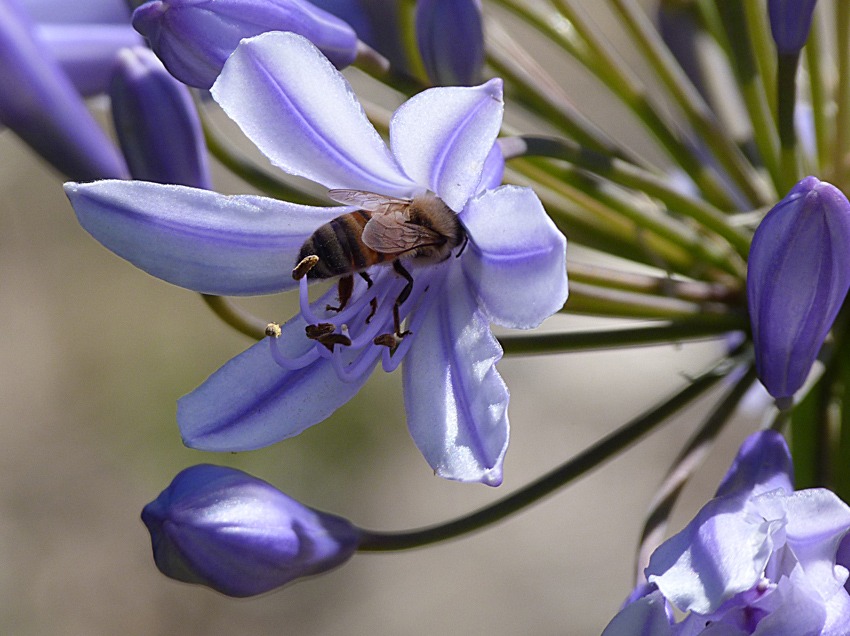
3 Honeybee feeding on a blue agapanthus

Honeybee feeding on a blue agapanthus


My guess was correct. The little insect was a blue banded bee (Amegilla cingulata). Blue banded bees are actually far more common than I realised and are found throughout SE Asia. They contribute to the pollination of many commercial crops with their unique ability to buzz pollinate; the result of intense wing vibrations when they cling to flowers.

4 Banded blue bee hovering in front of native hibiscus 2

Blue banded bee hovering in front of native hibiscus blossom


Unlike honey bees these native bees are not colonial with females building burrows in dried up river banks or even soft mortar in urban housing. Their sting is mild and they are not aggressive. Interestingly, these blue bees collect most of their nectar from blue flowers and since my initial sighting I have found them on the lavender and agapanthus in my own garden. They have obviously been there for years and I had never even noticed; yet another lesson in observation.

Cheers

Baz


Birds with Attitude

3 Dec


Dear Reader:

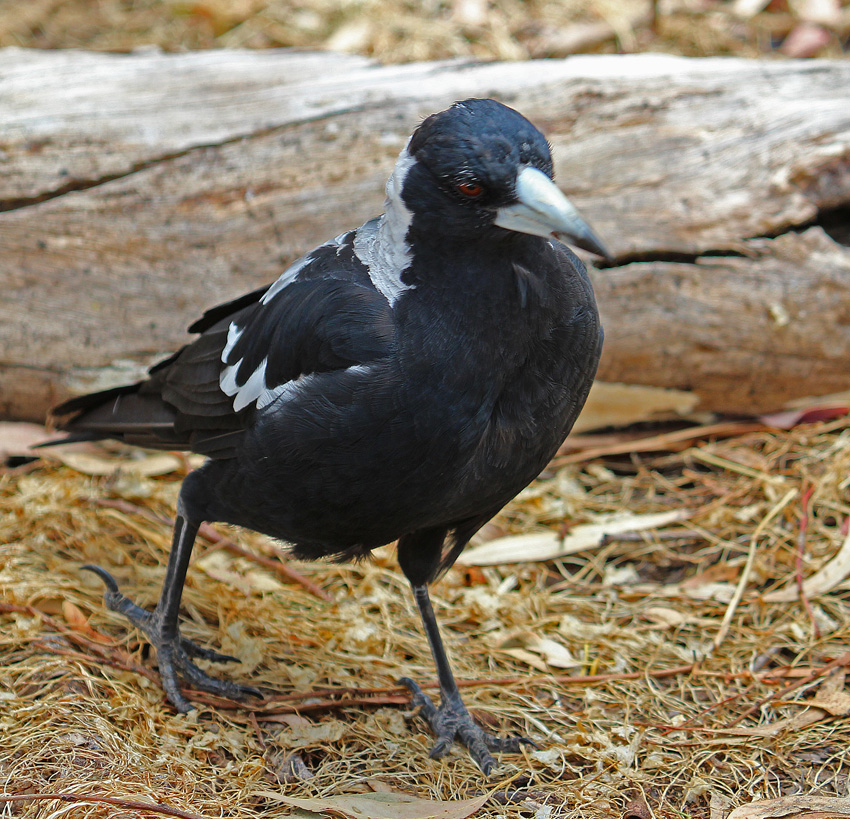
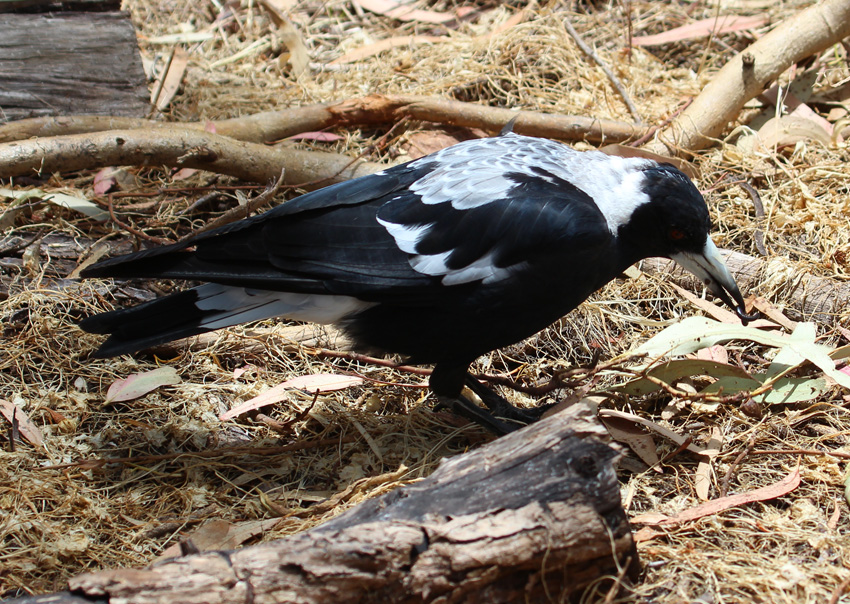
There were magpies scattered through the little park. I had seen them high in the trees and foraging nervously amongst the undergrowth. Every time I came close to one it would fly off and perch on a branch and watch me suspiciously. Suddenly, a small group of what I surmised must be sub-adults because of their grey flecked backs, decided to congregate in the understory just a few metres away from where I was sitting. They warbled and strutted and then seemed to organise themselves into a group.

E Magpie with attitude

The magpie strut


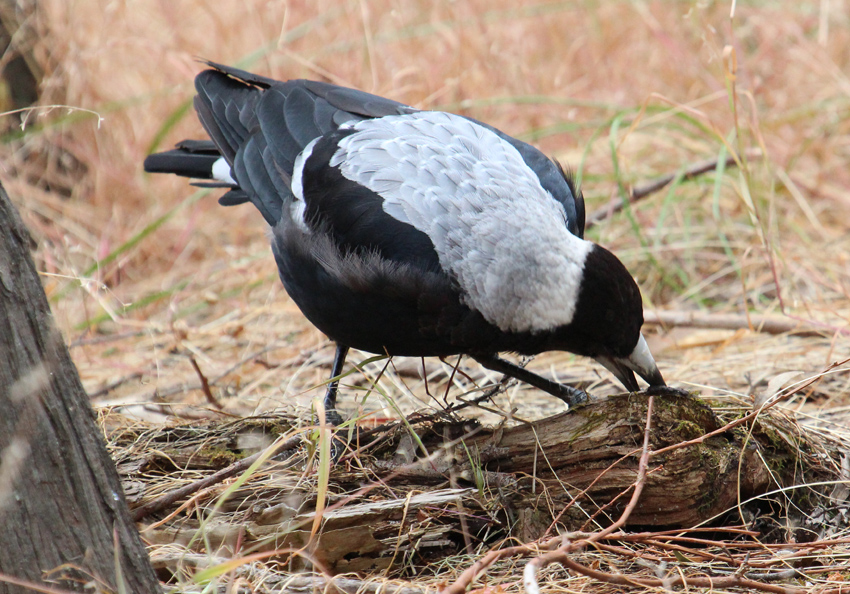
The birds moved in a skirmish line through the leaf litter chasing butterflies and raking through the ground with their powerful beaks. Every so often one would lift up its head and gulp down a grub then return to the hunt. I was perched on a fallen tree branch, clearly in their way but the birds just kept coming closer, brimming with the confidence that youth and inexperience bestows on many species including our own.

D Magpie with grub

Magpie about to swallow grub


Australian magpies (Gymnorina tibicen) are actually a member of the butcherbird family. They are medium sized, robust birds growing to around 44 cms in length with powerful stabbing beaks that are used for digging out ground based prey and for defence. Magpies live in groups of 2-24 birds with distinct social stratification- several high status females usually breed with a dominant male and the remainder live on the periphery helping to protect nests. They are extremely territorial during the breeding season and many a cyclist, golfer or innocent pedestrian crossing the parklands will tell tales of being attacked by dive bombing magpies.

F Magpie cleaning beak

Magpie cleaning beak while foraging


My far less adventurous magpie moment occurred inside a little conservation park in Burnside, one of Adelaide’s more affluent eastern suburbs quite close to the hills face. The park is classic scrub reminiscent of the way the plains would have been before European settlement. Tall eucalypts and native pines dominate the upper story and a variety of low bushes including spiky acacias form the mid range vegetation. Being the end of spring, there were still quite a few flowering plants amongst the leaf litter and fallen branches. And when I sat quietly and watched intently it was possible to catch glimpses of tiny brown skinks searching for prey in the jumbled layer of leaves and bark.

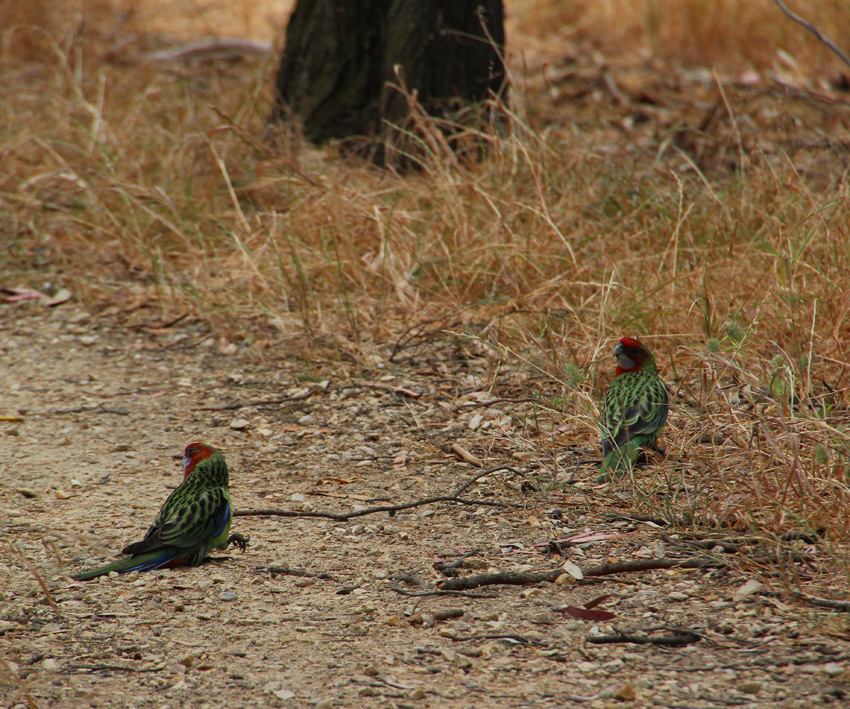
C Adelaide rosellas

Adelaide rosellas on the track near the park entrance


However, magpies were not the only birds using the park. As I entered through a side gate I watched a pair of Adelaide rosellas nibbling grass seeds on the path a mere 20 metres away. And the usual suspects; noisy miners, new Holland honeyeaters and some tiny, twittering finches, all added to the sounds and sights of my walk in the park.

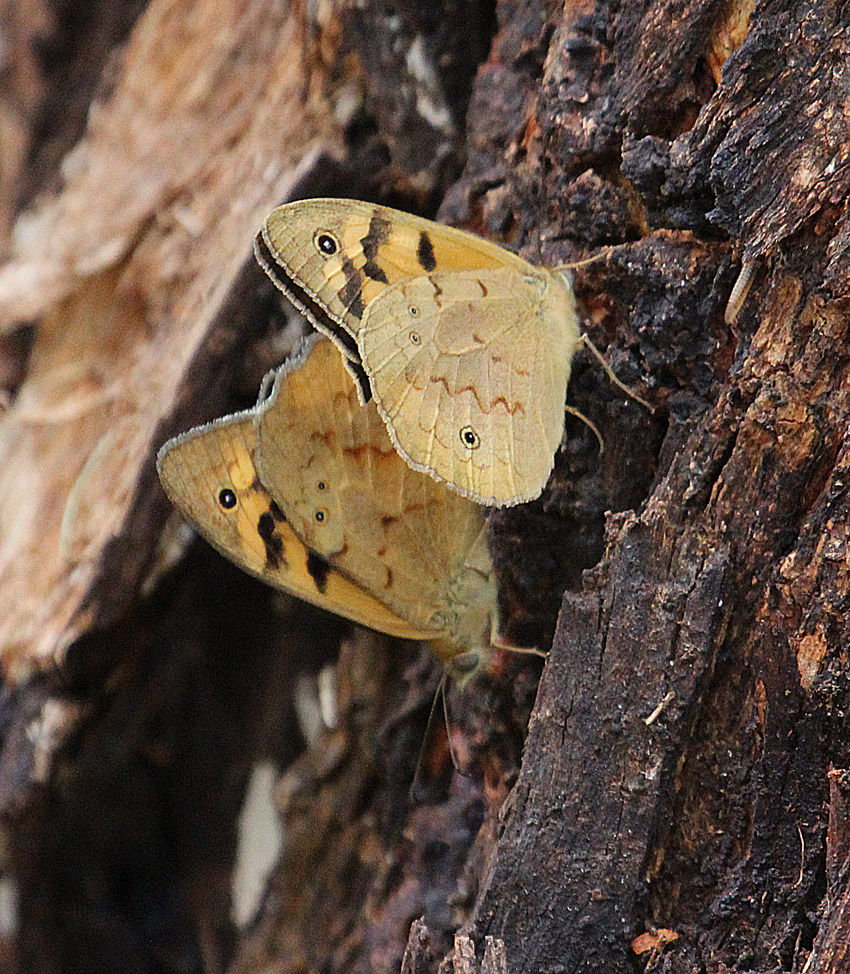
B Meadow argus butterflies

Meadow argus butterflies


Cheers

Baz


A Golden Day

24 Nov


Dear Reader:

The track is quite steep and the scrub dense. I can hear birds calling and catch fleeting glimpses of tiny finches foraging deep in the bushes. At the same time a group of lorikeets are feeding on eucalyptus blossoms in the canopy. But the birds are wary on this warm spring morning and keep moving out of camera range. Periodically, the eroded openings of narrow mine shafts, fenced off for safety, appear on both sides of the trail. I stop to reflect on the men who worked these dangerous tunnels armed only with buckets, ropes and spades. At the top of the hill, where I started my walk, a restored miner’s cottage and the weathered skeletons of a rock crusher and derrick suggest that the area had once been the centre of a sizeable mining operation.

1 mining equipment

Mining equipment


I am at the Barossa Goldfields about 40 kms from Adelaide between Williamstown and Gawler. At its peak in 1870, the lure of gold attracted around 4000 hopeful souls to these hills and over 25000 ounces of the precious metal was extracted. The site has been carefully restored by volunteers and is in the Para Wirra National Park; a worthwhile stop en route to the Barossa wineries if you care to take the back roads rather than the main highway. There is a network of well marked trails to suit walkers of all abilities and many excellent interpretive signs that cover everything from local geology to the everyday life of the original miners.

2 Cicadas

Cicadas

At the bottom of the trail there is a small creek still flowing from this year’s ample winter rains and as I cross it a kookaburra takes flight from a low branch where it had been watching for prey. The air is warm and buzzing with the calls of cicadas. I find a small eucalypt that seems to have more than its share of the ‘noisy little buggers’ and sit quietly in its shade for the next half hour trying to get a half decent shot.

4 Wattle bird

Wattle bird


As the trail climbs back out of the gully the terrain changes; the thick scrub gives way to more open grassland interspersed with stands of tall eucalypts. In the distance I catch sight of a pair of western grey kangaroos but they bound off over a ridge as I approach them. A scattering of rosellas are feeding in the grass and a wattle bird squawks defiance at a group of miner birds that are encroaching on its territory.

3 sleepy lizard

Sleepy lizard or shingleback skink

As the track takes a sharp bend I come across a sign that indicates a short cut back to the cottage and car park where I started my journey. It seems an opportune time to sit under a tree and take a ‘swig’ from my water bottle. However, I am not the only one who finds this a convenient resting place. I hear a faint rustling sound by my feet and a sleepy lizard materialises between a couple of rocks, its pine cone scales shiny and dark in the dappled light.


5 Grevillias

Grevillea flowers


I leave the lizard to its shady refuge and continue on my way, happy with my wildlife sightings and ready to wind up a successful morning’s trek. Close to the cottage another trail head appears. This track drops down sharply into a gully and I can see that the terrain has changed yet again. The soil is gravelly and grass trees, grevilleas and a variety of small plants with yellow, lilac and orange flowers, decorate the understory.

6 Grasshopper

Grasshopper species

The ever present eucalypts are a smaller more gnarled species. A few cicadas still buzz in the trees but on closer examination I can see a variety of other insects in the scrub including a glorious little cricket with ‘pink-camo-splotches’.

7 Grass tree amongst low eucalypts

Grass tree amongst stand of low growing eucalypts


I walk a couple of hundred metres further and realise that this trail is worth more than a cursory glance- but not today. And so ‘Dear Readers’ I look forward to another hike around the goldfields and the opportunity to share whatever I find with you.


Cheers

Baz


Photo Reflections 2

16 Nov

Dear Reader:

South Australia is an extraordinary place to live and work especially if you are a wildlife writer and photographer. Our fauna is both diverse and fascinating and en route to any destination there are always interesting country towns, world class wineries or vast rural properties to explore. This blog is a reflection of those attributes and is a collation of images and notes that remind me of the reasons I live and work here.

A Camping near Arkaroola

Camping near Arkaroola


Arkaroola is a world heritage wilderness area approximately 700 kilometres north of Adelaide. Its geology, Aboriginal heritage and wildlife make it a premier destination for off roaders, photographers and those who simply like a taste of real outback life.

B Nankeen night heron

Nankeen night heron

The wetlands around the Adelaide region have a core of commonly sighted species that include a variety of waterfowl, pelicans, ibises, swamp hens and swallows; to mention but a few. The nankeen night heron is one of the less frequently encountered birds which made photographing this one, as it hid in a willow overhanging a lake near my home, a special moment.

C Vines near McClaren Vale

Vines near McLaren Vale


The coast road that runs south from Adelaide along the Fleurieu Peninsula is a drive I have made countless times on the way to a dive site. On this occasion I was drawn to the dormant vines that stood in stark contrast to the overcast sky and yellow oxalis flowers.

D Biscuit star

Biscuit star


Sometimes the simplest creatures, the ones encountered countless times, catch your attention. Perhaps it is the light or just the way the animal is positioned. This common biscuit star caught my eye as it crept along the edge of a rock face covered in algae and a melange of encrusting organisms.

E Hoverfly on blossoms

Hoverfly on blossoms


Hoverflies are one of the most common invertebrates in our gardens. These agile little insects hover, flit and settle on a variety of flowering plants. They seem to be in constant motion. On an afternoon stroll through the Botanic Gardens an accommodating hoverfly settled on a nearby blossom giving me just a split second to get down low and capture this image which emphasises its startling compound eyes.

F Echidna foraging

Echidna foraging


Echidnas roam the length and breadth of Australia but they are not commonly seen. This one was trundling through the bush in the Adelaide Hills close to a termite mound that it had been ripping apart. It was the sound of the little spiky battle tank that gave away its location. Stealth does not appear to be part of their defensive repertoire. You don’t need to be furtive when you are armed with a plethora of sharp spines.


I hope you enjoyed this little reflection

Baz

Wine, Whales and Pelicans at the Bluff

26 Oct

Dear Reader: 

I am at ‘The Bluff’, a granite outcrop near the tip of the Fleurieu Peninsula. Comfortably tucked into a wicker chair on the balcony of the ‘Whalers Inn’,  I am enjoying a plate of local calamari and nursing a fruity white from one of our coastal vineyards. The restaurant is only ten minutes drive from the centre of Victor Harbor, the south coast’s largest town.

bluff vh

A view from the restaurant

P1000661

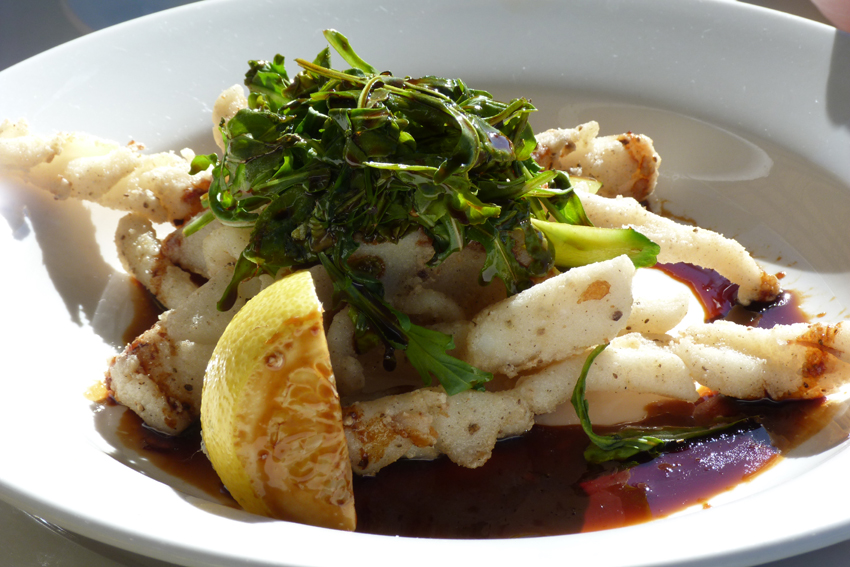
Calamari with soy, lemon and wilted greens

My field glasses and camera are within easy reach and every few minutes I scan the horizon beyond Wright Island for a tell-tale blow, breach or the raised fluke of a Southern Right Whale. I can just make out one animal a few kilometres out to sea and I am hoping that it will make its way closer inshore. Only a few days ago two adults and a calf were frolicking in the bay just a few hundred metres from where I am sitting. In fact, well over 40 whales have been seen during the last month. Southern Rights regularly migrate with their calves en route to their Antarctic feeding grounds at this time of year.

P1000649

Rocky outcrops and an offshore island


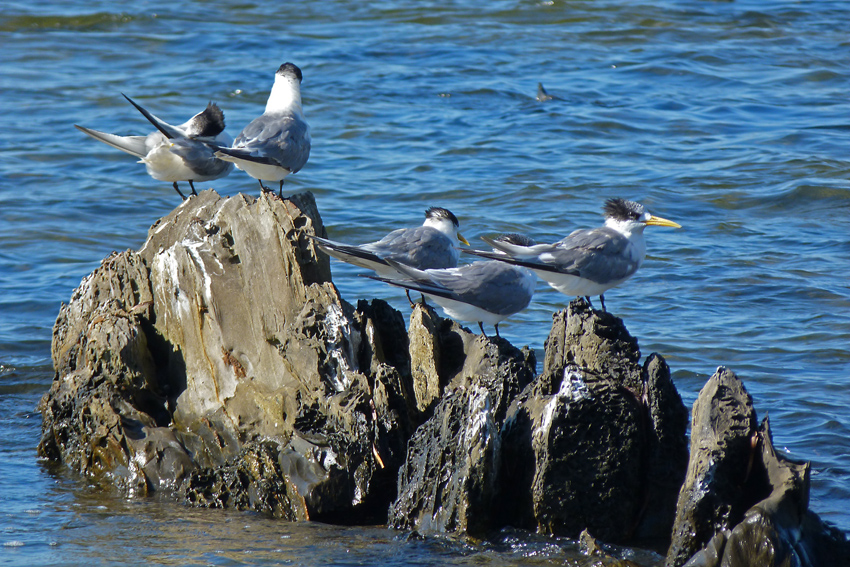
No such luck. The whale heads further out to sea and I know that it is late in the season and the chance of another sighting is slim. I shift my focus to the rocky foreshore where jagged outcrops of dark rock trail into the sea. A strong offshore breeze is ruffling the feathers of a group of caspian terns that are precariously clinging to the rocks. Over the last few hours they have been alternately patrolling the rolling swell between Wright Island and the mainland searching for baitfish then resting on the shoreline.

tern 2

Crested terns resting between forays


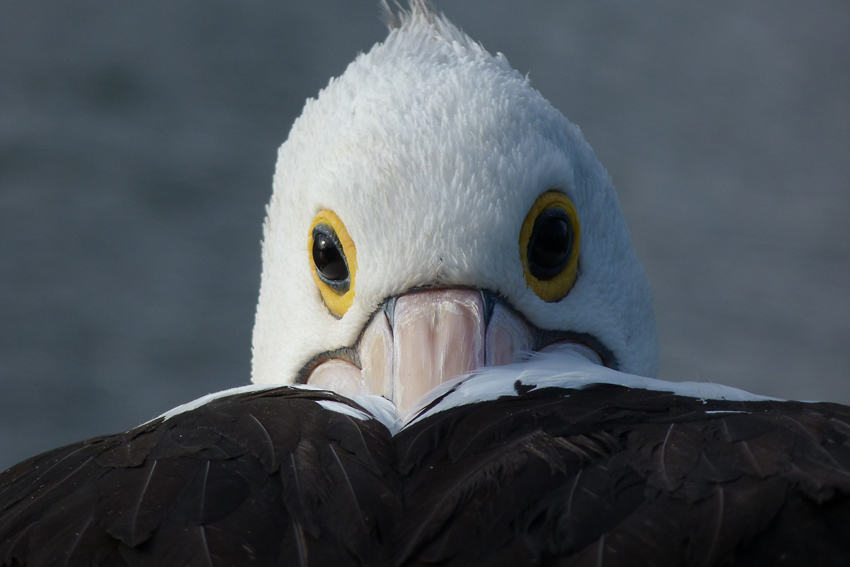
A little closer to the town, between a stand of huge Norfolk pines, there is a boat ramp and every so often anglers motor in from the deeper water and tie up at the dock. Several large granite boulders lie close to the channel and a couple of Australian pelicans have been patiently ensconced on their smooth surfaces eyeing each craft in the hope of a fishy handout. They are not too fussy and a few mullet, salmon trout or even some unused bait usually makes their wait worthwhile. While I finish my calamari the birds are rewarded by a boatie and his family of pelican friendly kids.

pelic 4

Australian pelican


There are, of course, the usual silver gulls flying, scavenging and wading in the shallows in search of any kind of food from a discarded potato chip to an unwary shore crab. But amongst their sleek silver forms I catch sight of a larger yellow beaked gull. It is a pacific gull, a less common species in this area, and it is wading in the shallows searching for prey in one of the tiny beaches that form between the rocky outcrops.

pacific  gull 3

Pacific gull


As the afternoon wears on and the temperature climbs, I finish my glass of wine, pay the bill and stroll down to the car. The sea is inviting and my snorkelling gear and underwater camera are in the back. Today I have dined well, photographed a diverse collection of seabirds, watched whales on a dazzling blue ocean, and now I have the chance of encountering some slightly smaller varieties of marine life in a great dive location.

That encounter will be the subject of a future blog.

Cheers

Baz


Kids, Kookaburras and Creeks

4 Oct

Dear Readers

It would be lovely to write for a living. To earn my dollars wandering South Australia’s diverse wilderness areas taking photos and composing articles to share with you. Dream over….reality check! Like most of the world I need a steady job to survive and my profession is teaching. One of the many requirements at my school is to take my year 6 students on camp each year. Fortunately, Adelaide has many wonderful destinations in the adjacent hills and along the coastline that provide a range of outdoor activities. Many of these sites also double as corporate destinations. This year we chose Wirraway a campsite located on the eastern fringe of the Mt Lofty Ranges. It is a beautiful location situated amongst rolling hills with a little creek running through the property. And, to my delight their program included a nature walk along with the adventure activities.

G

Typical hills country


Each morning I woke at six and reluctantly dragged my weary bones out of bed; any teachers reading this will immediately understand that the previous night’s sleep was limited to a few hours. The students were not allowed out of their dorms until 7.00 which gave me an hour to wander around the grounds uninterrupted. Campsites always attract wildlife. However well intentioned the staff may be there are always a few food scraps to be had, nooks and crannies to nest or hide in as well as wood piles and building materials that might be home to both predator and prey. On my first morning a pair of rats scurried under the raised foundations of the caretaker’s home watched with interest by me and anticipation by a kookaburra sitting in a an old gum tree (there’s a song title there).

kooka2 red

Hungry kookaburra


The camp site was also home to a wild rabbit that liked to munch the grass close to one of the girls’ dorms but scurried back into the bushes at the slightest noise. Each time it appeared I tried to signal the students to be quiet and take a look…no such luck. Only a picture snapped in the quiet hours and shown at the dinner table convinced them that I was not making it up.

A

Peter makes a rare appearance


Both male and female superb blue wrens were common though timid and constantly on the move keeping low in the bushes and feeding in the leaf litter. And a resident flock of red browed finches moved between the flowering trees and bushes often coming close when I was working with the students and staying away if I had a camera nearby. Fancy that!!

C

Male superb blue wren

B

Finches all in a line


Our nature walk was quite a revelation. You would not expect city kids to be overly responsive to a lengthy stroll in the bush when the alternative activities included horse riding, archery and rock climbing. Surprisingly, they showed a keen interest in what the guide had to say and even sat quietly by the creek for a few minutes trying to work out how many different frog species could be identified from their distinctive calls. Even the plant life scored a hit, most notably the unusual grass trees that were flowering at the time and an old weathered log with lichen and moss growing in its sinuous furrows.

E

Flowering grass plants

F

Patterns and colours in nature


The three days passed quickly and each group appeared to enjoy their excursions into the bush.  Kids get few opportunities to experience the outdoors in our digital world and watching their faces as they discovered the beauty of wild things was a rare pleasure.


Until my next post

Cheers

Baz

An Urban Billabong

29 Sep

Dear Reader:

The word billabong looms large in Australian folklore. It is where ‘a jolly swagman’ met his untimely end and mythical beasties called ‘bunyips’ supposedly emerge from the water to devour unwary campers. In reality, billabongs are freshwater wetlands that flood when river levels are high then become more isolated in the dry season. They are essentially backwaters that provide a refuge for many different species of animals as well as being popular locations for camping and fishing.

i

Still, dark waters of an urban billabong


In South Australia the lower reaches of the Murray River has many lovely billabongs that have provided me with many a peaceful afternoon’s wildlife watching and photography. However, the trail that runs along the banks of Adelaide’s Torrens River also incorporates a little billabong which is tucked behind the upmarket suburb of St Peters, just a stone’s throw from the CBD. It was rehabilitated in the mid eighties and over the intervening years various community and government groups have overseen its care and maintenance.

c

A mosaic of the rainbow serpent reflects the importance that Aboriginal people attached to billabongs


Last weekend, I packed my little super-zoom camera, hopped on the bike and pedalled up to the billabong to take stock of the wildlife. It has been a long wet winter and I was hoping that the warmth of the first few weeks of spring would stimulate some wildlife activity. I was not entirely disappointed. As I approached the little wooden landing that fronts the water, a pair of amorous crested pigeons pranced and displayed to each other. Close to a patch of reeds a mother black duck was tending a pair of fluffy little ducklings.

h

Courting crested pigeons

k

A pair of black swans nibble the water side vegetation


During the winter months the landscape may be verdant but few of the native shrubs flower and the insects that rely on the blossoms are rare. Now the billabong was clearly beginning to emerge from its winter blues and life was starting to reassert itself. As well as the hormonal pigeons and baby ducks a colony of colonial spiders had constructed a silken trap in an acacia bush and delicate little purple chocolate lilies were emerging from their winter dormancy.

chocolate lily

Chocolate lily

L

Colonial spiders construct a complex web in a wattle bush


As spring turns to summer I am sure the wildlife will continue to flourish and I look forward to revisiting and reporting back to you.

Cheers

Baz      

Mangrove Wildlife

9 Aug

Dear Reader:

The city of Port Adelaide is a working port that includes a power station, shipyards and fine old buildings that date from the early colonial days when sailing ships transported goods and settlers to the new colony. Yet only a few kilometres from this industrial zone is a haven for wildlife both above and below the water. Mangroves once dominated this area but land clearing, to establish new beachside suburbs, decimated this crucial coastal environment. Eventually local communities and conservationists finally put pressure on the government to preserve what was left.

AH Power station near the mangrove area

Power station near the mangrove area

This weekend I grabbed a camera and spent a leisurely hour walking around the Port taking in the sites and enjoying some seafood at one of the oldest hotels in the state. Early in the afternoon I drove a couple of kilometres to the Garden Island boat ramp where mangroves still dominate the shoreline of the Port River. This complex system of intertidal mudflats, seagrass meadows and the thick cover of mangrove trees supports a vital nursery area for many of the fish, prawn and crab species that live in St Vincent’s Gulf; Adelaide’s marine backyard and larder.

AG Puemataphores  in the mangrove forest

Puemataphores in the mangrove forest


As I walked along the little jetty that skirts the edge of the mangroves I chatted to a couple of fishers working the incoming tide. They had spotted a pod of dolphins cruising along one of the channels a little earlier in the afternoon and a pair of pied cormorants were boldly eying their bucket of baitfish as we spoke. The jetty also provides an excellent view into the mangroves and within a few minutes I had spotted a white faced heron perched on a low branch hunting for crabs. Nearby, a glorious little golden whistler was searching for insects near the entrance to a tidal creek.

AA Whitefaced heron hunting deep in the mangroves

White-faced heron hunting deep in the mangroves

AC Golden whistler in thorny bushes on the edge of the mangroves

Golden whistler in thorny bushes on the edge of the mangroves


Because the tide was out I had the perfect opportunity to walk into the mangroves and take a closer look amongst the tangle of limbs and bizarre little pneumatophores that protrude like blackened fingers from the forest floor. The sticky mud between these gas absorbing extensions of the root system was pock marked with little crab holes. It took some patience and a mini war with a squadron of mosquitoes before I caught a crab in the open and managed to capture an image.

AD Mangrove crab in samphire at the edge of the mudflat

Mangrove crab in samphire at the edge of the mudflat


A little itchy and with my boots liberally coated with dark mud, I decided to call it a day. Later in the year I will return to another area of mangroves a little further down the coast and share some more images and notes about the extraordinary animals that exist in this harsh and unusual habitat.

Cheers

BAZ