Archive | Travel stories RSS feed for this section

Tasmania’s Flinders Island….Day 1

18 Apr

Dear Reader:

The Black Tiger Snake is a good two metres long with its head raised towards me. However, I am safely seated in the driver’s seat of the rented SUV.

The reflection in the side mirror suggests a cautious approach to photographing a large Black Tiger Snake

I am spending seven days exploring Tasmania’s Flinders Island in Bass Strait, the largest of the Furneaux Island group. My apologies for straying from my usual South Australian blogs but this fascinating Island is certainly worth a few posts.

Typical Flinders Island coastline

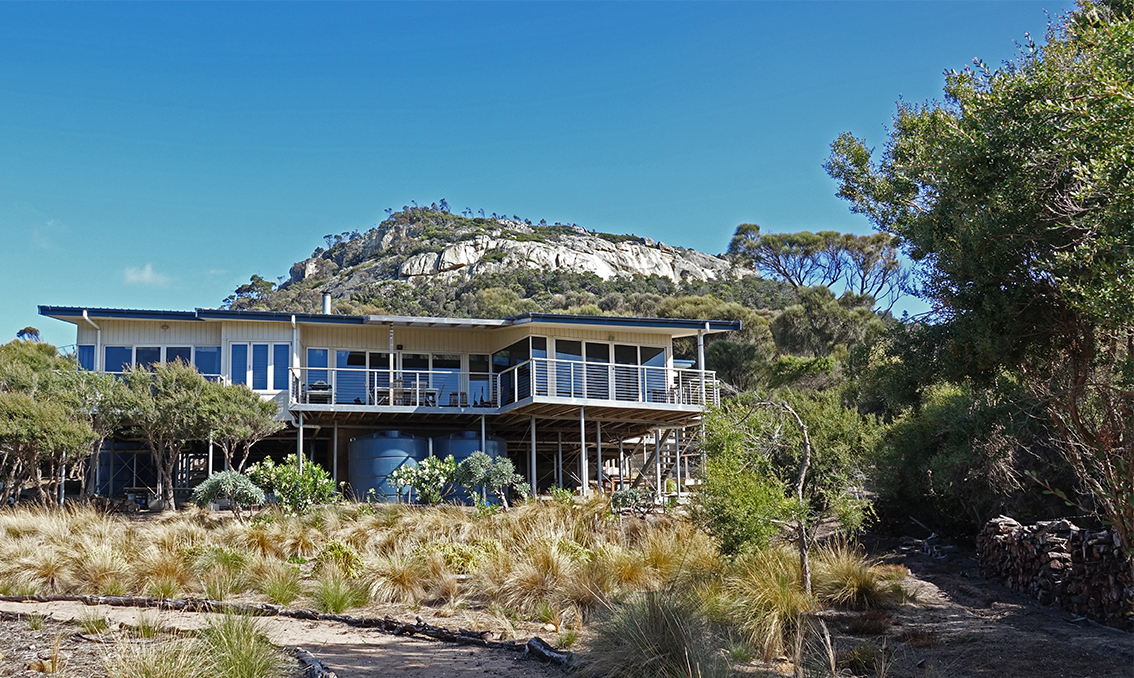
Nautilus, the coastal rental we are staying in, is truly wonderful; beautifully appointed and self-contained it offers panoramic views of the coastline.

View from Nautilus’s main living area

Unpacked and settled in, I take the path through the back garden and a  few metres of scrub emerging onto a granite platform which typifies this section of coast.

A gap in the scrub leads to the coast
Nautilus from the bottom of the garden area

The rugged outcrops and cliffs extend both ways along the shoreline, punctuated on the eastern flank by a bay with and stretch of golden sand. The sand yields Topaz crystals called ‘Killiekrankie Diamonds’. named for the tiny settlement and beach where they are found.

Killiecrankie’s bay and beach

A small bench sits on the border between scrub and granite. It is the perfect place to enjoy the striking scenery and look out for seabirds, dolphins and other coastal wildlife. I do not have to wait too long as a pod of dolphins cruises past several hundred metres out to sea while both Silver Gulls and Pacific Gulls fly along the seashore.

A Pacific Gull flies past

The sun is getting lower in the sky and there is just enough time to explore one of the many rockpools worn into the granite and accessible at low tide. This cursory look reveals periwinkles in the splash zone, limpets along the waterline and an occasional red anemone.

Rockpool in the granite coastline
Three Limpets amongst the Periwinkles….both use their tight sealing processes to retain water and can survive low tide exposure

Evening is closing in and it’s time to get back and start preparing dinner. Approaching the steps leading to the house, I notice a Red-necked or Bennett’s Wallaby in the driveway. It doesn’t seem too perturbed by my presence and hops into the nearby tree-line then stops and looks back at me.

A Red-necked Wallaby bounds across the path behind the house

My first day on Flinders Island has been quite exciting and I hope for more revelations as the week goes by.

Cheers

Baz

Additional notes

Other animals seen, heard but not photographed, Kookaburra, Fairy Wrens, Black Currawong, cormorant species

The camera used for this post is a Sony RX10 111

Please pass on this blog title and or contact information (URL) to any person or organisation with an interest in taking walks and enjoying wildlife in SA.

Click on these links and see more South Australian stories and pictures in my Weekend Notes articles as well as locating similar blogs on Feedspot’s top 20 Australian wildlife blogs

https://www.weekendnotes.com/adelaide/writer/452/

https://blog.feedspot.com/australian_wildlife_blogs/

Barnes on a Rainy Day

14 Oct

Dear Reader:

A trio of elegant Mute Swans glide effortlessly across the river. They are accompanied by both male and female Mallards.

Three Mute Swans and one cygnet alongside Mallards

English Mute Swans are a sharp contrast to the usual Black Swans that I encounter at home in SA.

Australian Black Swans and cygnets

I am taking a rainy day walk around the outer London village of Barnes; a 45 minute bus trip from central London. This largely affluent community sits on a bend in the Thames River.

One of several pubs in Barnes

There is a wide range of things to do in this village even on a rainy day. The architecture is varied and interesting, the river and central duck pond support a variety of wildlife and there is an eclectic variety of shops and galleries to browse.

Duck pond at Barnes

Beyond the swans, in mid river, two teams of rowers battle against the incoming tide as their coaches urge them on from a power boat. And yes, the term tide is correct, as the Thames is a tidal river for many miles above its confluence with the ocean.

Rowing on the Thames

Battling a sudden gust of wind I follow the Thames Path, past some interesting buildings with glorious views over the river. I am making my way towards a little gallery which I always visit when I come to London.

Walking along the Thames Path in the rain

Local artists are featured here and I chat with one of the owners, an artist himself, before purchasing a beautiful ceramic owl as a keepsake.

Inside the Riverside Gallery

On the nearby duck pond, my naturalist’s eye is drawn to a pair of Swans and their sub-adult cygnets. The birds start to paddle across the water in my direction. Even closer, a pair of Egyptian Geese leave water and begin to feed on the grassy verge by the pathway. 

Egyptian Geese feeding

The rain eases a little and I peer into shop fronts as I make my way along the high street towards a bus stop for my return trip to London.

A soggy dog at the bus stop

As always, my short excursion to Barnes has been wonderful. Despite the wet weather, which adds a certain convincing flavour to the day, I have managed to capture a few memorable images.

Cheers

Baz

Additional notes

The camera used was a Nikon Coolpix W300 (all weather camera)

This is an easy walk/drive which is quite suitable for families and seniors with public toilets, parking and other facilities nearby. It is dog friendly.

 Please pass on this blog title and or contact information (URL) to any person or organisation with an interest in taking walks and enjoying wildlife.

 Click on these links and see more  stories and pictures in my Weekend Notes articles as well as locating similar blogs on Feedspot’s top 20 Australian wildlife blogs

 https://www.weekendnotes.com/adelaide/writer/452/

https://blog.feedspot.com/australian_wildlife_blogs/