Tag Archives: environment

Tasmania’s Flinders Island….Day 1

18 Apr

Dear Reader:

The Black Tiger Snake is a good two metres long with its head raised towards me. However, I am safely seated in the driver’s seat of the rented SUV.

The reflection in the side mirror suggests a cautious approach to photographing a large Black Tiger Snake

I am spending seven days exploring Tasmania’s Flinders Island in Bass Strait, the largest of the Furneaux Island group. My apologies for straying from my usual South Australian blogs but this fascinating Island is certainly worth a few posts.

Typical Flinders Island coastline

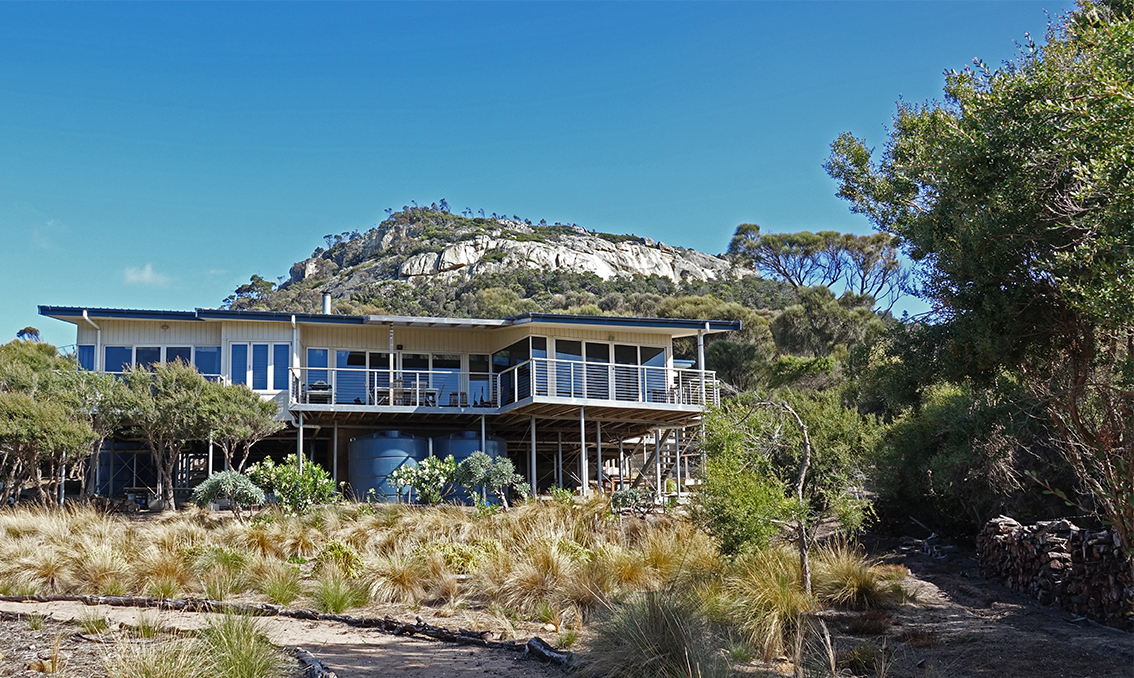
Nautilus, the coastal rental we are staying in, is truly wonderful; beautifully appointed and self-contained it offers panoramic views of the coastline.

View from Nautilus’s main living area

Unpacked and settled in, I take the path through the back garden and a  few metres of scrub emerging onto a granite platform which typifies this section of coast.

A gap in the scrub leads to the coast
Nautilus from the bottom of the garden area

The rugged outcrops and cliffs extend both ways along the shoreline, punctuated on the eastern flank by a bay with and stretch of golden sand. The sand yields Topaz crystals called ‘Killiekrankie Diamonds’. named for the tiny settlement and beach where they are found.

Killiecrankie’s bay and beach

A small bench sits on the border between scrub and granite. It is the perfect place to enjoy the striking scenery and look out for seabirds, dolphins and other coastal wildlife. I do not have to wait too long as a pod of dolphins cruises past several hundred metres out to sea while both Silver Gulls and Pacific Gulls fly along the seashore.

A Pacific Gull flies past

The sun is getting lower in the sky and there is just enough time to explore one of the many rockpools worn into the granite and accessible at low tide. This cursory look reveals periwinkles in the splash zone, limpets along the waterline and an occasional red anemone.

Rockpool in the granite coastline
Three Limpets amongst the Periwinkles….both use their tight sealing processes to retain water and can survive low tide exposure

Evening is closing in and it’s time to get back and start preparing dinner. Approaching the steps leading to the house, I notice a Red-necked or Bennett’s Wallaby in the driveway. It doesn’t seem too perturbed by my presence and hops into the nearby tree-line then stops and looks back at me.

A Red-necked Wallaby bounds across the path behind the house

My first day on Flinders Island has been quite exciting and I hope for more revelations as the week goes by.

Cheers

Baz

Additional notes

Other animals seen, heard but not photographed, Kookaburra, Fairy Wrens, Black Currawong, cormorant species

The camera used for this post is a Sony RX10 111

Please pass on this blog title and or contact information (URL) to any person or organisation with an interest in taking walks and enjoying wildlife in SA.

Click on these links and see more South Australian stories and pictures in my Weekend Notes articles as well as locating similar blogs on Feedspot’s top 20 Australian wildlife blogs

https://www.weekendnotes.com/adelaide/writer/452/

https://blog.feedspot.com/australian_wildlife_blogs/

Barrow Beach’s Dragons

26 Nov

It is a mild afternoon; a nice time for a drive down to one of my favourite outdoor destinations. Not well known or easily accessed, Barrow’s Beach is a half hour drive from Port Pirie and about fifteen minutes from Port Germein. A Google Earth hunt will best describe how to access the area, but beware; depending on weather and your desire for adventure, 4WD is recommended.


Typical terrain


We are scouting the beach for fishing spots and enjoying some wildlife photography at the same time. As we come off the track onto the beach I notice a group of Rose Breasted Cockatoos (Galahs) fossicking in the seaweed that has been washed up during stormy weather and high tides. Worth a shot as this is not their usual environment.


Beachside cockies


Further along the beach where the sand is quite tricky to negotiate a mixed flock of Pied Cormorants and Common Terns are resting on a sand bar. As we approach they take flight creating a lovely image as they pass low across the shallow water with the muted outline of the Flinders Ranges as a backdrop.


Formation flying


It seems that our drive is turning out to be more about wildlife than fishing. And our next few encounters highlight that idea. My fishing partner and driver Geoff traverses the beach and heads a back along a pot holed track overgrown with  wiry bushes and stunted trees . We stop several times to explore likely areas where reptiles, shore birds and even the odd kangaroo might be hiding.


Stay away


Kangaroos and shore birds do not seem to be on the menu in this area but we do flush out three separate species of lizards; a Shingleback, Bearded Dragon and a little Painted Dragon. Wonderful to see so many kinds of lizards in such a short period of time.


Glimpse of a dragon


Bearded dragon

Our trip is not ended and there is still much to see among the mangroves and little channels that flow through them but I shall leave that part of my adventure for another post in the future.

Cheers

Baz

Additional notes

This is a challenging drive with no facilities available. However once at the location walking is easy enough.

See more South Australian stories and pictures in Weekend Notes

https://www.weekendnotes.com/profile/651267/

 I have recently spent time in Africa and the link below will allow you to enjoy images and text describing some of my encounters with the wonderful wildlife of Botswana and Zambia. I will try to attach a new image and notes each month.

https://wildlifemomentssa.blogspot.com