Tag Archives: periwinkle

Tasmania’s Flinders Island….Day 1

18 Apr

Dear Reader:

The Black Tiger Snake is a good two metres long with its head raised towards me. However, I am safely seated in the driver’s seat of the rented SUV.

The reflection in the side mirror suggests a cautious approach to photographing a large Black Tiger Snake

I am spending seven days exploring Tasmania’s Flinders Island in Bass Strait, the largest of the Furneaux Island group. My apologies for straying from my usual South Australian blogs but this fascinating Island is certainly worth a few posts.

Typical Flinders Island coastline

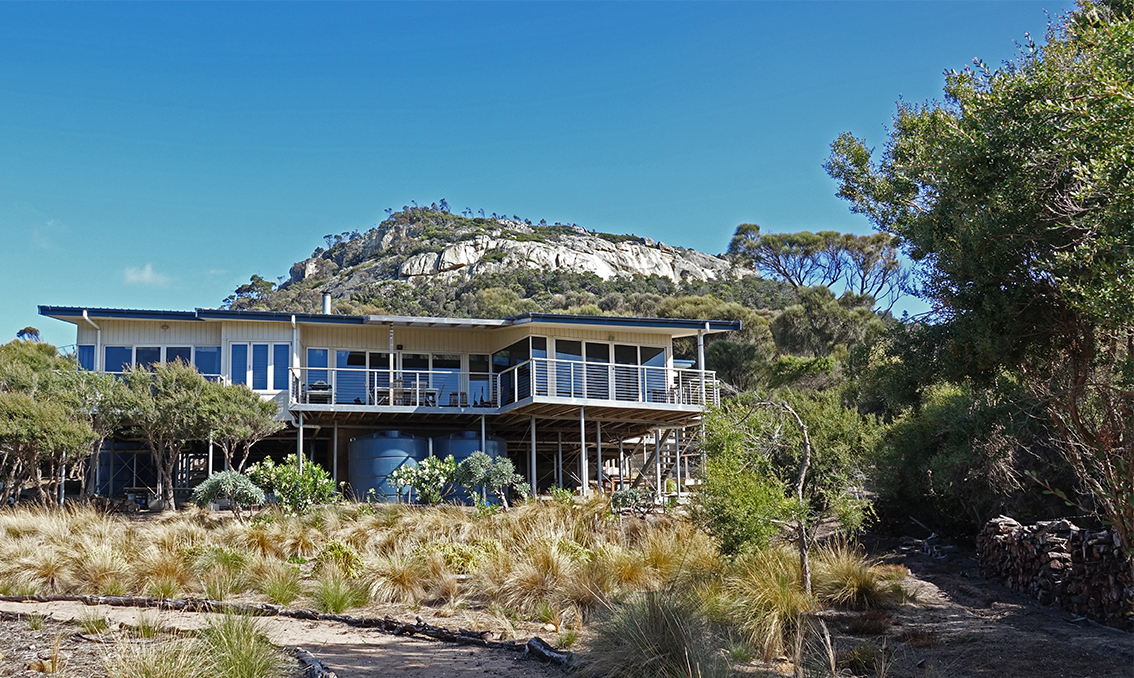
Nautilus, the coastal rental we are staying in, is truly wonderful; beautifully appointed and self-contained it offers panoramic views of the coastline.

View from Nautilus’s main living area

Unpacked and settled in, I take the path through the back garden and a  few metres of scrub emerging onto a granite platform which typifies this section of coast.

A gap in the scrub leads to the coast
Nautilus from the bottom of the garden area

The rugged outcrops and cliffs extend both ways along the shoreline, punctuated on the eastern flank by a bay with and stretch of golden sand. The sand yields Topaz crystals called ‘Killiekrankie Diamonds’. named for the tiny settlement and beach where they are found.

Killiecrankie’s bay and beach

A small bench sits on the border between scrub and granite. It is the perfect place to enjoy the striking scenery and look out for seabirds, dolphins and other coastal wildlife. I do not have to wait too long as a pod of dolphins cruises past several hundred metres out to sea while both Silver Gulls and Pacific Gulls fly along the seashore.

A Pacific Gull flies past

The sun is getting lower in the sky and there is just enough time to explore one of the many rockpools worn into the granite and accessible at low tide. This cursory look reveals periwinkles in the splash zone, limpets along the waterline and an occasional red anemone.

Rockpool in the granite coastline
Three Limpets amongst the Periwinkles….both use their tight sealing processes to retain water and can survive low tide exposure

Evening is closing in and it’s time to get back and start preparing dinner. Approaching the steps leading to the house, I notice a Red-necked or Bennett’s Wallaby in the driveway. It doesn’t seem too perturbed by my presence and hops into the nearby tree-line then stops and looks back at me.

A Red-necked Wallaby bounds across the path behind the house

My first day on Flinders Island has been quite exciting and I hope for more revelations as the week goes by.

Cheers

Baz

Additional notes

Other animals seen, heard but not photographed, Kookaburra, Fairy Wrens, Black Currawong, cormorant species

The camera used for this post is a Sony RX10 111

Please pass on this blog title and or contact information (URL) to any person or organisation with an interest in taking walks and enjoying wildlife in SA.

Click on these links and see more South Australian stories and pictures in my Weekend Notes articles as well as locating similar blogs on Feedspot’s top 20 Australian wildlife blogs

https://www.weekendnotes.com/adelaide/writer/452/

https://blog.feedspot.com/australian_wildlife_blogs/

Patowolonga’s Cormorants

1 Dec

Dear Reader:

It is a glorious spring day, not a breath of wind to ruffle the placid expanse of water that stretches out in front of me. By the breakwater there is a gathering of little black cormorants paddling alongside the rocky barrier. Every few minutes, one of the birds dives and swims out into the deeper water to hunt. Cormorants use both wings and feet to navigate underwater. Their aquatic speed and agility combined with specially adapted eyes and serrated beaks make them formidable fishers.

1-red

Black cormorant

2-red

Black cormorant diving


I am walking around the Patawolonga from Glenelg towards the first road and foot-bridge. This man-made lake extends between Glenelg and West beach for around 1.5 kilometres and serves as a flood mitigation system. The area also incorporates a berths for larger boats and lock that lead on to Holdfast Shores Marina an upmarket, shopping, restaurant and residential complex.

3-red

View from the bridge


When I reach the bridge there is a spectacular view back down the lake towards Glenelg that takes in the old replica ship The Buffalo which brought some of South Australia’s first colonists and governor ashore. The extensive grassed areas that run alongside ‘The Pat’ are shaded by eucalypts and Norfolk pines which attract a wide range of common urban birds. Today there are numerous crested pigeons foraging in the grass as well as wagtails and swallows demonstrating their sophisticated aerial acrobatics as they hunt for insects nearer the water.

4-red

Crested pigeon


From the western end of the bridge I walk back towards Glenelg along the edge of the marina. There are several fishermen casting for bream and I stop and chat with them. Apparently a small pod of dolphins has been in the area over the last few days. Not great for fishing but wonderful for those who simply enjoy the wildlife. The rocks along this part of the Patawolonga have a healthy cover of small molluscs and occasionally I catch sight of small schools of baitfish in the shallows.

5-red

periwinkles at low water


The path stops near a dive shop and I have to walk around the lake past neatly kept houses. When I reach the lock I can see dozens of swallows hawking insects. A few have settled on the glass and steel partitions that enclose some of the nearby units to rest for few minutes before resuming their hunting sorties.

6-red

resting swallow


The lock is not being used by any of the local boaties and I am able to walk across to finish my circuit of the lake, watched intently by yet another cormorant. This time it is a pied cormorant, perched high on a railing. The bird is drying its wings before it too dives back into the water for lunch while I head for nearby Jetty Road with similar intent.

7-red

Pied cormorant drying wings on lock


Cheers

Baz


Additional notes

This is an easy walk which is quite suitable for families and seniors with public toilets, barbecues, parking and other facilities nearby.